2A47 | pdb_00002a47

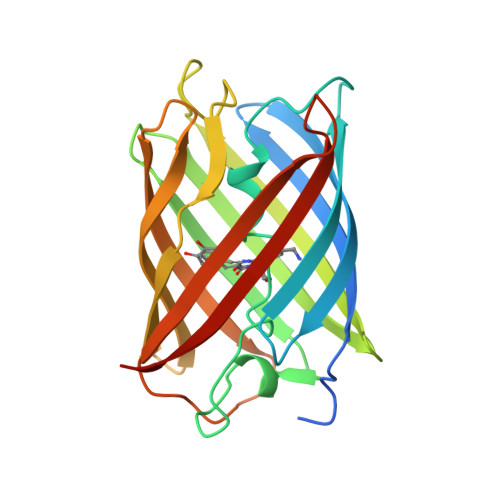
Crystal structure of amFP486 H199T


Experimental Data Snapshot

  • Method: X-RAY DIFFRACTION
  • Resolution: 1.72 Å
  • R-Value Free: 
    0.224 (Depositor), 0.176 (DCC) 
  • R-Value Work: 
    0.169 (Depositor), 0.176 (DCC) 
  • R-Value Observed: 
    0.172 (Depositor) 

Starting Model: experimental
View more details

wwPDB Validation 3D Report Full Report

Validation slider image for 2A47

This is version 2.0 of the entry. See complete history

Literature

Crystal structures and mutational analysis of amFP486, a cyan fluorescent protein from Anemonia majano

Henderson, J.N.Remington, S.J.

(2005) Proc Natl Acad Sci U S A 102: 12712-12717

  • DOI: https://doi.org/10.1073/pnas.0502250102
  • Primary Citation Related Structures: 
    2A46, 2A47, 2A48

  • PubMed Abstract: 

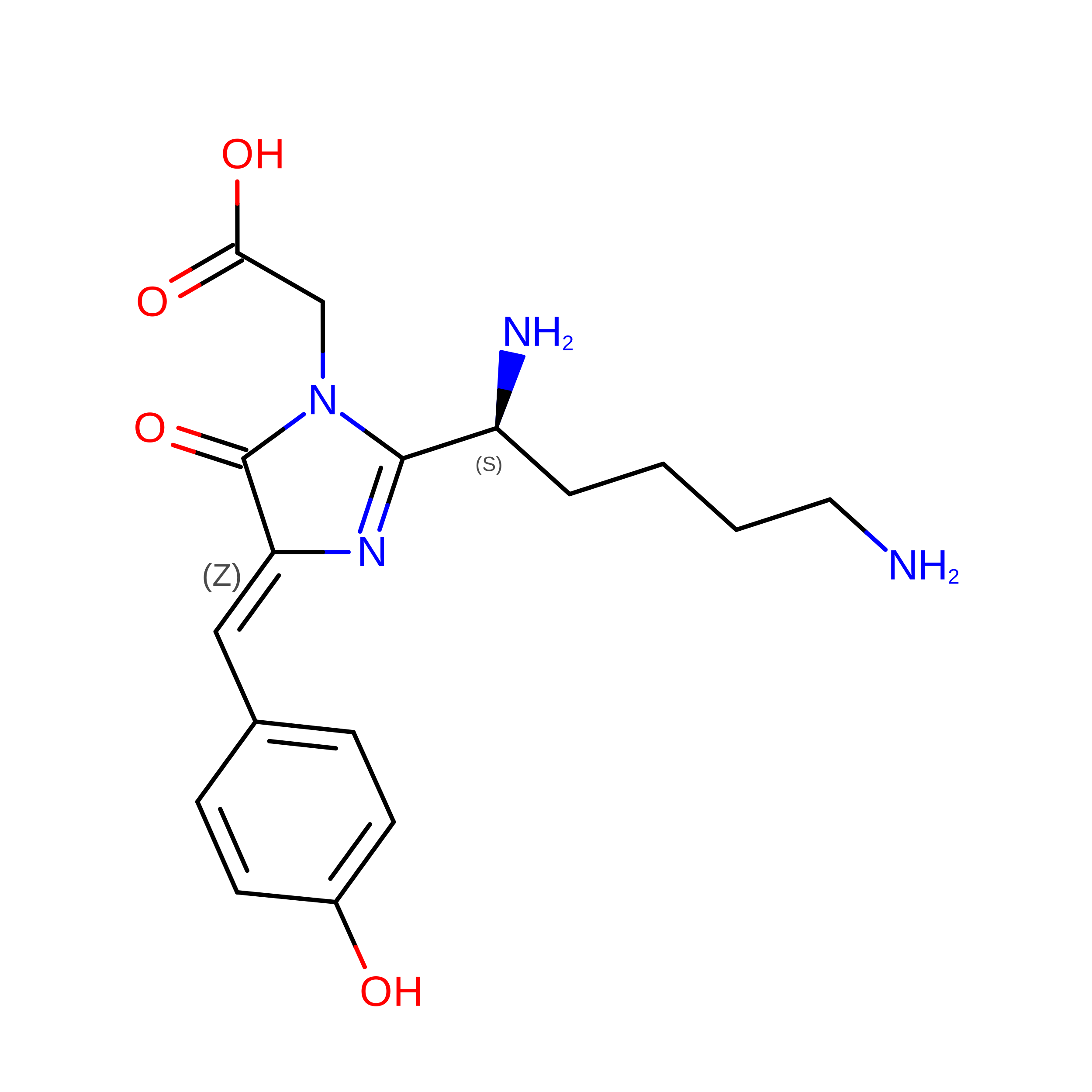
    Fluorescent proteins isolated from coral reef organisms can be roughly grouped into four color classes by emission, cyan, green, yellow, and red. To gain insight into the structural basis for cyan emission, the crystal structure of amFP486 (lambda(em)max = 486 nm) was determined by molecular replacement, and the model was refined at 1.65-A resolution. The electron density map reveals a chromophore formed from the tripeptide sequence -K-Y-G- that is indistinguishable from that of GFP (lambda(em)max = 509 nm). However, the chromophore environment closely parallels those of the yellow- and red-shifted homologs zFP538, DsRed, and eqFP611. Mutagenesis was performed for Glu-150, Ala-165, His-199, and Glu-217, which are immediately adjacent to the chromophore. His-199 and Ala-165 are key side chains responsible for the blue shift, presumably by localizing chromophore charge density on the phenolate moiety. Furthermore, in the H199T mutant the fluorescence quantum yield is reduced by a factor of approximately 110. The crystal structures of H199T (lambda(em)max = 515 nm) and E150Q (lambda(em)max = 506 nm) were determined. Remarkably, the H199T structure reveals that the stacking interaction of His-199 with the chromophore also controls the fluorescence efficiency, because the chromophore is statistically distributed in a 1:1 ratio between cis (fluorescent) and trans (nonfluorescent) conformations.


  • Organizational Affiliation
    • Department of Physics and Institute of Molecular Biology, University of Oregon, Eugene, OR 97403, USA.

Macromolecule Content 

  • Total Structure Weight: 26.64 kDa 
  • Atom Count: 1,871 
  • Modeled Residue Count: 218 
  • Deposited Residue Count: 238 
  • Unique protein chains: 1

Macromolecules

Find similar proteins by:|  3D Structure
Entity ID: 1
MoleculeChains  Sequence LengthOrganismDetailsImage
GFP-like fluorescent chromoprotein amFP486238Anemonia manjanoMutation(s): 2 
UniProt
Find proteins for Q9U6Y6 (Anemonia manjano)
Explore Q9U6Y6 
Go to UniProtKB:  Q9U6Y6
Entity Groups
Sequence Clusters30% Identity50% Identity70% Identity90% Identity95% Identity100% Identity
UniProt GroupQ9U6Y6
Sequence Annotations
Expand
Reference Sequence

Small Molecules

Ligands 1 Unique
IDChains Name / Formula / InChI Key2D Diagram3D Interactions
BME

Query on BME


Download:Ideal Coordinates CCD File
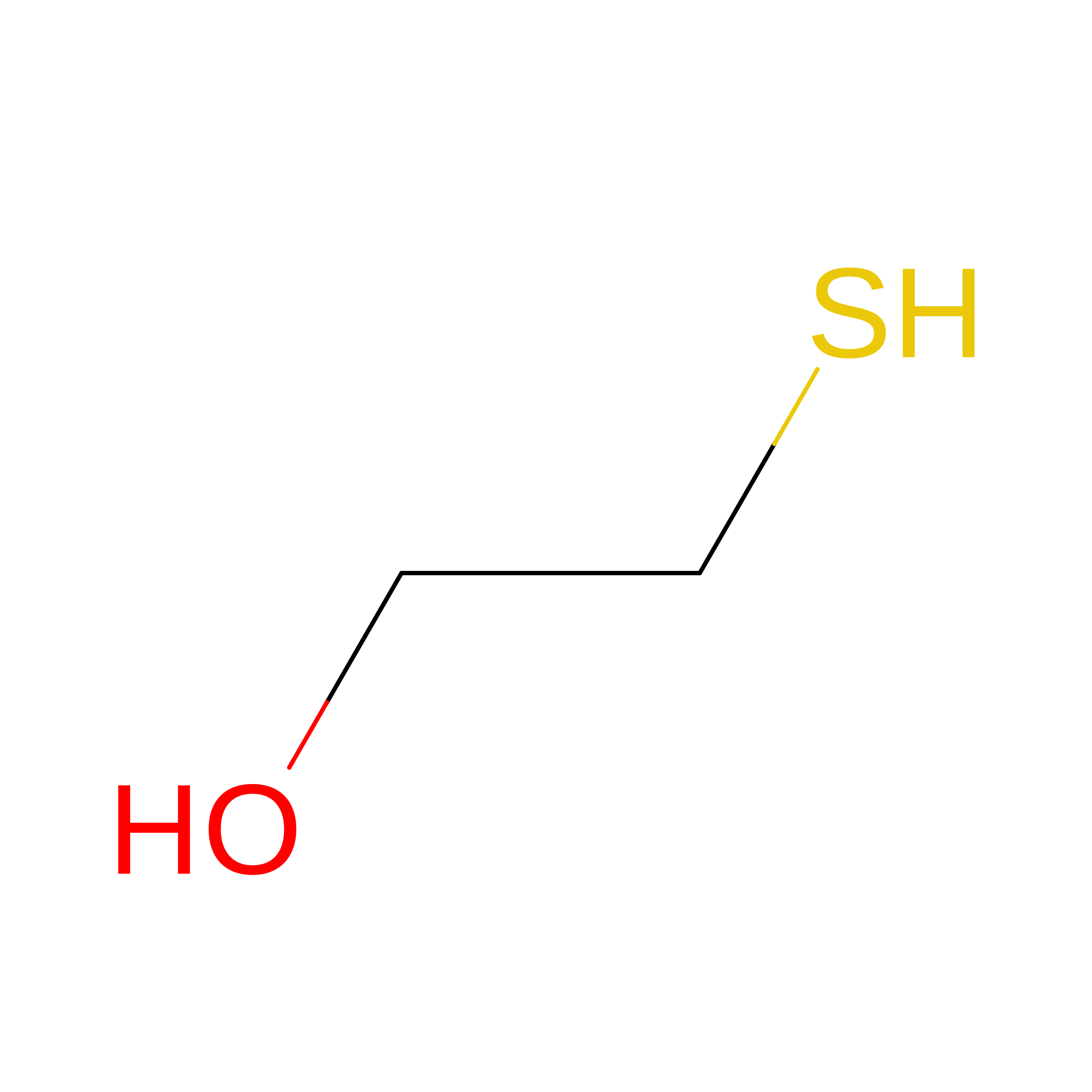
B [auth A]BETA-MERCAPTOETHANOL
C2 H6 O S
DGVVWUTYPXICAM-UHFFFAOYSA-N
Modified Residues  1 Unique
IDChains TypeFormula2D DiagramParent
CR7
Query on CR7
A
L-PEPTIDE LINKINGC17 H22 N4 O4LYS, TYR, GLY

Experimental Data & Validation

Experimental Data

  • Method: X-RAY DIFFRACTION
  • Resolution: 1.72 Å
  • R-Value Free:  0.224 (Depositor), 0.176 (DCC) 
  • R-Value Work:  0.169 (Depositor), 0.176 (DCC) 
  • R-Value Observed: 0.172 (Depositor) 
Space Group: I 41 2 2
Unit Cell:
Length ( Å )Angle ( ˚ )
a = 112.955α = 90
b = 112.955β = 90
c = 81.951γ = 90
Software Package:
Software NamePurpose
DENZOdata reduction
SCALEPACKdata scaling
EPMRphasing
TNTrefinement
PDB_EXTRACTdata extraction
HKL-2000data reduction

Structure Validation

View Full Validation Report


Entry History 

Deposition Data

Revision History  (Full details and data files)

  • Version 1.0: 2005-08-16
    Type: Initial release
  • Version 1.1: 2008-04-30
    Changes: Version format compliance
  • Version 1.2: 2011-07-13
    Changes: Version format compliance
  • Version 1.3: 2017-10-11
    Changes: Refinement description
  • Version 1.4: 2021-10-20
    Changes: Database references, Derived calculations
  • Version 1.5: 2023-08-23
    Changes: Data collection, Refinement description
  • Version 1.6: 2023-11-15
    Changes: Data collection, Derived calculations
  • Version 2.0: 2026-03-18
    Changes: Polymer sequence, Structure summary