Download Mendeley
Spatial Structure of Zervamicin Iib Bound to Dpc Micelles: Implications for Voltage-Gating.
Shenkarev, Z.O., Balashova, T.A., Efremov, R.G., Yakimenko, Z.A., Ovchinnikova, T.V., Raap, J., Arseniev, A.S.(2002) Biophys J 82: 762
- PubMed: 11806918 Search on PubMedSearch on PubMed Central
- DOI: https://doi.org/10.1016/S0006-3495(02)75438-6
- Primary Citation Related Structures:
1IH9 - PubMed Abstract:
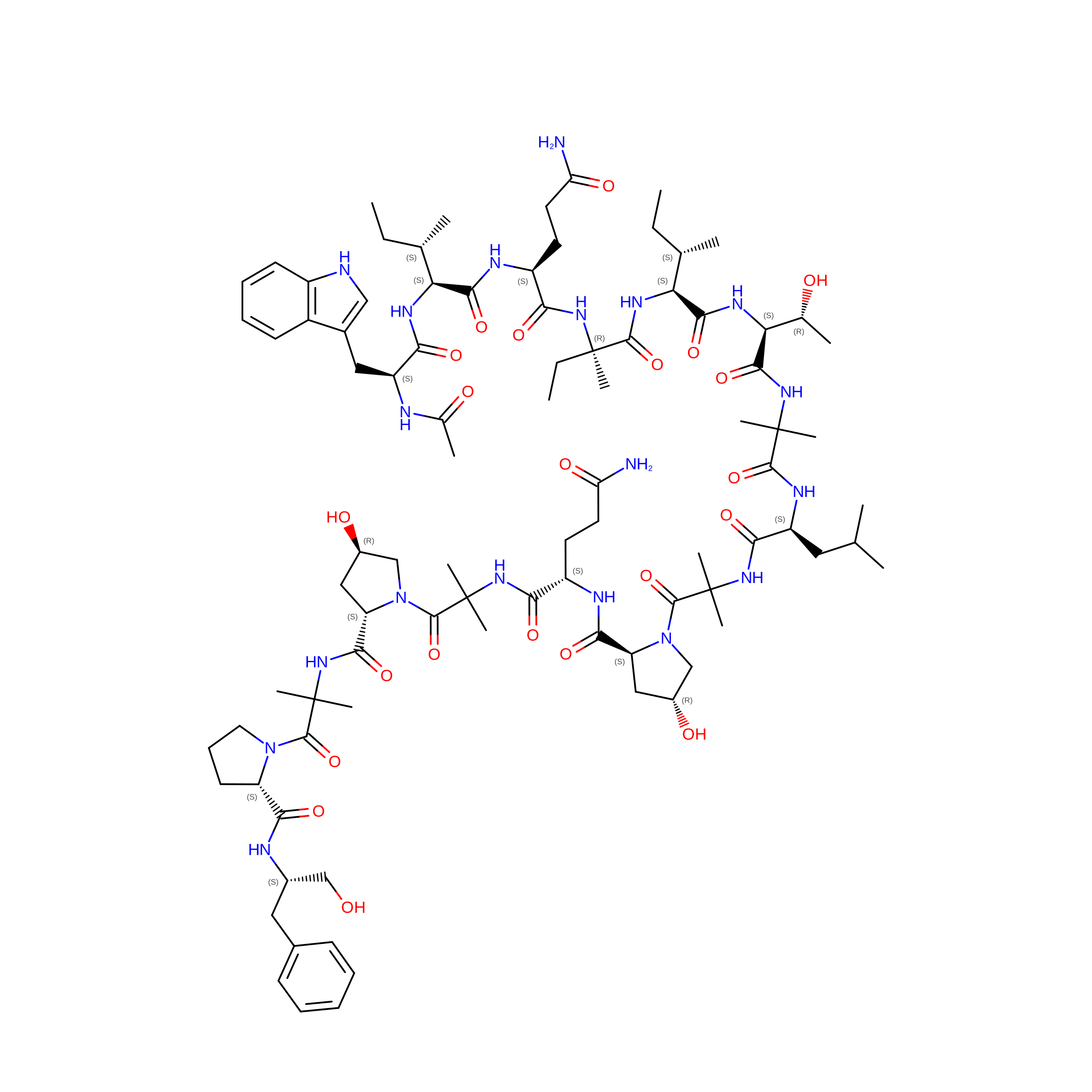
Zervamicin IIB is a 16-amino acid peptaibol that forms voltage-dependent ion channels with multilevel conductance states in planar lipid bilayers and vesicular systems. The spatial structure of zervamicin IIB bound to dodecylphosphocholine micelles was studied by nuclear magnetic resonance spectroscopy. The set of 20 structures obtained has a bent helical conformation with a mean backbone root mean square deviation value of approximately 0.2 A and resembles the structure in isotropic solvents (Balashova et al., 2000. NMR structure of the channel-former zervamicin IIB in isotropic solvents. FEBS Lett 466:333-336). The N-terminus represents an alpha-helix, whereas the C-terminal part has a mixed 3(10)/alpha(R) hydrogen-bond pattern. In the anisotropic micelle environment, the bending angle on Hyp10 (23 degrees) is smaller than that (47 degrees) in isotropic solvents. In the NOESY (Nuclear Overhauser Effect Spectroscopy) spectra, the characteristic attenuation of the peptide signals by 5- and 16-doxylstearate relaxation probes indicates a peripheral mode of the peptaibol binding to the micelle with the N-terminus immersed slightly deeper into micelle interior. Analysis of the surface hydrophobicity reveals that the zervamicin IIB helix is amphiphilic and well suited to formation of a tetrameric transmembrane bundle, according to the barrel-stave mechanism. The results are discussed in a context of voltage-driven peptaibol insertion into membrane.
- Shemyakin-Ovchinnikov Institute of Bioorganic Chemistry, Russian Academy of Sciences, 117997 Moscow, Russia.
Organizational Affiliation: