Download Mendeley
Nonvisual arrestin oligomerization and cellular localization are regulated by inositol hexakisphosphate binding
Milano, S.K., Kim, Y.M., Stefano, F.P., Benovic, J.L., Brenner, C.(2006) J Biol Chem 281: 9812-9823
- PubMed: 16439357 Search on PubMed
- DOI: https://doi.org/10.1074/jbc.M512703200
- Primary Citation Related Structures:
1ZSH - PubMed Abstract:
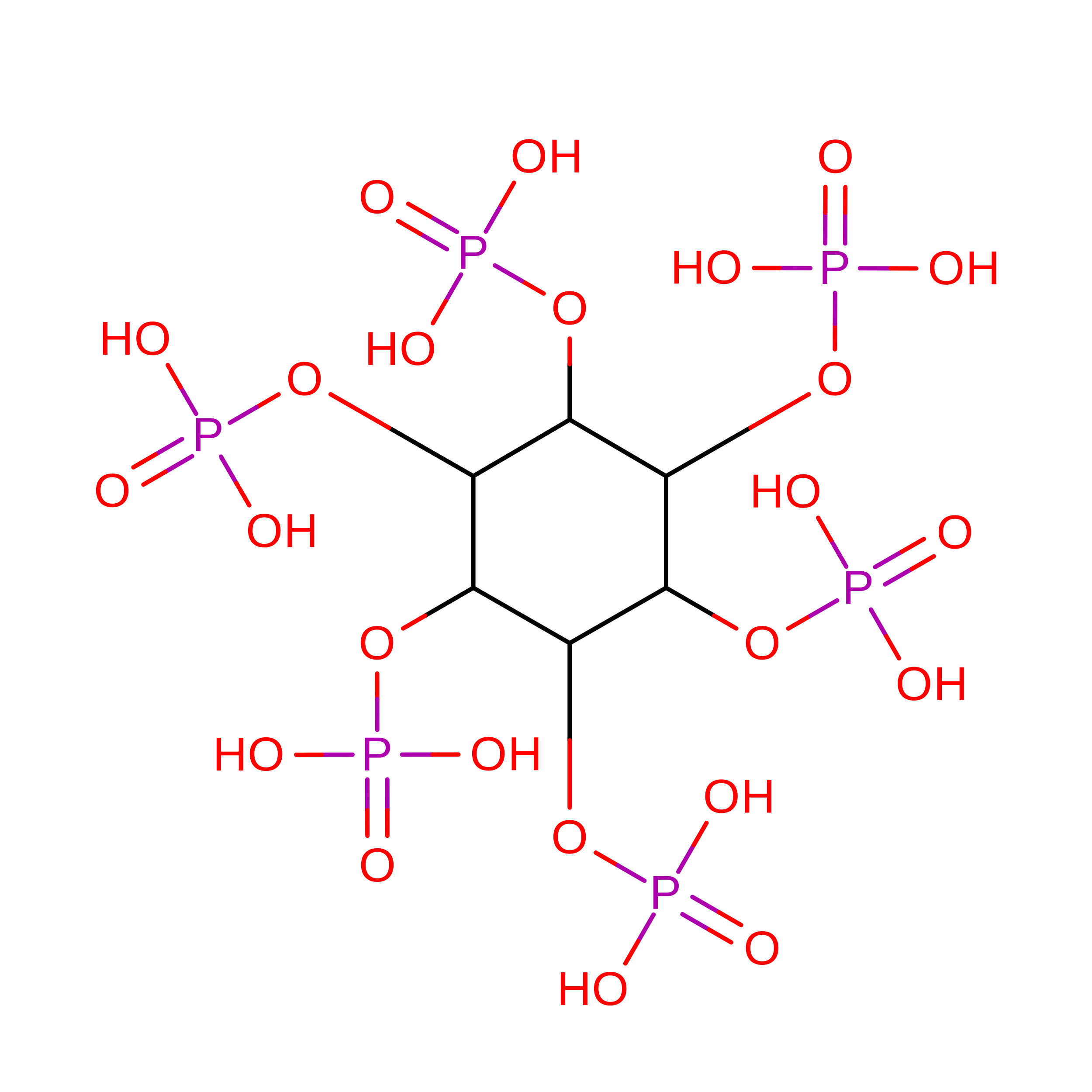
Interactions between arrestins and phosphoinositides have been reported to regulate multiple membrane-associated signaling and trafficking events including clathrin-mediated endocytosis and light adaptation in Drosophila. Arrestins have been proposed to have nuclear and cytosolic functions as well, although the ligand dependence of these functions has not been investigated. Here we characterize the structural, molecular, and cellular interactions between arrestin-2 and inositol hexakisphosphate (inositol 1,2,3,4,5,6-hexakisphosphate (IP(6))). The crystal structure of the arrestin-2.IP(6) complex was solved to 2.9 A with crystal lattice contacts suggesting two sites on a protein monomer mediating IP(6) binding. Mutagenesis coupled to isothermal titration calorimetry and tritiated IP(6) binding assays confirmed two-site binding with a low affinity IP(6)-binding site in the N-domain and a high affinity site in the C-domain. Native gel electrophoresis, gel filtration, and analytical ultracentrifugation demonstrated the ability of IP(6) to promote arrestin-2 oligomerization via the two crystallographically defined ligand-binding locations. In addition, analysis in mammalian cells revealed that arrestin-2 not only undergoes homo-oligomerization, but it can also hetero-oligomerize with arrestin-3 in a manner that depends on IP(6)-binding sites. Mutation of either IP(6)-binding site in arrestin-2 disrupted oligomerization while interactions with known binding partners including clathrin, AP-2, and ERK2 were maintained. Subcellular localization studies showed that arrestin-2 oligomers are primarily cytoplasmic, whereas arrestin-2 monomers displayed increased nuclear localization. Thus, by promoting cytosolic oligomerization, IP(6) binding is proposed to be a negative regulator of interactions of arrestin with plasma membrane and nuclear signaling proteins.
- Department of Biochemistry and Molecular Biology, Thomas Jefferson University, Philadelphia, Pennsylvania 19107, USA.
Organizational Affiliation: