1V6W | pdb_00001v6w

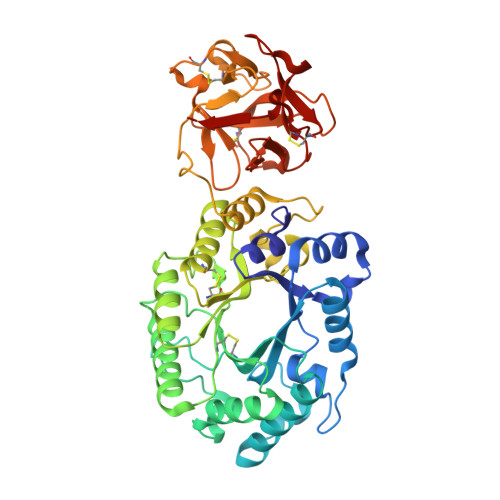
Crystal Structure Of Xylanase From Streptomyces Olivaceoviridis E-86 Complexed With 2(2)-4-O-methyl-alpha-D-glucuronosyl-xylobiose


Experimental Data Snapshot

  • Method: X-RAY DIFFRACTION
  • Resolution: 2.00 Å
  • R-Value Free: 
    0.208 (Depositor) 
  • R-Value Work: 
    0.174 (Depositor) 
  • R-Value Observed: 
    0.174 (Depositor) 

Starting Model: experimental
View more details

wwPDB Validation 3D Report Full Report

Validation slider image for 1V6W

This is version 2.2 of the entry. See complete history

Literature

Crystal structures of decorated xylooligosaccharides bound to a family 10 xylanase from Streptomyces olivaceoviridis E-86

Fujimoto, Z.Kaneko, S.Kuno, A.Kobayashi, H.Kusakabe, I.Mizuno, H.

(2004) J Biological Chem 279: 9606-9614

  • DOI: https://doi.org/10.1074/jbc.M312293200
  • Primary Citation Related Structures: 
    1V6U, 1V6V, 1V6W, 1V6X

  • PubMed Abstract: 

    The family 10 xylanase from Streptomyces olivaceoviridis E-86 (SoXyn10A) consists of a GH10 catalytic domain, which is joined by a Gly/Pro-rich linker to a family 13 carbohydrate-binding module (CBM13) that interacts with xylan. To understand how GH10 xylanases and CBM13 recognize decorated xylans, the crystal structure of SoXyn10A was determined in complex with alpha-l-arabinofuranosyl- and 4-O-methyl-alpha-d-glucuronosyl-xylooligosaccharides. The bound sugars were observed in the subsites of the catalytic cleft and also in subdomains alpha and gamma of CBM13. The data reveal that the binding mode of the oligosaccharides in the active site of the catalytic domain is entirely consistent with the substrate specificity and, in conjunction with the accompanying paper, demonstrate that the accommodation of the side chains in decorated xylans is conserved in GH10 xylanases of SoXyn10A against arabinoglucuronoxylan. CBM13 was shown to bind xylose or xylooligosaccharides reversibly by using nonsymmetric sugars as the ligands. The independent multiple sites in CBM13 may increase the probability of substrate binding.


  • Organizational Affiliation
    • Department of Biochemistry, National Institute of Agrobiological Sciences, Tsukuba, Ibaraki 305-8602, Japan. zui@affrc.go.jp

Macromolecule Content 

  • Total Structure Weight: 95.11 kDa 
  • Atom Count: 7,634 
  • Modeled Residue Count: 872 
  • Deposited Residue Count: 872 
  • Unique protein chains: 1

Macromolecules

Find similar proteins by:|  3D Structure
Entity ID: 1
MoleculeChains  Sequence LengthOrganismDetailsImage
ENDO-1,4-BETA-D-XYLANASE
A, B
436Streptomyces olivaceoviridisMutation(s): 0 
EC: 3.2.1.8
UniProt
Find proteins for Q7SI98 (Streptomyces olivaceoviridis)
Explore Q7SI98 
Go to UniProtKB:  Q7SI98
Entity Groups
Sequence Clusters30% Identity50% Identity70% Identity90% Identity95% Identity100% Identity
UniProt GroupQ7SI98
Sequence Annotations
Expand
Reference Sequence

Oligosaccharides

Help  
Entity ID: 2
MoleculeChains Length2D Diagram GlycosylationD Interactions
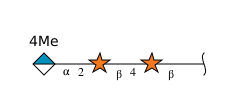
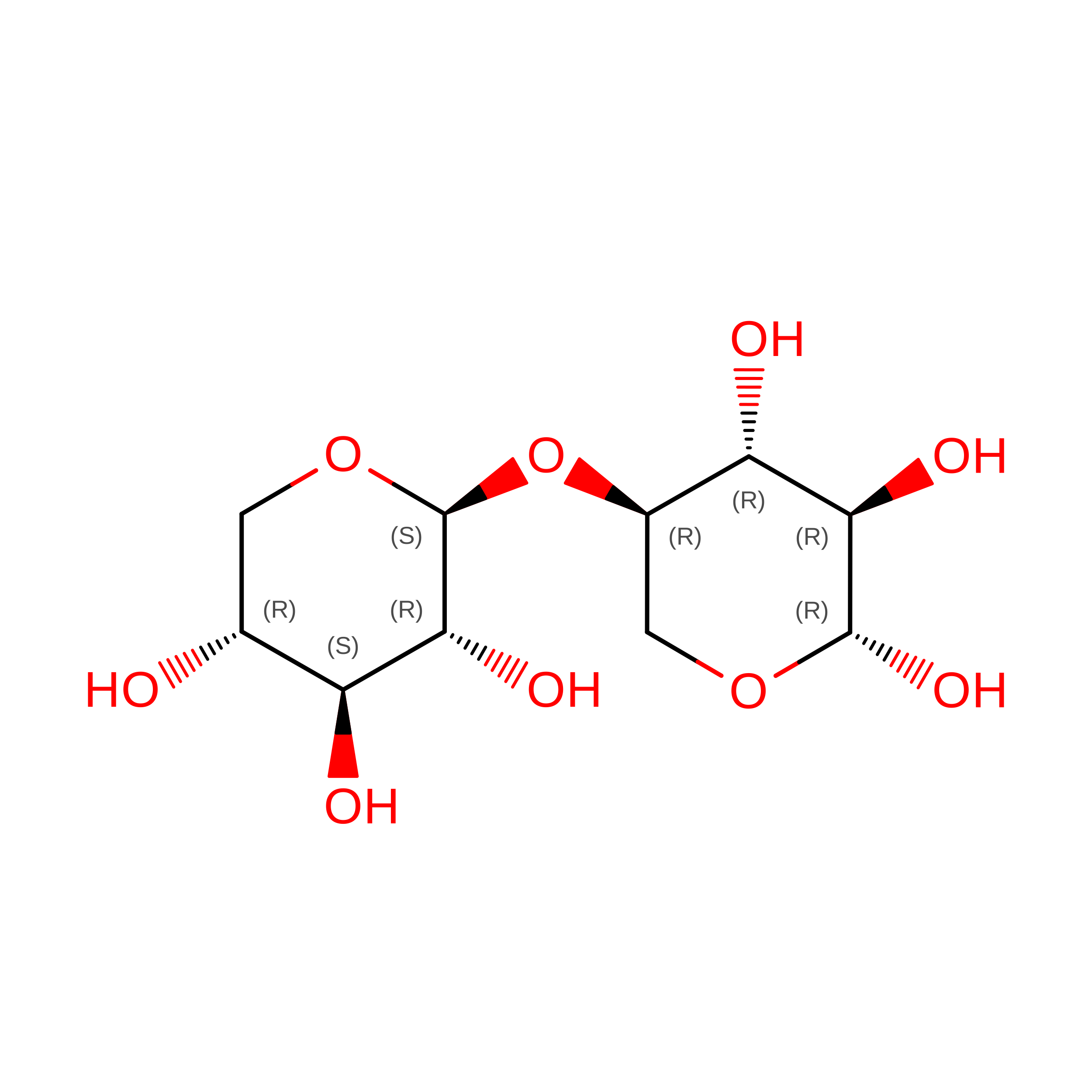
4-O-methyl-alpha-D-glucopyranuronic acid-(1-2)-beta-D-xylopyranose-(1-4)-beta-D-xylopyranose
C, D
3N/A
Glycosylation Resources
GlyTouCan: G78055TN
GlyCosmos: G78055TN
Entity ID: 3
MoleculeChains Length2D Diagram GlycosylationD Interactions
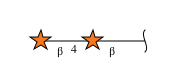
beta-D-xylopyranose-(1-4)-beta-D-xylopyranose
E
2N/A
Glycosylation Resources
GlyTouCan: G87728WL
GlyCosmos: G87728WL

Small Molecules

Ligands 1 Unique
IDChains Name / Formula / InChI Key2D Diagram3D Interactions
XYP

Query on XYP


Download:Ideal Coordinates CCD File
F [auth B],
G [auth B]
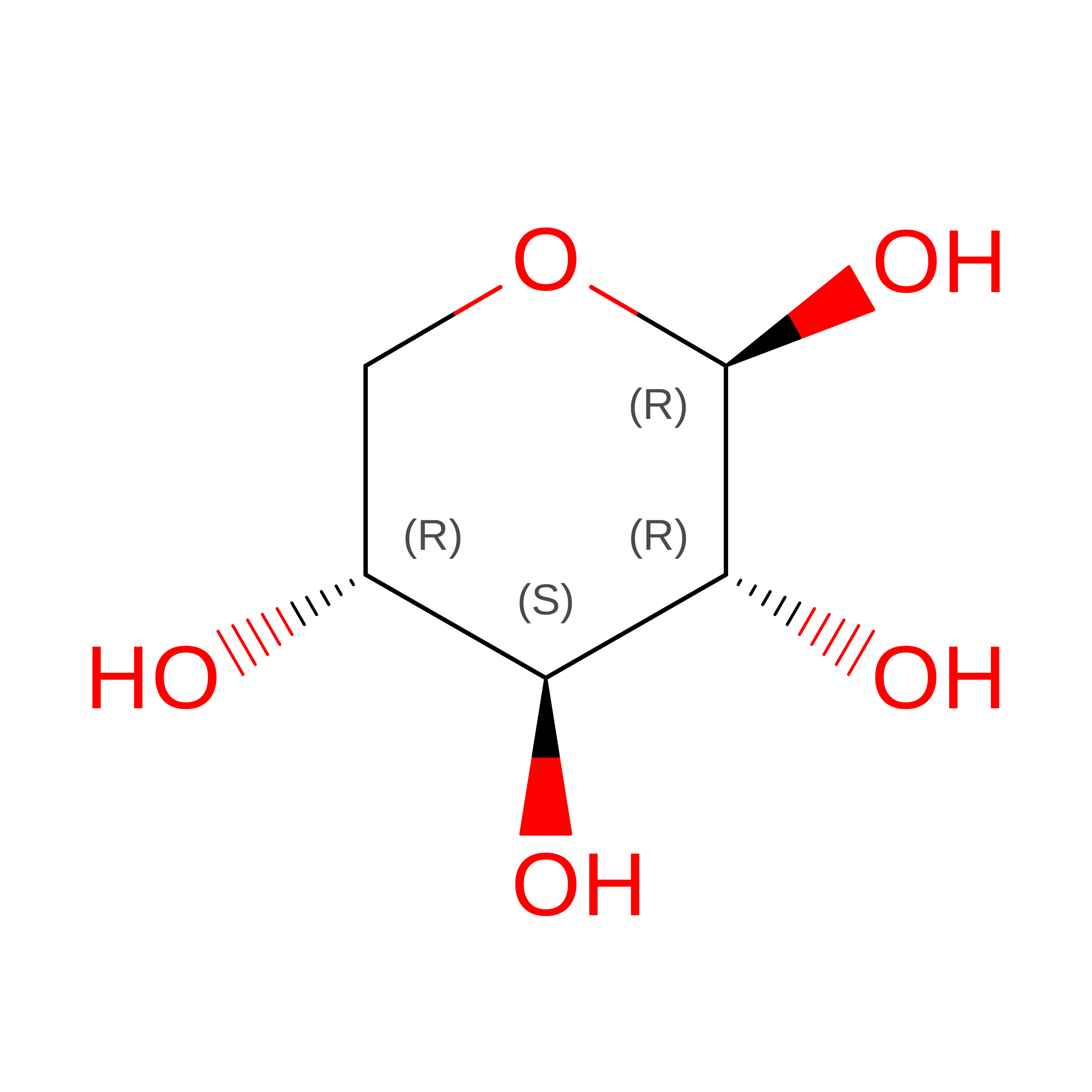
beta-D-xylopyranose
C5 H10 O5
SRBFZHDQGSBBOR-KKQCNMDGSA-N

Biologically Interesting Molecules (External Reference) 

1 Unique

Experimental Data & Validation

Experimental Data

  • Method: X-RAY DIFFRACTION
  • Resolution: 2.00 Å
  • R-Value Free:  0.208 (Depositor) 
  • R-Value Work:  0.174 (Depositor) 
  • R-Value Observed: 0.174 (Depositor) 
Space Group: P 21 21 21
Unit Cell:
Length ( Å )Angle ( ˚ )
a = 79.02α = 90
b = 93.81β = 90
c = 138.29γ = 90
Software Package:
Software NamePurpose
CNSrefinement
MOSFLMdata reduction
CCP4data scaling
CNSphasing

Structure Validation

View Full Validation Report


Entry History 

Deposition Data

Revision History  (Full details and data files)

  • Version 1.0: 2004-04-27
    Type: Initial release
  • Version 1.1: 2008-04-27
    Changes: Version format compliance
  • Version 1.2: 2011-07-13
    Changes: Version format compliance
  • Version 2.0: 2020-07-29
    Type: Remediation
    Reason: Carbohydrate remediation
    Changes: Atomic model, Data collection, Derived calculations, Structure summary
  • Version 2.1: 2023-10-25
    Changes: Data collection, Database references, Derived calculations, Refinement description, Structure summary
  • Version 2.2: 2024-11-20
    Changes: Structure summary