1TOX | pdb_00001tox

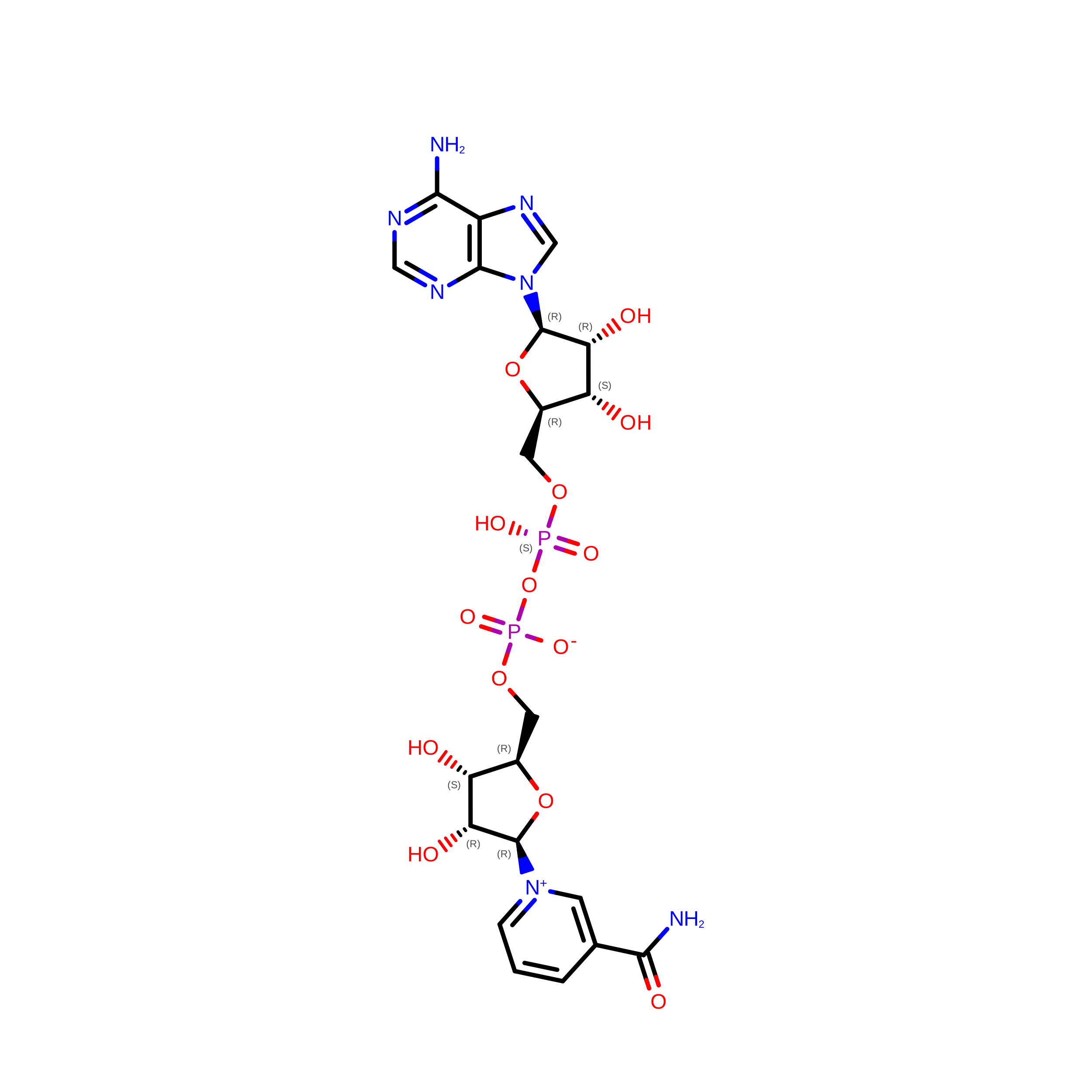
DIPHTHERIA TOXIN DIMER COMPLEXED WITH NAD


Experimental Data Snapshot

  • Method: X-RAY DIFFRACTION
  • Resolution: 2.30 Å
  • R-Value Free: 
    0.307 (Depositor) 
  • R-Value Work: 
    0.227 (Depositor), 0.213 (DCC) 
  • R-Value Observed: 
    0.227 (Depositor) 

wwPDB Validation 3D Report Full Report

Validation slider image for 1TOX

Ligand Structure Quality Assessment 


This is version 1.4 of the entry. See complete history

Literature

Crystal structure of diphtheria toxin bound to nicotinamide adenine dinucleotide.

Bell, C.E.Eisenberg, D.

(1996) Biochemistry 35: 1137-1149

  • DOI: https://doi.org/10.1021/bi9520848
  • Primary Citation Related Structures: 
    1TOX

  • PubMed Abstract: 

    Diphtheria toxin (DT), a 58 kDa protein secreted by lysogenic strains of Corynebacterium diphtheriae, causes the disease diphtheria in humans by gaining entry into the cytoplasm of cells and inhibiting protein synthesis. Specifically, the catalytic (C) domain of DT transfers the ADP-ribose group of NAD to elongation factor-2 (EF-2), rendering EF-2 inactive. In order to investigate how the C-domain of DT binds NAD and catalyzes the ADP-ribosylation of EF-2, the crystal structure of DT in complex with NAD has been determined to 2.3 A resolution. This is the first crystal structure of an ADP-ribosyltransferase (ADP-RT) enzyme in complex with NAD and suggests the features of the ADP-RT fold which are important for NAD binding. The conformation of NAD in the complex and the proximity of the Glu148 carboxylate group of the C-domain to the scissile, N-glycosidic bond of NAD suggest plausible modes of catalysis of the ADP-ribosylation reaction. Residues 39-46 of the active-site loop of the C-domain become disordered upon NAD binding, suggesting a potential role for this loop in the recognition of the ADP-ribose acceptor substrate, EF-2. The negatively charged phosphates and two ribose hydroxyls of NAD are not in direct contact with any atoms of the C-domain. Instead, they form an exposed surface which appears to be presented for recognition by EF-2. Structural alignments of the DT-NAD complex with the structures of other members of the ADP-RT family suggest how NAD may bind to these other enzymes.


  • Organizational Affiliation
    • UCLA-DOE Laboratory of Structural Biology and Molecular Medicine, Molecular Biology Institute, USA.

Macromolecule Content 

  • Total Structure Weight: 118.15 kDa 
  • Atom Count: 8,295 
  • Modeled Residue Count: 1,028 
  • Deposited Residue Count: 1,070 
  • Unique protein chains: 1

Macromolecules

Find similar proteins by:|  3D Structure
Entity ID: 1
MoleculeChains  Sequence LengthOrganismDetailsImage
DIPHTHERIA TOXIN (DIMERIC)
A, B
535Corynephage betaMutation(s): 0 
EC: 2.4.2.36
UniProt
Find proteins for P00588 (Corynephage beta)
Explore P00588 
Go to UniProtKB:  P00588
Entity Groups
Sequence Clusters30% Identity50% Identity70% Identity90% Identity95% Identity100% Identity
UniProt GroupP00588
Sequence Annotations
Expand
Reference Sequence

Experimental Data & Validation

Experimental Data

  • Method: X-RAY DIFFRACTION
  • Resolution: 2.30 Å
  • R-Value Free:  0.307 (Depositor) 
  • R-Value Work:  0.227 (Depositor), 0.213 (DCC) 
  • R-Value Observed: 0.227 (Depositor) 
Space Group: C 1 2 1
Unit Cell:
Length ( Å )Angle ( ˚ )
a = 105α = 90
b = 89.5β = 94
c = 130.1γ = 90
Software Package:
Software NamePurpose
R-AXISdata collection
X-PLORmodel building
X-PLORrefinement
R-AXISdata reduction
X-PLORphasing

Structure Validation

View Full Validation Report


Ligand Structure Quality Assessment 


Entry History 

Deposition Data

Revision History  (Full details and data files)

  • Version 1.0: 1996-06-10
    Type: Initial release
  • Version 1.1: 2008-03-03
    Changes: Version format compliance
  • Version 1.2: 2011-07-13
    Changes: Derived calculations, Version format compliance
  • Version 1.3: 2024-06-05
    Changes: Data collection, Database references, Derived calculations, Other
  • Version 1.4: 2024-10-30
    Changes: Structure summary