1SVI | pdb_00001svi

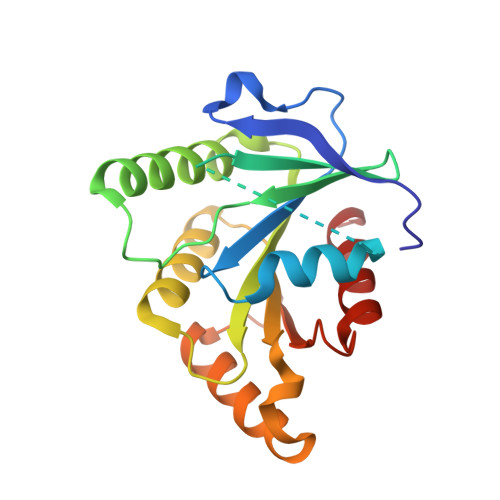
Crystal Structure of the GTP-binding protein YsxC complexed with GDP


Experimental Data Snapshot

  • Method: X-RAY DIFFRACTION
  • Resolution: 1.95 Å
  • R-Value Free: 
    0.222 (Depositor) 
  • R-Value Work: 
    0.176 (Depositor) 
  • R-Value Observed: 
    0.178 (Depositor) 

wwPDB Validation 3D Report Full Report

Validation slider image for 1SVI

This is version 1.4 of the entry. See complete history

Literature

Analysis of the Open and Closed Conformations of the GTP-binding Protein YsxC from Bacillus subtilis.

Ruzheinikov, S.N.Das, S.K.Sedelnikova, S.E.Baker, P.J.Artymiuk, P.J.Garcia-Lara, J.Foster, S.J.Rice, D.W.

(2004) J Mol Biology 339: 265-278

  • DOI: https://doi.org/10.1016/j.jmb.2004.03.043
  • Primary Citation Related Structures: 
    1SUL, 1SVI, 1SVW

  • PubMed Abstract: 

    Genetic analysis has suggested that the product of the Bacillus subtilis ysxC gene is essential for survival of the microorganism and hence may represent a target for the development of a novel anti-infective agent. B.subtilis YsxC is a member of the translation factor related class of GTPases and its crystal structure has been determined in an apo form and in complex with GDP and GMPPNP/Mg2+. Analysis of these structures has allowed us to examine the conformational changes that occur during the process of nucleotide binding and GTP hydrolysis. These structural changes particularly affect parts of the switch I and switch II region of YsxC, which become ordered and disordered, respectively in the "closed" or "on" GTP-bound state and disordered and ordered, respectively, in the "open" or "off" GDP-bound conformation. Finally, the binding of the magnesium cation results in subtle shifts of residues in the G3 region, at the start of switch II, which serve to optimize the interaction with a key aspartic acid residue. The structural flexibility observed in YsxC is likely to contribute to the role of the protein, possibly allowing transduction of an essential intracellular signal, which may be mediated via interactions with a conserved patch of surface-exposed, basic residues that lies adjacent to the GTP-binding site.


  • Organizational Affiliation
    • Department of Molecular Biology and Biotechnology, Krebs Institute for Biomolecular Research, University of Sheffield, Firth Court, Western Bank, Sheffield S10 2TN, UK.

Macromolecule Content 

  • Total Structure Weight: 22.5 kDa 
  • Atom Count: 1,731 
  • Modeled Residue Count: 182 
  • Deposited Residue Count: 195 
  • Unique protein chains: 1

Macromolecules

Find similar proteins by:|  3D Structure
Entity ID: 1
MoleculeChains  Sequence LengthOrganismDetailsImage
GTP-binding protein YSXC195Bacillus subtilisMutation(s): 0 
Gene Names: YsxCENGBBSU28190
UniProt
Find proteins for P38424 (Bacillus subtilis (strain 168))
Explore P38424 
Go to UniProtKB:  P38424
Entity Groups
Sequence Clusters30% Identity50% Identity70% Identity90% Identity95% Identity100% Identity
UniProt GroupP38424
Sequence Annotations
Expand
Reference Sequence

Small Molecules

Ligands 1 Unique
IDChains Name / Formula / InChI Key2D Diagram3D Interactions
GDP

Query on GDP


Download:Ideal Coordinates CCD File
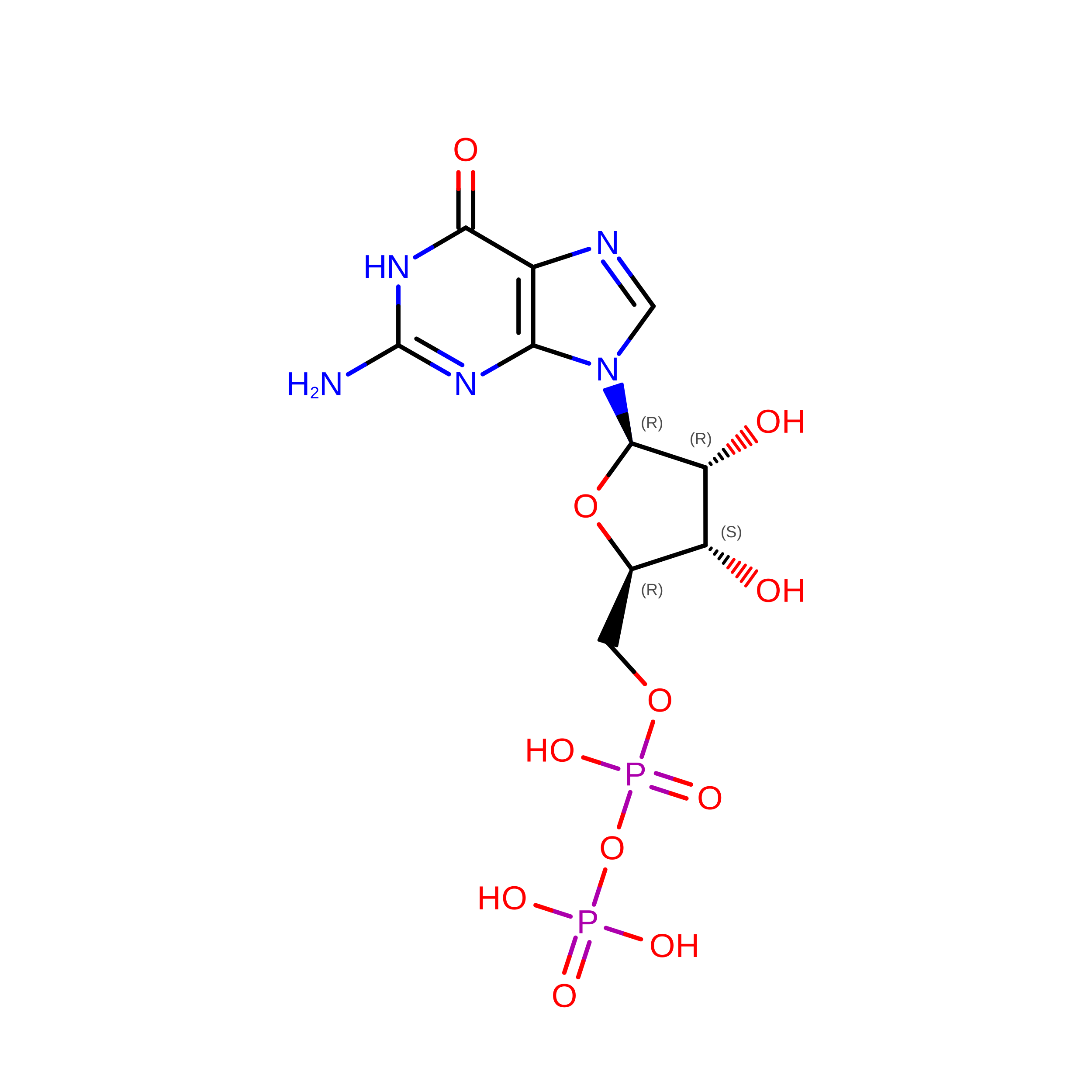
B [auth A]GUANOSINE-5'-DIPHOSPHATE
C10 H15 N5 O11 P2
QGWNDRXFNXRZMB-UUOKFMHZSA-N

Experimental Data & Validation

Experimental Data

  • Method: X-RAY DIFFRACTION
  • Resolution: 1.95 Å
  • R-Value Free:  0.222 (Depositor) 
  • R-Value Work:  0.176 (Depositor) 
  • R-Value Observed: 0.178 (Depositor) 
Space Group: C 1 2 1
Unit Cell:
Length ( Å )Angle ( ˚ )
a = 46.179α = 90
b = 68.305β = 94.05
c = 61.999γ = 90
Software Package:
Software NamePurpose
REFMACrefinement
MAR345data collection
SCALEPACKdata scaling
MLPHAREphasing

Structure Validation

View Full Validation Report


Entry History 

Deposition Data

Revision History  (Full details and data files)

  • Version 1.0: 2004-05-25
    Type: Initial release
  • Version 1.1: 2008-04-30
    Changes: Version format compliance
  • Version 1.2: 2011-07-13
    Changes: Version format compliance
  • Version 1.3: 2017-10-11
    Changes: Refinement description
  • Version 1.4: 2024-02-14
    Changes: Data collection, Database references, Derived calculations