1QYE | pdb_00001qye

Crystal Structure of the N-domain of the ER Hsp90 chaperone GRP94 in complex with 2-chlorodideoxyadenosine


Experimental Data Snapshot

  • Method: X-RAY DIFFRACTION
  • Resolution: 2.10 Å
  • R-Value Free: 
    0.272 (Depositor), 0.271 (DCC) 
  • R-Value Work: 
    0.207 (Depositor), 0.207 (DCC) 
  • R-Value Observed: 
    0.207 (Depositor) 

Starting Model: experimental
View more details

wwPDB Validation 3D Report Full Report

Validation slider image for 1QYE

Ligand Structure Quality Assessment 


This is version 1.3 of the entry. See complete history

Literature

Structure of the N-terminal Domain of GRP94. Basis for Ligand Specificity and Regulation

Soldano, K.L.Jivan, A.Nicchitta, C.V.Gewirth, D.T.

(2003) J Biological Chem 278: 48330-48338

  • DOI: https://doi.org/10.1074/jbc.M308661200
  • Primary Citation Related Structures: 
    1QY8, 1QYE, 1U2O, 6D28

  • PubMed Abstract: 

    GRP94, the endoplasmic reticulum (ER) paralog of the chaperone Hsp90, plays an essential role in the structural maturation or secretion of a subset of proteins destined for transport to the cell surface, such as the Toll-like receptors 2 and 4, and IgG, respectively. GRP94 differs from cytoplasmic Hsp90 by exhibiting very weak ATP binding and hydrolysis activity. GRP94 also binds selectively to a series of substituted adenosine analogs. The high resolution crystal structures at 1.75-2.1 A of the N-terminal and adjacent charged domains of GRP94 in complex with N-ethylcarboxamidoadenosine, radicicol, and 2-chlorodideoxyadenosine reveals a structural mechanism for ligand discrimination among hsp90 family members. The structures also identify a putative subdomain that may act as a ligand-responsive switch. The residues of the charged region fold into a disordered loop whose termini are ordered and continue the twisted beta sheet that forms the structural core of the N-domain. This continuation of the beta sheet past the charged domain suggests a structural basis for the association of the N-terminal and middle domains of the full-length chaperone.


  • Organizational Affiliation
    • Departments of Biochemistry and Cell Biology, Duke University Medical Center, Durham, North Carolina 27710, USA.

Macromolecule Content 

  • Total Structure Weight: 31.05 kDa 
  • Atom Count: 2,045 
  • Modeled Residue Count: 225 
  • Deposited Residue Count: 269 
  • Unique protein chains: 1

Macromolecules

Find similar proteins by:|  3D Structure
Entity ID: 1
MoleculeChains  Sequence LengthOrganismDetailsImage
Endoplasmin269Canis lupus familiarisMutation(s): 0 
Gene Names: TRA1
EC: 3.6.4
UniProt
Find proteins for P41148 (Canis lupus familiaris)
Explore P41148 
Go to UniProtKB:  P41148
Entity Groups
Sequence Clusters30% Identity50% Identity70% Identity90% Identity95% Identity100% Identity
UniProt GroupP41148
Sequence Annotations
Expand
Reference Sequence

Small Molecules

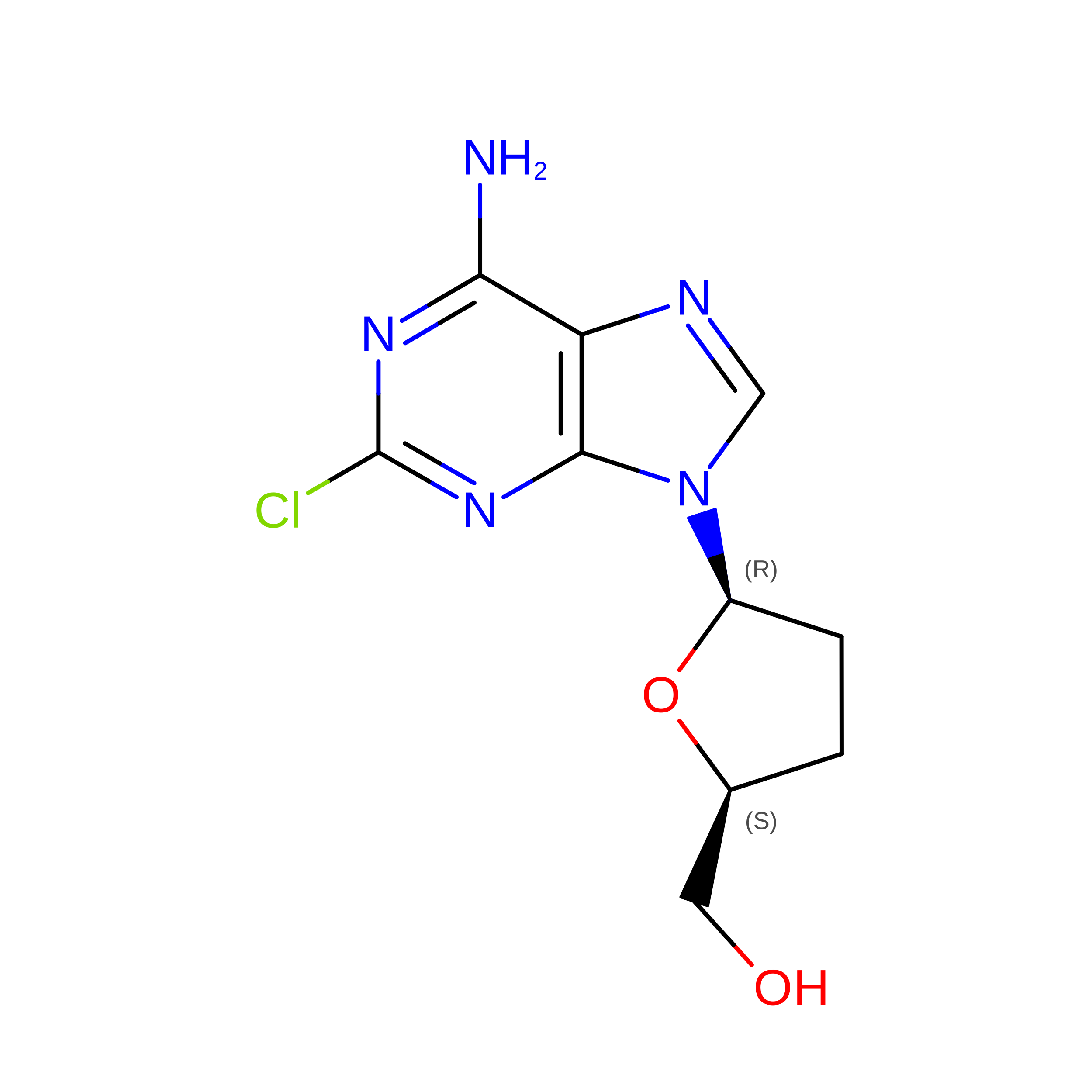
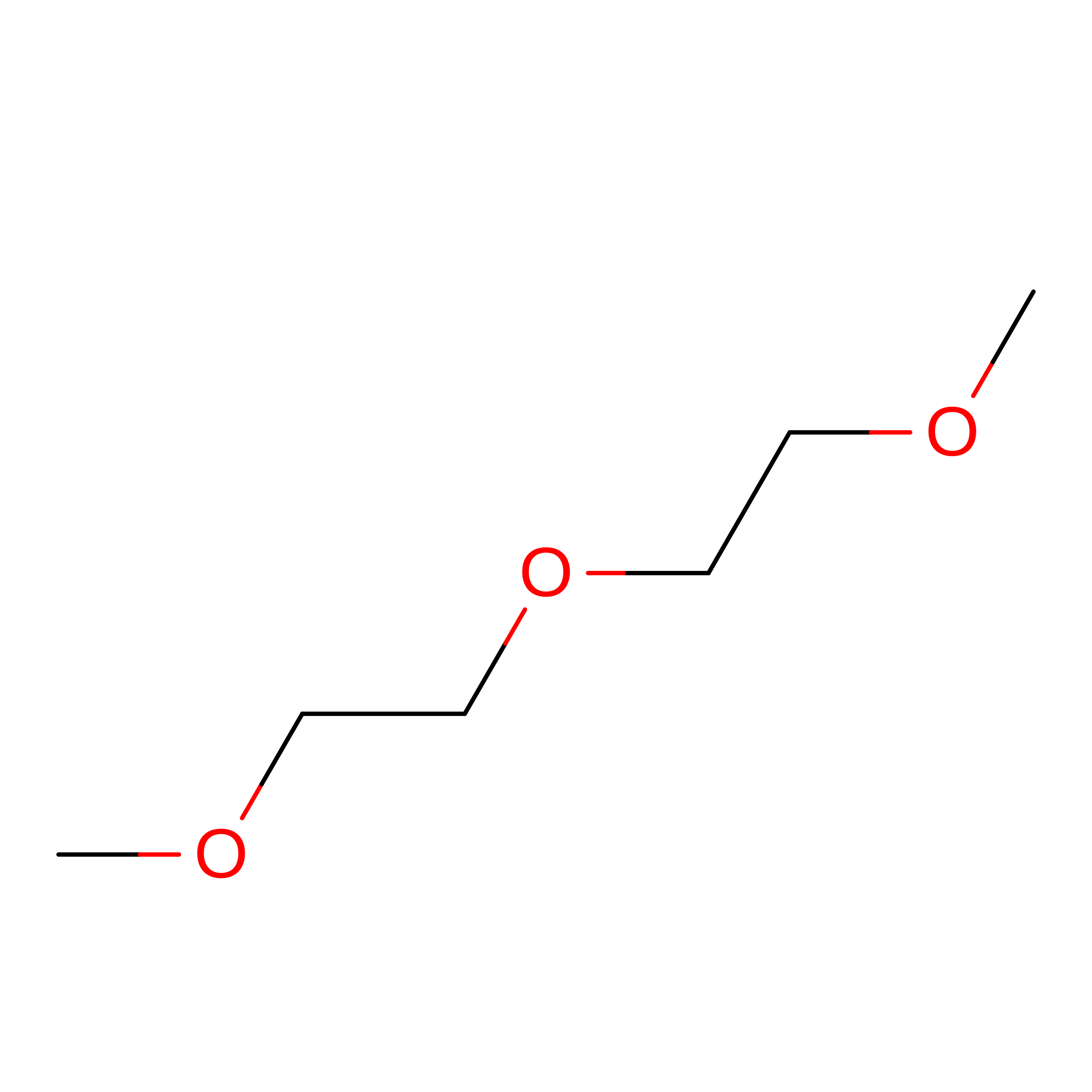
Ligands 2 Unique
IDChains Name / Formula / InChI Key2D Diagram3D Interactions
CDY

Query on CDY


Download:Ideal Coordinates CCD File
B [auth A]2-CHLORODIDEOXYADENOSINE
C10 H12 Cl N5 O2
FNLILOONPKMGST-NTSWFWBYSA-N
M2M

Query on M2M


Download:Ideal Coordinates CCD File
C [auth A]1-METHOXY-2-(2-METHOXYETHOXY)ETHANE
C6 H14 O3
SBZXBUIDTXKZTM-UHFFFAOYSA-N

Experimental Data & Validation

Experimental Data

  • Method: X-RAY DIFFRACTION
  • Resolution: 2.10 Å
  • R-Value Free:  0.272 (Depositor), 0.271 (DCC) 
  • R-Value Work:  0.207 (Depositor), 0.207 (DCC) 
  • R-Value Observed: 0.207 (Depositor) 
Space Group: C 2 2 21
Unit Cell:
Length ( Å )Angle ( ˚ )
a = 87.008α = 90
b = 98.974β = 90
c = 63.254γ = 90
Software Package:
Software NamePurpose
CNSrefinement
HKL-2000data reduction
SCALEPACKdata scaling
CNSphasing

Structure Validation

View Full Validation Report


Ligand Structure Quality Assessment 


Entry History 

Deposition Data

Revision History  (Full details and data files)

  • Version 1.0: 2003-11-11
    Type: Initial release
  • Version 1.1: 2008-04-29
    Changes: Version format compliance
  • Version 1.2: 2011-07-13
    Changes: Version format compliance
  • Version 1.3: 2023-08-23
    Changes: Data collection, Database references, Derived calculations, Refinement description