1QKM | pdb_00001qkm

HUMAN OESTROGEN RECEPTOR BETA LIGAND-BINDING DOMAIN IN COMPLEX WITH PARTIAL AGONIST GENISTEIN


Experimental Data Snapshot

  • Method: X-RAY DIFFRACTION
  • Resolution: 1.80 Å
  • R-Value Free: 
    0.252 (Depositor), 0.248 (DCC) 
  • R-Value Work: 
    0.215 (Depositor), 0.216 (DCC) 

Starting Model: experimental
View more details

wwPDB Validation 3D Report Full Report

Validation slider image for 1QKM

Ligand Structure Quality Assessment 


This is version 1.3 of the entry. See complete history

Literature

Structure of the Ligand-Binding Domain of Oestrogen Receptor Beta in the Presence of a Partial Agonist and a Full Antagonist

Pike, A.C.W.Brzozowski, A.M.Hubbard, R.E.Bonn, T.Thorsell, A.-G.Engstrom, O.Ljunggren, J.Gustaffson, J.-A.Carlquist, M.

(1999) EMBO J 18: 4608

  • DOI: https://doi.org/10.1093/emboj/18.17.4608
  • Primary Citation Related Structures: 
    1QKM, 1QKN

  • PubMed Abstract: 

    Oestrogens exert their physiological effects through two receptor subtypes. Here we report the three-dimensional structure of the oestrogen receptor beta isoform (ERbeta) ligand-binding domain (LBD) in the presence of the phyto-oestrogen genistein and the antagonist raloxifene. The overall structure of ERbeta-LBD is very similar to that previously reported for ERalpha. Each ligand interacts with a unique set of residues within the hormone-binding cavity and induces a distinct orientation in the AF-2 helix (H12). The bulky side chain of raloxifene protrudes from the cavity and physically prevents the alignment of H12 over the bound ligand. In contrast, genistein is completely buried within the hydrophobic core of the protein and binds in a manner similar to that observed for ER's endogenous hormone, 17beta-oestradiol. However, in the ERbeta-genistein complex, H12 does not adopt the distinctive 'agonist' position but, instead, lies in a similar orientation to that induced by ER antagonists. Such a sub-optimal alignment of the transactivation helix is consistent with genistein's partial agonist character in ERbeta and demonstrates how ER's transcriptional response to certain bound ligands is attenuated.


  • Organizational Affiliation
    • Structural Biology Laboratory, Chemistry Department, University of York, York YO10 5DD, UK.

Macromolecule Content 

  • Total Structure Weight: 29 kDa 
  • Atom Count: 1,991 
  • Modeled Residue Count: 230 
  • Deposited Residue Count: 255 
  • Unique protein chains: 1

Macromolecules

Find similar proteins by:|  3D Structure
Entity ID: 1
MoleculeChains  Sequence LengthOrganismDetailsImage
ESTROGEN RECEPTOR BETA255Homo sapiensMutation(s): 0 
Gene Names: OESTROGEN RECEPTOR BETA
UniProt & NIH Common Fund Data Resources
Find proteins for Q92731 (Homo sapiens)
Explore Q92731 
Go to UniProtKB:  Q92731
PHAROS:  Q92731
GTEx:  ENSG00000140009 
Entity Groups
Sequence Clusters30% Identity50% Identity70% Identity90% Identity95% Identity100% Identity
UniProt GroupQ92731
Sequence Annotations
Expand
Reference Sequence

Small Molecules

Ligands 1 Unique
IDChains Name / Formula / InChI Key2D Diagram3D Interactions
GEN

Query on GEN


Download:Ideal Coordinates CCD File
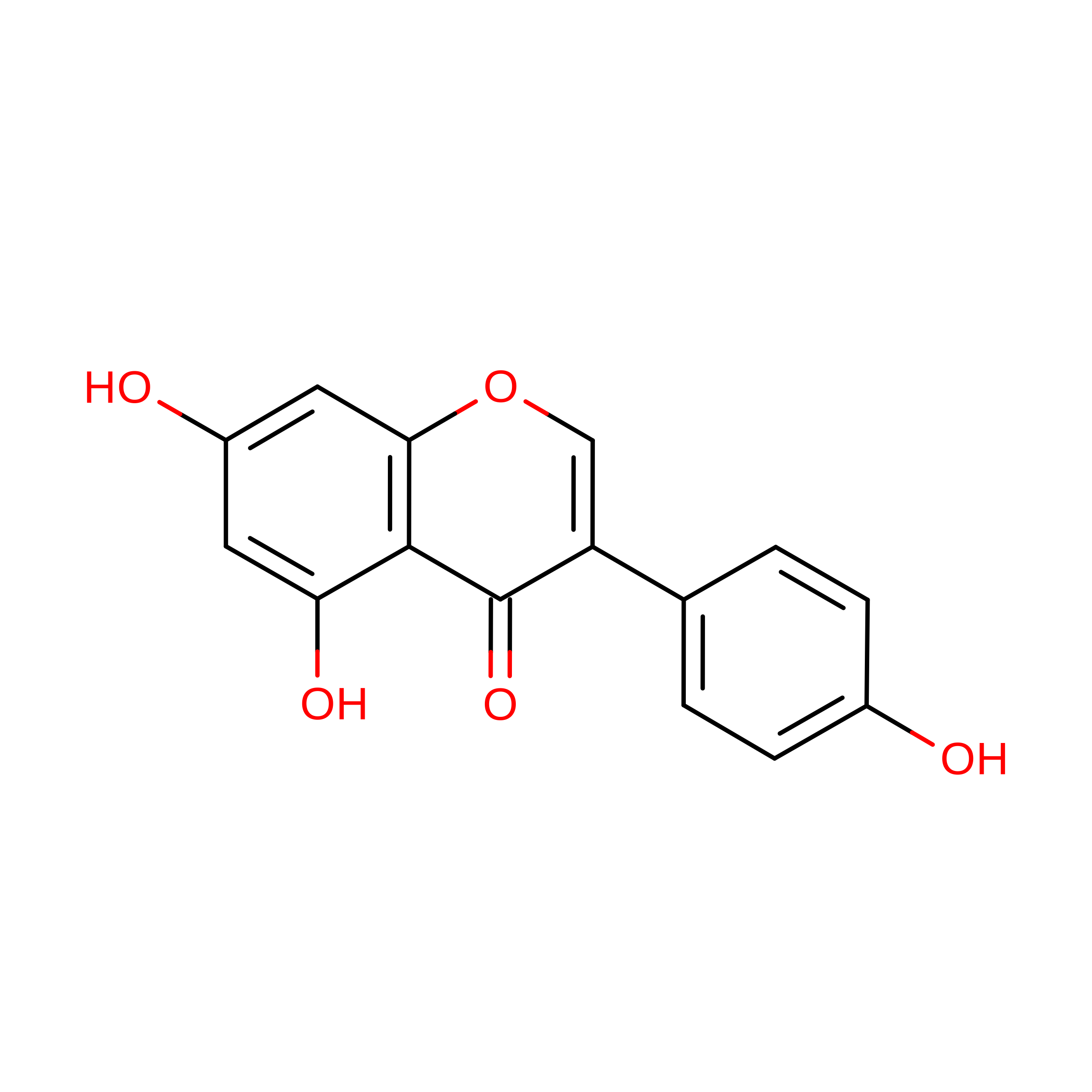
B [auth A]GENISTEIN
C15 H10 O5
TZBJGXHYKVUXJN-UHFFFAOYSA-N
Binding Affinity Annotations 
IDSourceBinding Affinity
GEN BindingDB:  1QKM Ki: 24 (nM) from 1 assay(s)
IC50: min: 1.3, max: 990 (nM) from 15 assay(s)
EC50: min: 2.4, max: 200 (nM) from 6 assay(s)

Experimental Data & Validation

Experimental Data

  • Method: X-RAY DIFFRACTION
  • Resolution: 1.80 Å
  • R-Value Free:  0.252 (Depositor), 0.248 (DCC) 
  • R-Value Work:  0.215 (Depositor), 0.216 (DCC) 
Space Group: P 61 2 2
Unit Cell:
Length ( Å )Angle ( ˚ )
a = 63.12α = 90
b = 63.12β = 90
c = 250.23γ = 120
Software Package:
Software NamePurpose
REFMACrefinement
DENZOdata reduction
SCALEPACKdata scaling
AMoREphasing

Structure Validation

View Full Validation Report


Ligand Structure Quality Assessment 


Entry History 

Deposition Data

Revision History  (Full details and data files)

  • Version 1.0: 2000-07-28
    Type: Initial release
  • Version 1.1: 2011-05-08
    Changes: Version format compliance
  • Version 1.2: 2011-07-13
    Changes: Version format compliance
  • Version 1.3: 2023-12-13
    Changes: Data collection, Database references, Derived calculations, Other, Refinement description