1KMF | pdb_00001kmf

NMR STRUCTURE OF HUMAN INSULIN MUTANT ILE-A2-ALLO-ILE, HIS-B10-ASP, PRO-B28-LYS, LYS-B29-PRO, 15 STRUCTURES


Experimental Data Snapshot

  • Method: SOLUTION NMR
  • Conformers Calculated: 50 
  • Conformers Submitted: 15 
  • Selection Criteria: structures with the lowest energy 

wwPDB Validation 3D Report Full Report

Validation slider image for 1KMF

This is version 1.4 of the entry. See complete history

Literature

Chiral mutagenesis of insulin's hidden receptor-binding surface: structure of an allo-isoleucine(A2) analogue.

Xu, B.Hua, Q.X.Nakagawa, S.H.Jia, W.Chu, Y.C.Katsoyannis, P.G.Weiss, M.A.

(2002) J Mol Biology 316: 435-441

  • DOI: https://doi.org/10.1006/jmbi.2001.5377
  • Primary Citation Related Structures: 
    1KMF

  • PubMed Abstract: 

    The hydrophobic core of vertebrate insulins contains an invariant isoleucine residue at position A2. Lack of variation may reflect this side-chain's dual contribution to structure and function: Ile(A2) is proposed both to stabilize the A1-A8 alpha-helix and to contribute to a "hidden" functional surface exposed on receptor binding. Substitution of Ile(A2) by alanine results in segmental unfolding of the A1-A8 alpha-helix, lower thermodynamic stability and impaired receptor binding. Such a spectrum of perturbations, although of biophysical interest, confounds interpretation of structure-activity relationships. To investigate the specific contribution of Ile(A2) to insulin's functional surface, we have employed non-standard mutagenesis: inversion of side-chain chirality in engineered monomer allo-Ile(A2)-DKP-insulin. Although the analogue retains native structure and stability, its affinity for the insulin receptor is impaired by 50-fold. Thus, whereas insulin's core readily accommodates allo-isoleucine at A2, its activity is exquisitely sensitive to chiral inversion. We propose that the Ile(A2) side-chain inserts within a chiral pocket of the receptor as part of insulin's hidden functional surface.


  • Organizational Affiliation
    • Department of Biochemistry, Case Western Reserve University School of Medicine, Cleveland, OH 44106-4935, USA.

Macromolecule Content 

  • Total Structure Weight: 5.79 kDa 
  • Atom Count: 403 
  • Modeled Residue Count: 51 
  • Deposited Residue Count: 51 
  • Unique protein chains: 2

Macromolecules

Find similar proteins by:  Sequence   |   3D Structure  
Entity ID: 1
MoleculeChains  Sequence LengthOrganismDetailsImage
Insulin21N/AMutation(s): 1 
UniProt & NIH Common Fund Data Resources
Find proteins for P01308 (Homo sapiens)
Explore P01308 
Go to UniProtKB:  P01308
PHAROS:  P01308
GTEx:  ENSG00000254647 
Entity Groups
Sequence Clusters30% Identity50% Identity70% Identity90% Identity95% Identity100% Identity
UniProt GroupP01308
Sequence Annotations
Expand
Reference Sequence
Find similar proteins by:|  3D Structure
Entity ID: 2
MoleculeChains  Sequence LengthOrganismDetailsImage
Insulin30N/AMutation(s): 3 
UniProt & NIH Common Fund Data Resources
Find proteins for P01308 (Homo sapiens)
Explore P01308 
Go to UniProtKB:  P01308
PHAROS:  P01308
GTEx:  ENSG00000254647 
Entity Groups
Sequence Clusters30% Identity50% Identity70% Identity90% Identity95% Identity100% Identity
UniProt GroupP01308
Sequence Annotations
Expand
Reference Sequence

Small Molecules

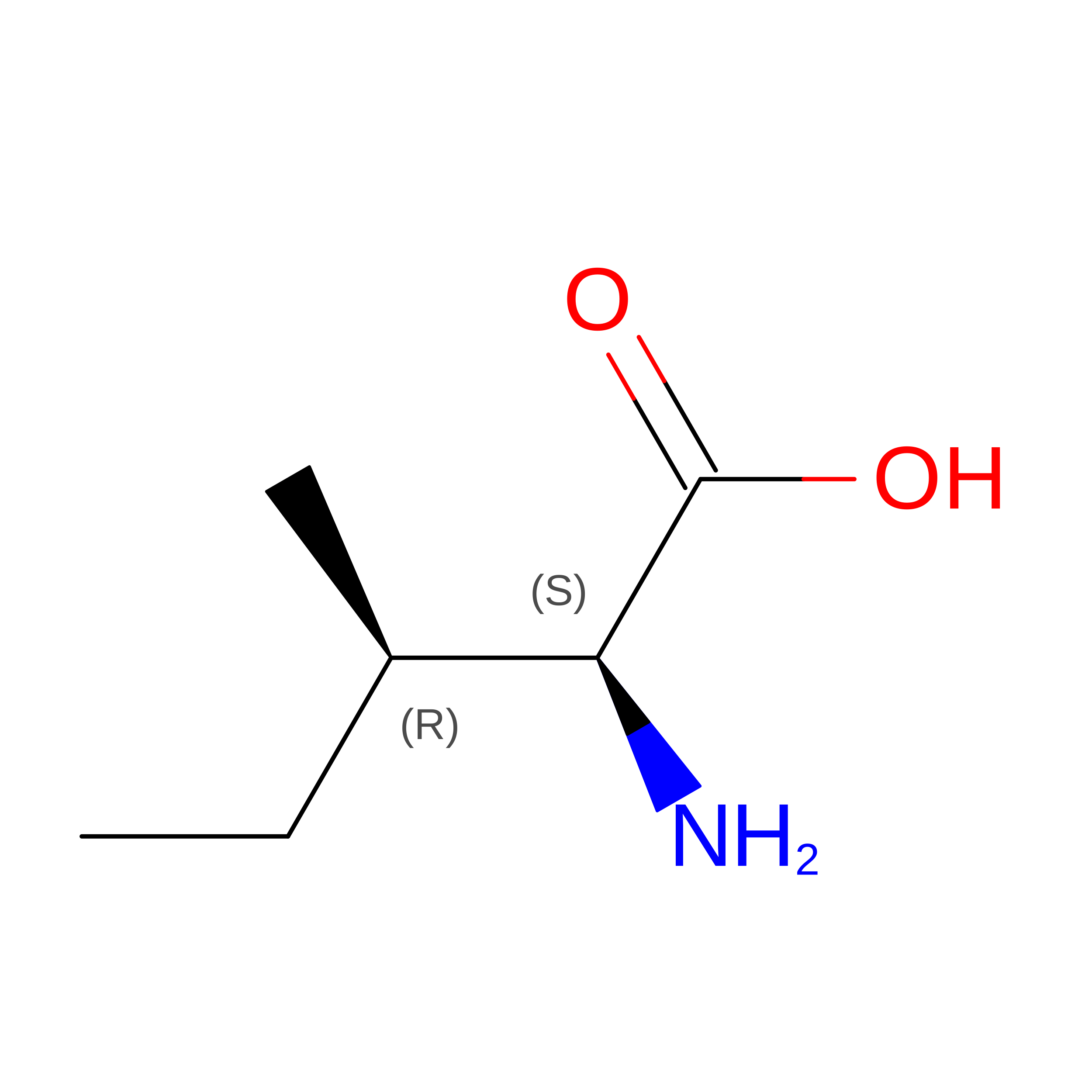
Modified Residues  1 Unique
IDChains TypeFormula2D DiagramParent
IIL
Query on IIL
A
L-PEPTIDE LINKINGC6 H13 N O2ILE

Experimental Data & Validation

Experimental Data

  • Method: SOLUTION NMR
  • Conformers Calculated: 50 
  • Conformers Submitted: 15 
  • Selection Criteria: structures with the lowest energy 

Structure Validation

View Full Validation Report


Entry History 

Deposition Data

Revision History  (Full details and data files)

  • Version 1.0: 2002-01-09
    Type: Initial release
  • Version 1.1: 2008-04-27
    Changes: Version format compliance
  • Version 1.2: 2011-07-13
    Changes: Version format compliance
  • Version 1.3: 2021-10-27
    Changes: Database references, Derived calculations
  • Version 1.4: 2024-11-06
    Changes: Data collection, Structure summary