1KE8 | pdb_00001ke8

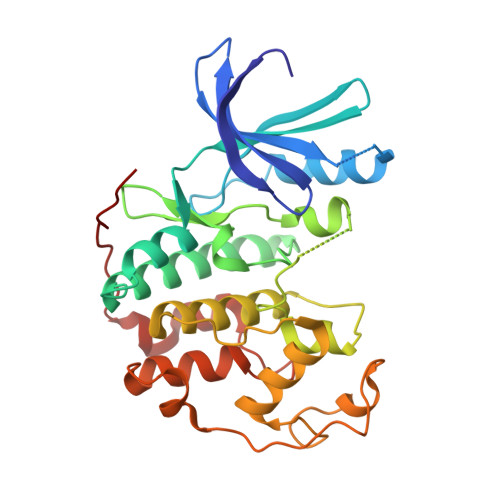
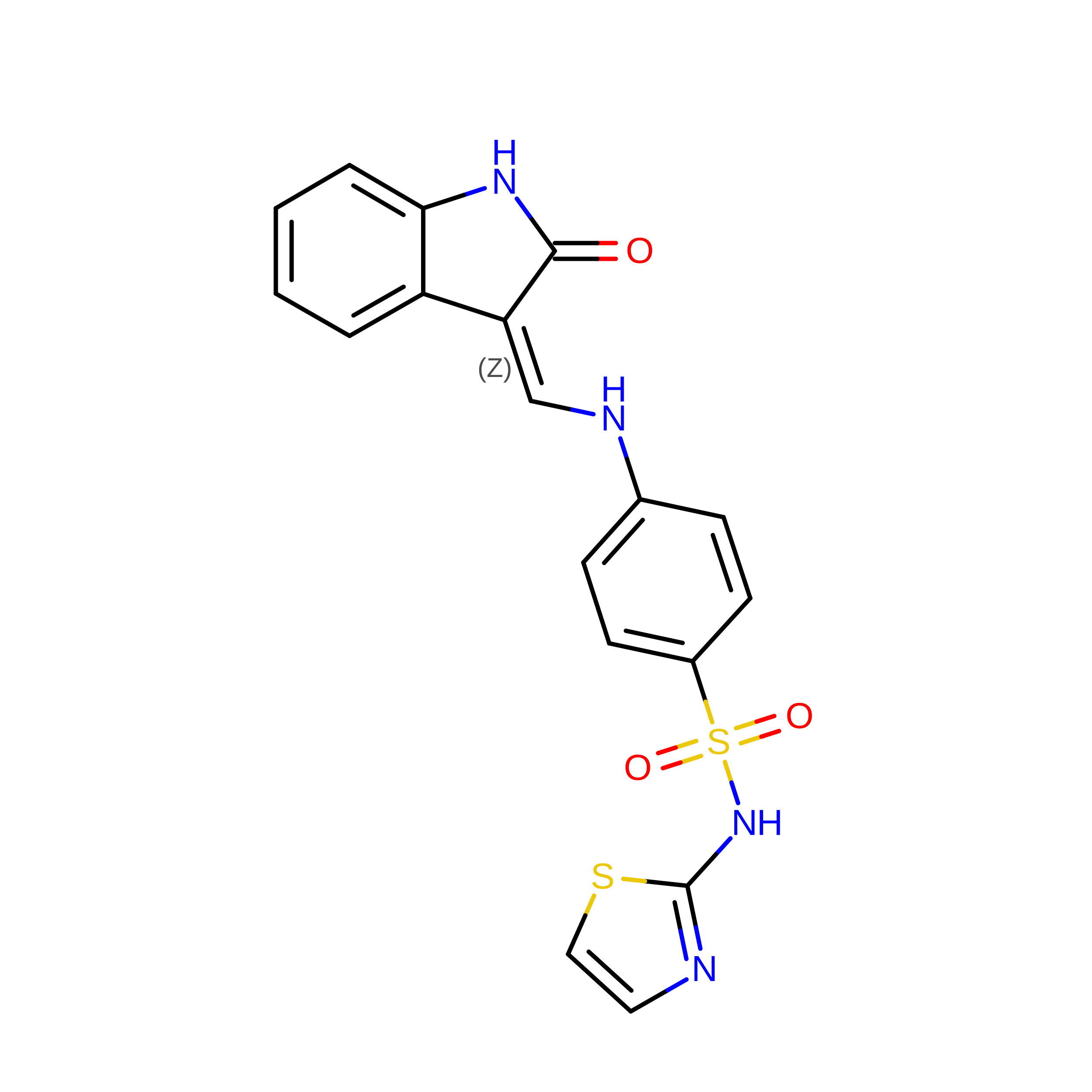
CYCLIN-DEPENDENT KINASE 2 (CDK2) COMPLEXED WITH 4-{[(2-OXO-1,2-DIHYDRO-3H-INDOL-3-YLIDENE)METHYL]AMINO}-N-(1,3-THIAZOL-2-YL)BENZENESULFONAMIDE


Experimental Data Snapshot

  • Method: X-RAY DIFFRACTION
  • Resolution: 2.00 Å
  • R-Value Free: 
    0.228 (Depositor) 
  • R-Value Work: 
    0.187 (Depositor), 0.199 (DCC) 

Starting Model: experimental
View more details

wwPDB Validation 3D Report Full Report

Validation slider image for 1KE8

Ligand Structure Quality Assessment 


This is version 1.4 of the entry. See complete history

Literature

Oxindole-based inhibitors of cyclin-dependent kinase 2 (CDK2): design, synthesis, enzymatic activities, and X-ray crystallographic analysis.

Bramson, H.N.Corona, J.Davis, S.T.Dickerson, S.H.Edelstein, M.Frye, S.V.Gampe Jr., R.T.Harris, P.A.Hassell, A.Holmes, W.D.Hunter, R.N.Lackey, K.E.Lovejoy, B.Luzzio, M.J.Montana, V.Rocque, W.J.Rusnak, D.Shewchuk, L.Veal, J.M.Walker, D.H.Kuyper, L.F.

(2001) J Med Chem 44: 4339-4358

  • DOI: https://doi.org/10.1021/jm010117d
  • Primary Citation Related Structures: 
    1KE5, 1KE6, 1KE7, 1KE8, 1KE9

  • PubMed Abstract: 

    Two closely related classes of oxindole-based compounds, 1H-indole-2,3-dione 3-phenylhydrazones and 3-(anilinomethylene)-1,3-dihydro-2H-indol-2-ones, were shown to potently inhibit cyclin-dependent kinase 2 (CDK2). The initial lead compound was prepared as a homologue of the 3-benzylidene-1,3-dihydro-2H-indol-2-one class of kinase inhibitor. Crystallographic analysis of the lead compound bound to CDK2 provided the basis for analogue design. A semiautomated method of ligand docking was used to select compounds for synthesis, and a number of compounds with low nanomolar inhibitory activity versus CDK2 were identified. Enzyme binding determinants for several analogues were evaluated by X-ray crystallography. Compounds in this series inhibited CDK2 with a potency approximately 10-fold greater than that for CDK1. Members of this class of inhibitor cause an arrest of the cell cycle and have shown potential utility in the prevention of chemotherapy-induced alopecia.


  • Organizational Affiliation
    • GlaxoSmithKline Inc., Five Moore Drive, Research Triangle Park, North Carolina 27709, USA.

Macromolecule Content 

  • Total Structure Weight: 34.37 kDa 
  • Atom Count: 2,406 
  • Modeled Residue Count: 282 
  • Deposited Residue Count: 298 
  • Unique protein chains: 1

Macromolecules

Find similar proteins by:|  3D Structure
Entity ID: 1
MoleculeChains  Sequence LengthOrganismDetailsImage
CELL DIVISION PROTEIN KINASE 2298Homo sapiensMutation(s): 0 
EC: 2.7.1.37 (PDB Primary Data), 2.7.11.22 (UniProt)
UniProt & NIH Common Fund Data Resources
Find proteins for P24941 (Homo sapiens)
Explore P24941 
Go to UniProtKB:  P24941
PHAROS:  P24941
GTEx:  ENSG00000123374 
Entity Groups
Sequence Clusters30% Identity50% Identity70% Identity90% Identity95% Identity100% Identity
UniProt GroupP24941
Sequence Annotations
Expand
Reference Sequence

Small Molecules

Ligands 1 Unique
IDChains Name / Formula / InChI Key2D Diagram3D Interactions
LS4

Query on LS4


Download:Ideal Coordinates CCD File
B [auth A]4-{[(2-OXO-1,2-DIHYDRO-3H-INDOL-3-YLIDENE)METHYL]AMINO}-N-(1,3-THIAZOL-2-YL)BENZENESULFONAMIDE
C18 H14 N4 O3 S2
BOMPRXSVSIPRDT-PTNGSMBKSA-N

Experimental Data & Validation

Experimental Data

  • Method: X-RAY DIFFRACTION
  • Resolution: 2.00 Å
  • R-Value Free:  0.228 (Depositor) 
  • R-Value Work:  0.187 (Depositor), 0.199 (DCC) 
Space Group: P 21 21 21
Unit Cell:
Length ( Å )Angle ( ˚ )
a = 72.53α = 90
b = 74.04β = 90
c = 54.08γ = 90
Software Package:
Software NamePurpose
X-PLORmodel building
X-PLORrefinement
DENZOdata reduction
SCALEPACKdata scaling
X-PLORphasing

Structure Validation

View Full Validation Report


Ligand Structure Quality Assessment 


Entry History 

Deposition Data

Revision History  (Full details and data files)

  • Version 1.0: 2002-05-14
    Type: Initial release
  • Version 1.1: 2008-04-27
    Changes: Version format compliance
  • Version 1.2: 2011-07-13
    Changes: Version format compliance
  • Version 1.3: 2018-01-31
    Changes: Experimental preparation
  • Version 1.4: 2023-08-16
    Changes: Data collection, Database references, Derived calculations, Refinement description