1KAR | pdb_00001kar

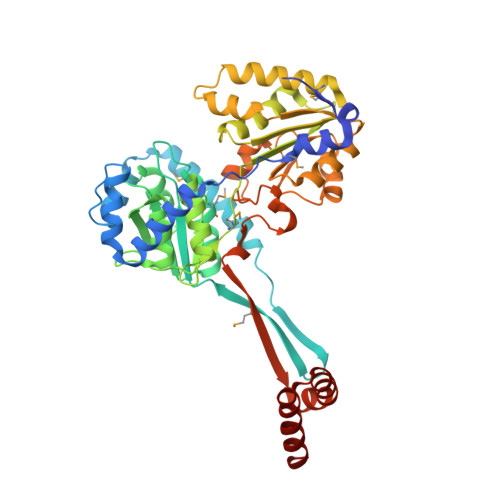
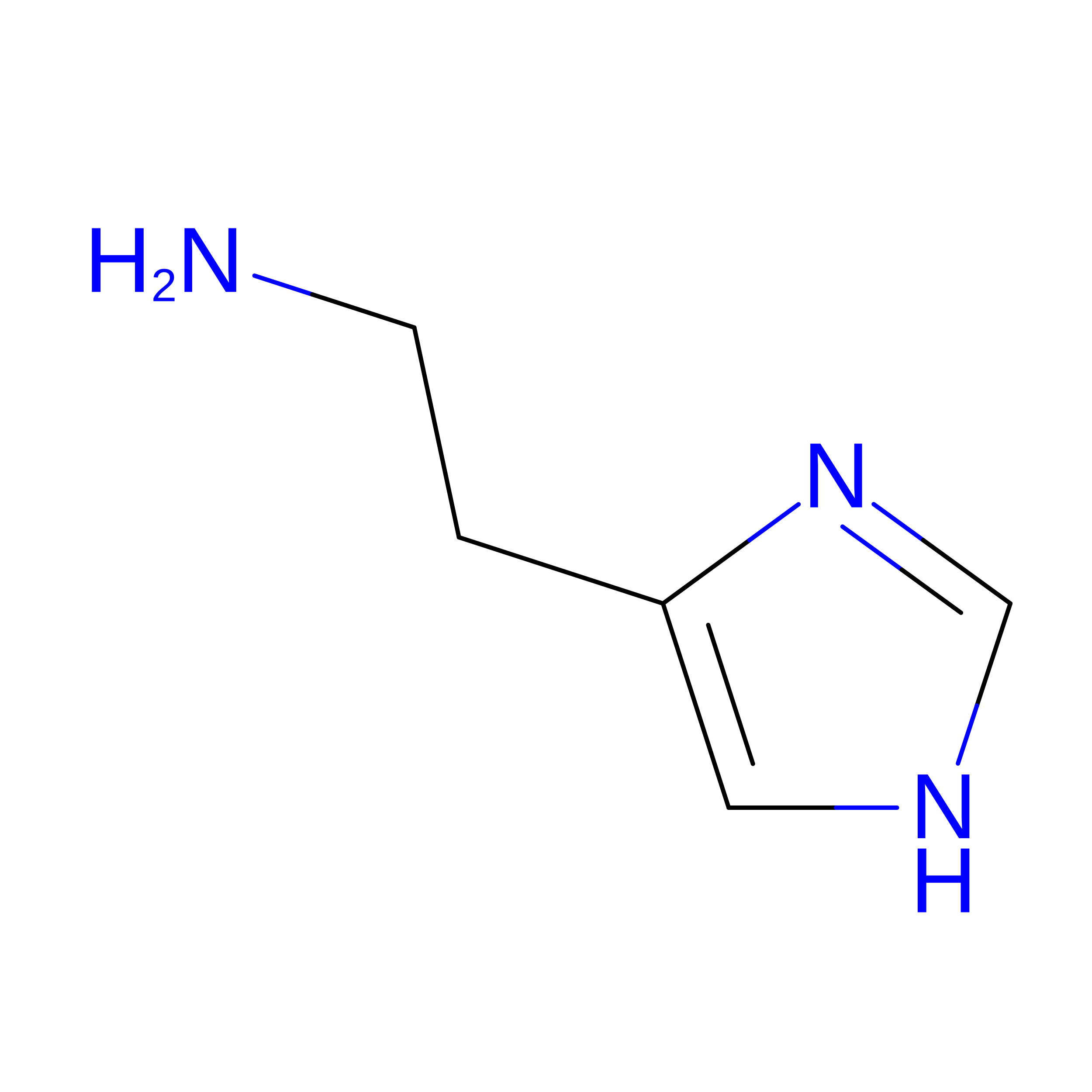
L-HISTIDINOL DEHYDROGENASE (HISD) STRUCTURE COMPLEXED WITH HISTAMINE (INHIBITOR), ZINC AND NAD (COFACTOR)


Experimental Data Snapshot

  • Method: X-RAY DIFFRACTION
  • Resolution: 2.10 Å
  • R-Value Free: 
    0.281 (Depositor) 
  • R-Value Work: 
    0.248 (Depositor) 
  • R-Value Observed: 
    0.248 (Depositor) 

Starting Model: experimental
View more details

wwPDB Validation 3D Report Full Report

Validation slider image for 1KAR

This is version 1.6 of the entry. See complete history

Literature

Mechanism of action and NAD+-binding mode revealed by the crystal structure of L-histidinol dehydrogenase.

Barbosa, J.A.R.G.Sivaraman, J.Li, Y.Larocque, R.Matte, A.Schrag, J.D.Cygler, M.

(2002) Proc Natl Acad Sci U S A 99: 1859-1864

  • DOI: https://doi.org/10.1073/pnas.022476199
  • Primary Citation Related Structures: 
    1K75, 1KAE, 1KAH, 1KAR

  • PubMed Abstract: 

    The histidine biosynthetic pathway is an ancient one found in bacteria, archaebacteria, fungi, and plants that converts 5-phosphoribosyl 1-pyrophosphate to l-histidine in 10 enzymatic reactions. This pathway provided a paradigm for the operon, transcriptional regulation of gene expression, and feedback inhibition of a pathway. l-histidinol dehydrogenase (HisD, EC ) catalyzes the last two steps in the biosynthesis of l-histidine: sequential NAD-dependent oxidations of l-histidinol to l-histidinaldehyde and then to l-histidine. HisD functions as a homodimer and requires the presence of one Zn(2+) cation per monomer. We have determined the three-dimensional structure of Escherichia coli HisD in the apo state as well as complexes with substrate, Zn(2+), and NAD(+) (best resolution is 1.7 A). Each monomer is made of four domains, whereas the intertwined dimer possibly results from domain swapping. Two domains display a very similar incomplete Rossmann fold that suggests an ancient event of gene duplication. Residues from both monomers form the active site. Zn(2+) plays a crucial role in substrate binding but is not directly involved in catalysis. The active site residue His-327 participates in acid-base catalysis, whereas Glu-326 activates a water molecule. NAD(+) binds weakly to one of the Rossmann fold domains in a manner different from that previously observed for other proteins having a Rossmann fold.


  • Organizational Affiliation
    • Biotechnology Research Institute, National Research Council of Canada, 6100 Royalmount Avenue, Montreal, QC, Canada H4P 2R2.

Macromolecule Content 

  • Total Structure Weight: 93.32 kDa 
  • Atom Count: 6,438 
  • Modeled Residue Count: 862 
  • Deposited Residue Count: 868 
  • Unique protein chains: 1

Macromolecules

Find similar proteins by:|  3D Structure
Entity ID: 1
MoleculeChains  Sequence LengthOrganismDetailsImage
Histidinol dehydrogenase
A, B
434Escherichia coliMutation(s): 7 
Gene Names: HISD
EC: 1.1.1.23
UniProt
Find proteins for P06988 (Escherichia coli (strain K12))
Explore P06988 
Go to UniProtKB:  P06988
Entity Groups
Sequence Clusters30% Identity50% Identity70% Identity90% Identity95% Identity100% Identity
UniProt GroupP06988
Sequence Annotations
Expand
Reference Sequence

Small Molecules

Experimental Data & Validation

Experimental Data

  • Method: X-RAY DIFFRACTION
  • Resolution: 2.10 Å
  • R-Value Free:  0.281 (Depositor) 
  • R-Value Work:  0.248 (Depositor) 
  • R-Value Observed: 0.248 (Depositor) 
Space Group: P 21 21 21
Unit Cell:
Length ( Å )Angle ( ˚ )
a = 55.34α = 90
b = 109.04β = 90
c = 157.94γ = 90
Software Package:
Software NamePurpose
CNSrefinement
DENZOdata reduction
SCALEPACKdata scaling
CNSphasing

Structure Validation

View Full Validation Report


Entry History 

Deposition Data

Revision History  (Full details and data files)

  • Version 1.0: 2002-06-12
    Type: Initial release
  • Version 1.1: 2008-04-27
    Changes: Version format compliance
  • Version 1.2: 2011-07-13
    Changes: Version format compliance
  • Version 1.3: 2014-11-12
    Changes: Structure summary
  • Version 1.4: 2023-08-16
    Changes: Data collection, Database references, Derived calculations, Refinement description
  • Version 1.5: 2023-11-15
    Changes: Data collection
  • Version 1.6: 2024-10-30
    Changes: Structure summary