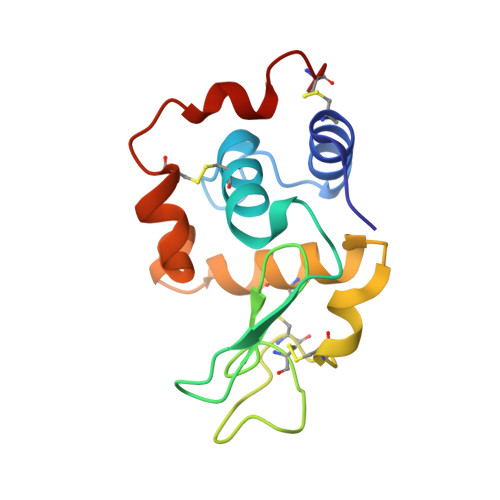
1I20 | pdb_00001i20

MUTANT HUMAN LYSOZYME (A92D)


Experimental Data Snapshot

  • Method: X-RAY DIFFRACTION
  • Resolution: 1.90 Å
  • R-Value Work: 
    0.164 (Depositor) 
  • R-Value Observed: 
    0.164 (Depositor) 

Starting Model: experimental
View more details

wwPDB Validation 3D Report Full Report

Validation slider image for 1I20

This is version 1.5 of the entry. See complete history

Literature

Structural and thermodynamic responses of mutations at a Ca2+ binding site engineered into human lysozyme.

Kuroki, R.Yutani, K.

(1998) J Biological Chem 273: 34310-34315

  • DOI: https://doi.org/10.1074/jbc.273.51.34310
  • Primary Citation Related Structures: 
    1I1Z, 1I20, 1I22

  • PubMed Abstract: 

    Structural determinants of Ca2+ binding sites within proteins typically comprise several acidic residues in appropriate juxtaposition. Three residues (Ala-83, Gln-86, and Ala-92) in human lysozyme are characteristically mutated to Lys, Asp, and Asp, respectively, in natural Ca2+ binding lysozymes and alpha-lactalbumins. The effects of these mutations on the stability and Ca2+ binding properties of human lysozyme were investigated using calorimetry and were interpreted with crystal structures. The double mutant, in which Glu-86 and Ala-92 were replaced with Asp, clearly showed Ca2+ binding affinity, whereas neither point mutant showed Ca2+ affinity, indicating that both residues are essential. The further mutation of Ala-83 --> Lys did not affect the Ca2+ binding of the double mutant. The point mutations Ala-83 --> Lys and Glu-86 --> Asp did not affect the stability, whereas the mutation Ala-92 --> Asp was about 1.3 kcal/mol less stable. Structural analyses showed that both Asp-86 and Lys-83 were exposed to solvent. Side chains of Asp-86 and Asp-91 were rotated in opposite directions about chi1 angle, as if to reduce the electrostatic repulsion. The charged amino acids at the Ca2+ binding site did not significantly affect stability of the protein, possibly because of the local conformational change of the side chains.


  • Organizational Affiliation
    • Central Laboratories for Key Technology, Kirin Brewery Co. Ltd., 1-13-5 Fukuura, Kanazawa-ku, Yokohama 236 Japan. r-kuroki@kirin.co.jp

Macromolecule Content 

  • Total Structure Weight: 14.76 kDa 
  • Atom Count: 1,114 
  • Modeled Residue Count: 130 
  • Deposited Residue Count: 130 
  • Unique protein chains: 1

Macromolecules

Find similar proteins by:|  3D Structure
Entity ID: 1
MoleculeChains  Sequence LengthOrganismDetailsImage
LYSOZYME C130Homo sapiensMutation(s): 1 
EC: 3.2.2.17 (PDB Primary Data), 3.2.1.17 (UniProt)
UniProt & NIH Common Fund Data Resources
Find proteins for P61626 (Homo sapiens)
Explore P61626 
Go to UniProtKB:  P61626
PHAROS:  P61626
GTEx:  ENSG00000090382 
Entity Groups
Sequence Clusters30% Identity50% Identity70% Identity90% Identity95% Identity100% Identity
UniProt GroupP61626
Sequence Annotations
Expand
Reference Sequence

Experimental Data & Validation

Experimental Data

  • Method: X-RAY DIFFRACTION
  • Resolution: 1.90 Å
  • R-Value Work:  0.164 (Depositor) 
  • R-Value Observed: 0.164 (Depositor) 
Space Group: P 21 21 21
Unit Cell:
Length ( Å )Angle ( ˚ )
a = 57.07α = 90
b = 60.63β = 90
c = 33.85γ = 90
Software Package:
Software NamePurpose
SDMSdata collection
SDMSdata reduction
TNTrefinement
SDMSdata scaling
TNTphasing

Structure Validation

View Full Validation Report


Entry History 

Deposition Data

  • Released Date: 2001-02-28 
  • Deposition Author(s): Kuroki, R.

Revision History  (Full details and data files)

  • Version 1.0: 2001-02-28
    Type: Initial release
  • Version 1.1: 2008-04-27
    Changes: Version format compliance
  • Version 1.2: 2011-07-13
    Changes: Version format compliance
  • Version 1.3: 2021-11-10
    Changes: Database references, Derived calculations
  • Version 1.4: 2023-10-25
    Changes: Data collection, Refinement description
  • Version 1.5: 2024-10-30
    Changes: Structure summary