1AQ0 | pdb_00001aq0

BARLEY 1,3-1,4-BETA-GLUCANASE IN MONOCLINIC SPACE GROUP


Experimental Data Snapshot

  • Method: X-RAY DIFFRACTION
  • Resolution: 2.00 Å
  • R-Value Free: 
    0.213 (Depositor) 
  • R-Value Work: 
    0.170 (Depositor) 
  • R-Value Observed: 
    0.170 (Depositor) 

Starting Model: experimental
View more details

wwPDB Validation 3D Report Full Report

Validation slider image for 1AQ0

This is version 2.2 of the entry. See complete history

Literature

Crystal structure of barley 1,3-1,4-beta-glucanase at 2.0-A resolution and comparison with Bacillus 1,3-1,4-beta-glucanase.

Muller, J.J.Thomsen, K.K.Heinemann, U.

(1998) J Biological Chem 273: 3438-3446

  • DOI: https://doi.org/10.1074/jbc.273.6.3438
  • Primary Citation Related Structures: 
    1AQ0

  • PubMed Abstract: 

    Both plants and bacteria produce enzymes capable of degrading the mixed-linked beta-glucan of the endosperm cell walls of cereal grains. The enzymes share the specificity for beta-1,4 glycosyl bonds of O-3-substituted glucose units in linear polysaccharides and a similar cleavage mechanism but are unrelated in sequence and tertiary structure. The three-dimensional structure of the 1,3-1, 4-beta-glucanase isoenzyme EII from barley was determined from monoclinic crystals at a resolution of 2.0 A. The protein is folded into a betaalpha8 barrel structure as has been shown previously (Varghese, J. N., Garrett, T. P. J., Colman, P. M., Chen, L., Hoj, P. B., and Fincher, G. B. (1994) Proc. Natl. Acad. Sci. U.S.A. 91, 2785-2789) by diffraction analysis at lower resolution of tetragonal crystals. It contains one N-glycosylation site which is described in detail with the sugar moieties attached to residue Asn190. The geometry and hydration of the barley 1,3-1,4-beta-glucanase is analyzed; a model beta-glucan fragment is placed into the binding site by molecular dynamics simulation, and the beta-glucan binding grooves of the plant and bacterial enzymes are compared. Their active sites are shown to have a small number of common features in generally dissimilar geometries that serve to explain both the identical substrate specificity and the observed differences in inhibitor binding.


  • Organizational Affiliation
    • Forschungsgruppe Kristallographie, Max-Delbrück-Centrum für Molekulare Medizin, Robert-Rössle-Strasse 10, D-13122 Berlin, Germany. jjm@mdc-berlin.de

Macromolecule Content 

  • Total Structure Weight: 65.25 kDa 
  • Atom Count: 5,023 
  • Modeled Residue Count: 612 
  • Deposited Residue Count: 612 
  • Unique protein chains: 1

Macromolecules

Find similar proteins by:|  3D Structure
Entity ID: 1
MoleculeChains  Sequence LengthOrganismDetailsImage
1,3-1,4-BETA-GLUCANASE
A, B
306Hordeum vulgareMutation(s): 0 
EC: 3.2.1.73
UniProt
Find proteins for P12257 (Hordeum vulgare)
Explore P12257 
Go to UniProtKB:  P12257
Entity Groups
Sequence Clusters30% Identity50% Identity70% Identity90% Identity95% Identity100% Identity
UniProt GroupP12257
Glycosylation
Glycosylation Sites: 1
Sequence Annotations
Expand
Reference Sequence

Oligosaccharides

Help  
Entity ID: 2
MoleculeChains Length2D Diagram GlycosylationD Interactions
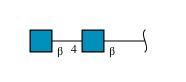
2-acetamido-2-deoxy-beta-D-glucopyranose-(1-4)-2-acetamido-2-deoxy-beta-D-glucopyranose
C, D
2N-Glycosylation
Glycosylation Resources
GlyTouCan: G42666HT
GlyCosmos: G42666HT
GlyGen: G42666HT

Small Molecules

Experimental Data & Validation

Experimental Data

  • Method: X-RAY DIFFRACTION
  • Resolution: 2.00 Å
  • R-Value Free:  0.213 (Depositor) 
  • R-Value Work:  0.170 (Depositor) 
  • R-Value Observed: 0.170 (Depositor) 
Space Group: P 1 21 1
Unit Cell:
Length ( Å )Angle ( ˚ )
a = 49.58α = 90
b = 82.99β = 104.36
c = 77.56γ = 90
Software Package:
Software NamePurpose
X-PLORmodel building
X-PLORrefinement
MOSFLMdata reduction
Agrovatadata scaling
ROTAVATAdata scaling
X-PLORphasing

Structure Validation

View Full Validation Report


Entry History 

Deposition Data

Revision History  (Full details and data files)

  • Version 1.0: 1998-02-11
    Type: Initial release
  • Version 1.1: 2008-03-24
    Changes: Version format compliance
  • Version 1.2: 2011-07-13
    Changes: Non-polymer description, Version format compliance
  • Version 2.0: 2020-07-29
    Type: Remediation
    Reason: Carbohydrate remediation
    Changes: Atomic model, Data collection, Database references, Derived calculations, Other, Refinement description, Structure summary
  • Version 2.1: 2023-08-02
    Changes: Database references, Refinement description, Structure summary
  • Version 2.2: 2024-10-23
    Changes: Data collection, Structure summary