9Y5Y | pdb_00009y5y

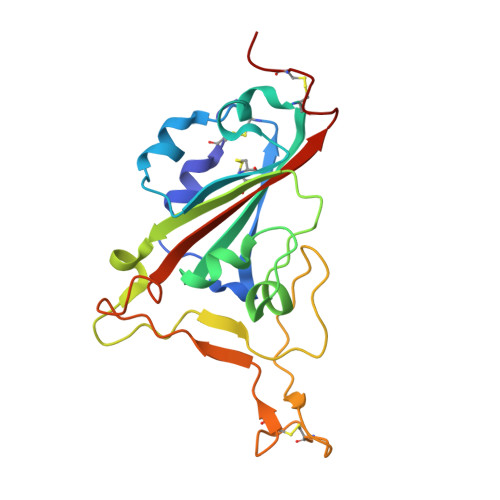
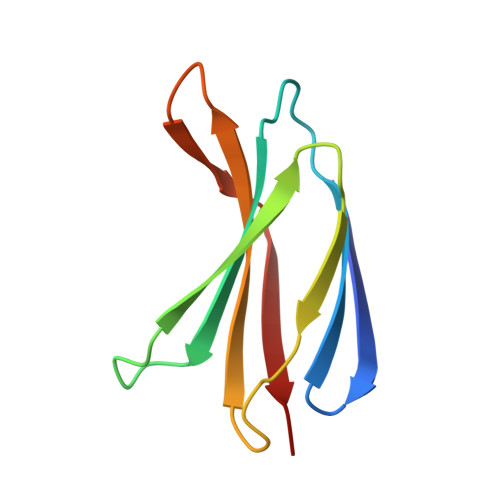
Structure of the Omicron Spike RBD bound by the monobody s19382 (local refinement from dimerized Spike protein ECDs)


Experimental Data Snapshot

  • Method: ELECTRON MICROSCOPY
  • Resolution: 3.16 Å
  • Aggregation State: PARTICLE 
  • Reconstruction Method: SINGLE PARTICLE 

wwPDB Validation   3D Report Full Report


This is version 1.1 of the entry. See complete history


Literature

ADAPT-M: A workflow for rapid, quantitative in vitro measurements of enriched protein libraries.

Perez, C.P.DelRosso, N.V.Noland, C.L.Parekh, U.Choe, C.A.Eguchi, R.R.Wen, Q.Fordyce, P.M.Huang, P.S.

(2025) bioRxiv 

  • DOI: https://doi.org/10.1101/2025.10.21.683815
  • Primary Citation of Related Structures:  
    9Y5Y

  • PubMed Abstract: 

    Protein-protein interactions underpin most cellular interactions, and engineered binders present powerful tools for probing biology and developing novel therapeutics. One bottleneck in binder generation is the scalable, quantitative characterization of these interactions. We present ADAPT-M ( A ffinity D etermination by A daptation of P ro T ein binders for M icrofluidics), a streamlined workflow that connects yeast surface display (YSD) with in vitro affinity and kinetic measurements using the high-throughput STAMMPPING microfluidic platform. ADAPT-M quantifies K d s and dissociation kinetic parameters for hundreds of enriched protein variants in under one week without requiring hands-on protein purification. We applied ADAPT-M to a computationally designed library targeting the SARS-CoV-2 Omicron BA.1 receptor binding domain, successfully recovering and measuring K d s for most highly enriched YSD variants. Measurements correlate strongly with biolayer interferometry and yeast titration assays. ADAPT-M further enabled selection of lead candidates for structural and mutational analysis, which revealed designed paratopes were preserved despite binding to off-target epitopes. By bridging YSD screening and in vitro validation, ADAPT-M accelerates protein binder discovery and supports data-driven protein engineering.


  • Organizational Affiliation
    • Biophysics Program, Stanford University, Stanford, CA, USA.

Macromolecules
Find similar proteins by:  (by identity cutoff)  |  3D Structure
Entity ID: 1
MoleculeChains Sequence LengthOrganismDetailsImage
Spike protein S1
A, C, E, G
195Severe acute respiratory syndrome coronavirus 2Mutation(s): 15 
Gene Names: S2
UniProt
Find proteins for P0DTC2 (Severe acute respiratory syndrome coronavirus 2)
Explore P0DTC2 
Go to UniProtKB:  P0DTC2
Entity Groups  
Sequence Clusters30% Identity50% Identity70% Identity90% Identity95% Identity100% Identity
UniProt GroupP0DTC2
Sequence Annotations
Expand
  • Reference Sequence
Find similar proteins by:  (by identity cutoff)  |  3D Structure
Entity ID: 2
MoleculeChains Sequence LengthOrganismDetailsImage
Monobody s19382
B, D, F, H, I
B, D, F, H, I, J, K, L
89synthetic constructMutation(s): 0 
Entity Groups  
Sequence Clusters30% Identity50% Identity70% Identity90% Identity95% Identity100% Identity
Sequence Annotations
Expand
  • Reference Sequence
Experimental Data & Validation

Experimental Data

  • Method: ELECTRON MICROSCOPY
  • Resolution: 3.16 Å
  • Aggregation State: PARTICLE 
  • Reconstruction Method: SINGLE PARTICLE 
EM Software:
TaskSoftware PackageVersion
MODEL REFINEMENTPHENIX1.21.2_5419
RECONSTRUCTIONcryoSPARC

Structure Validation

View Full Validation Report


Entry History & Funding Information

Deposition Data


Funding OrganizationLocationGrant Number
Other private--

Revision History  (Full details and data files)

  • Version 1.0: 2025-11-12
    Type: Initial release
  • Version 1.1: 2025-12-17
    Changes: Data collection, Database references