9VG7 | pdb_00009vg7

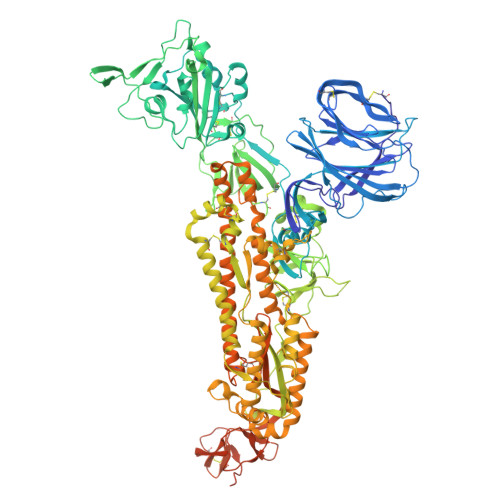
Cryo-EM Structure of Rc-o319 Ectodomain trimer


Experimental Data Snapshot

  • Method: ELECTRON MICROSCOPY
  • Resolution: 2.55 Å
  • Aggregation State: PARTICLE 
  • Reconstruction Method: SINGLE PARTICLE 

wwPDB Validation   3D Report Full Report


This is version 1.1 of the entry. See complete history


Literature

Molecular basis of sarbecovirus evolution and receptor tropism in natural hosts, potential intermediate hosts, and humans.

Kosugi, Y.Matsumoto, K.Lytras, S.Plianchaisuk, A.Tolentino, J.E.Fujita, S.Yo, M.S.Luo, C.Kim, Y.Shihoya, W.Ito, J.Nureki, O.Sato, K.

(2025) Cell Rep 44: 116220-116220

  • DOI: https://doi.org/10.1016/j.celrep.2025.116220
  • Primary Citation of Related Structures:  
    9M3F, 9VG7

  • PubMed Abstract: 

    The spike protein of many sarbecoviruses binds to the angiotensin-converting enzyme 2 (ACE2) receptor and facilitates viral entry. The diversification of the sarbecovirus spike gene and the mammalian ACE2 gene suggests that sarbecoviruses and their hosts have co-evolved, and the genetic diversity in these genes affects the host tropism of sarbecoviruses. Better comprehending the evolutionary potential of sarbecoviruses can lead to preparedness for the next pandemic. However, the host tropism of sarbecoviruses is not fully understood. Here, we performed pseudovirus infection assays using 53 sarbecoviruses and ACE2s from 17 mammals to elucidate the ACE2 tropism of sarbecoviruses in natural hosts, potential intermediate hosts, and humans. We determined the factors responsible for the ACE2 tropism of sarbecoviruses through structural and phylogenetic analyses and infection experiments, revealing which substitutions can expand the host range of sarbecoviruses. These results highlight the mechanisms modulating host tropism throughout sarbecovirus evolution.


  • Organizational Affiliation
    • Division of Systems Virology, Department of Microbiology and Immunology, The Institute of Medical Science, The University of Tokyo, Tokyo, Japan; Graduate School of Medicine, The University of Tokyo, Tokyo, Japan.

Macromolecules
Find similar proteins by:  (by identity cutoff)  |  3D Structure
Entity ID: 1
MoleculeChains Sequence LengthOrganismDetailsImage
Spike glycoprotein
A, B, C
1,167Homo sapiensMutation(s): 0 
UniProt
Find proteins for P0DTC2 (Severe acute respiratory syndrome coronavirus 2)
Explore P0DTC2 
Go to UniProtKB:  P0DTC2
Entity Groups  
Sequence Clusters30% Identity50% Identity70% Identity90% Identity95% Identity100% Identity
UniProt GroupP0DTC2
Glycosylation
Glycosylation Sites: 7Go to GlyGen: P0DTC2-1
Sequence Annotations
Expand
  • Reference Sequence
Oligosaccharides

Help

Entity ID: 2
MoleculeChains Length2D Diagram Glycosylation3D Interactions
2-acetamido-2-deoxy-beta-D-glucopyranose-(1-4)-2-acetamido-2-deoxy-beta-D-glucopyranose
D, F, G, H, J
D, F, G, H, J, K, L, N, O
2N-Glycosylation
Glycosylation Resources
GlyTouCan:  G42666HT
GlyCosmos:  G42666HT
GlyGen:  G42666HT
Entity ID: 3
MoleculeChains Length2D Diagram Glycosylation3D Interactions
beta-D-mannopyranose-(1-4)-2-acetamido-2-deoxy-beta-D-glucopyranose-(1-4)-2-acetamido-2-deoxy-beta-D-glucopyranose
E, I, M
3N-Glycosylation
Glycosylation Resources
GlyTouCan:  G15407YE
GlyCosmos:  G15407YE
GlyGen:  G15407YE
Small Molecules
Ligands 1 Unique
IDChains Name / Formula / InChI Key2D Diagram3D Interactions
NAG
Query on NAG

Download Ideal Coordinates CCD File 
P [auth A]
Q [auth A]
R [auth A]
S [auth B]
T [auth B]
P [auth A],
Q [auth A],
R [auth A],
S [auth B],
T [auth B],
U [auth B],
V [auth C],
W [auth C],
X [auth C]
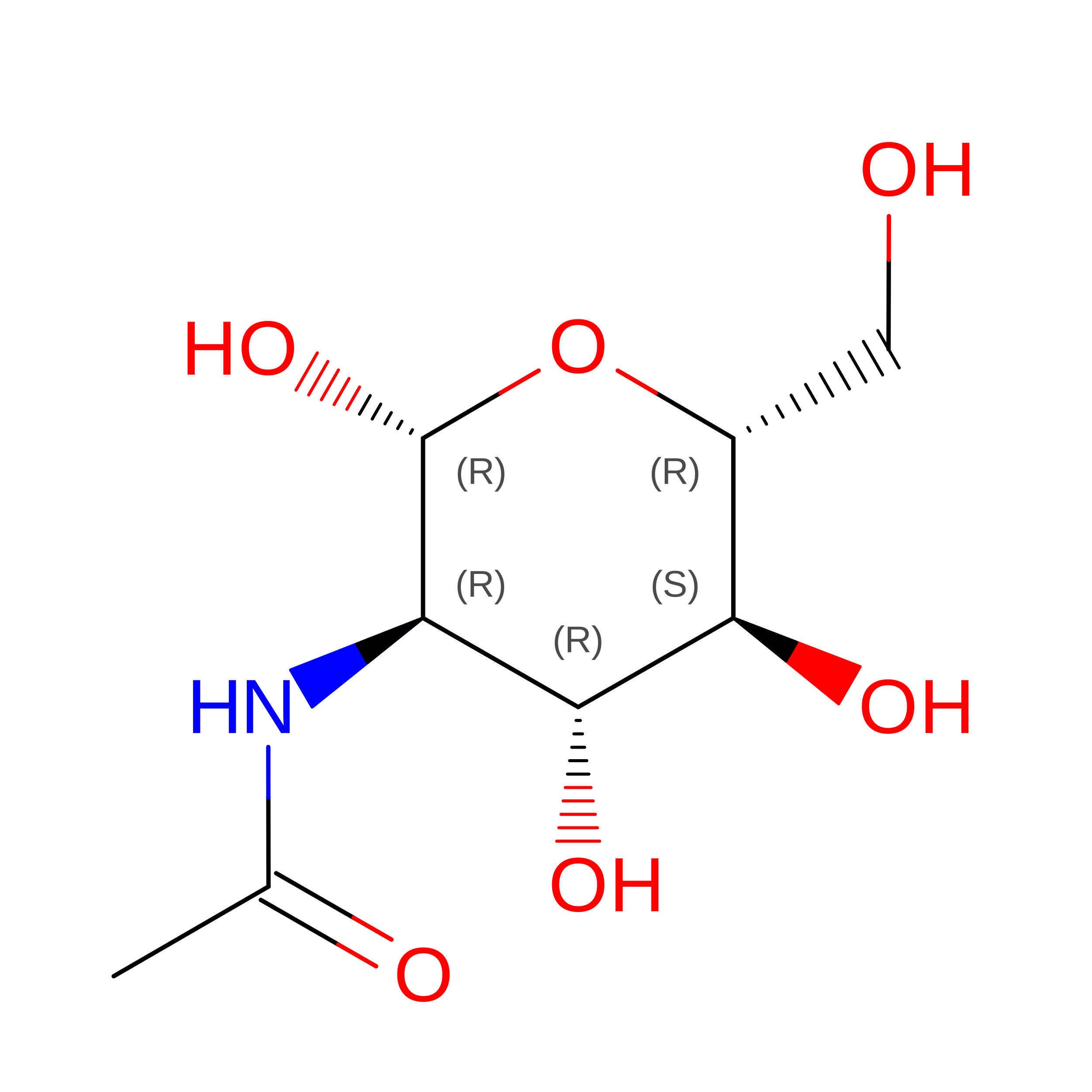
2-acetamido-2-deoxy-beta-D-glucopyranose
C8 H15 N O6
OVRNDRQMDRJTHS-FMDGEEDCSA-N
Experimental Data & Validation

Experimental Data

  • Method: ELECTRON MICROSCOPY
  • Resolution: 2.55 Å
  • Aggregation State: PARTICLE 
  • Reconstruction Method: SINGLE PARTICLE 

Structure Validation

View Full Validation Report


Entry History & Funding Information

Deposition Data


Funding OrganizationLocationGrant Number
Japan Society for the Promotion of Science (JSPS)Japan--

Revision History  (Full details and data files)

  • Version 1.0: 2025-08-27
    Type: Initial release
  • Version 1.1: 2025-10-15
    Changes: Data collection, Database references