Download Mendeley
Structural insights into the catalytic mechanism of the phenylethanoid glycoside rhamnosyltransferase UGT79G15 from Rehmannia glutinosa.
Ma, R., Wei, H., Zhuang, Y., Wu, Y., Li, Z., Chen, Y., Huang, J., Yan, X., Liu, W., Liu, T.(2025) Plant Commun 6: 101539-101539
- PubMed: 41013894 Search on PubMedSearch on PubMed Central
- DOI: https://doi.org/10.1016/j.xplc.2025.101539
- Primary Citation Related Structures:
9UEI, 9UF7, 9UFI - PubMed Abstract:
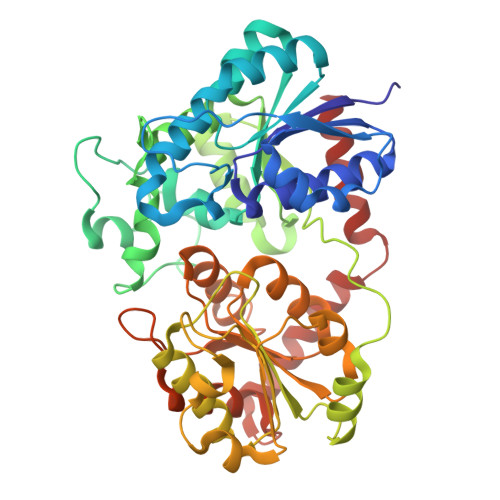
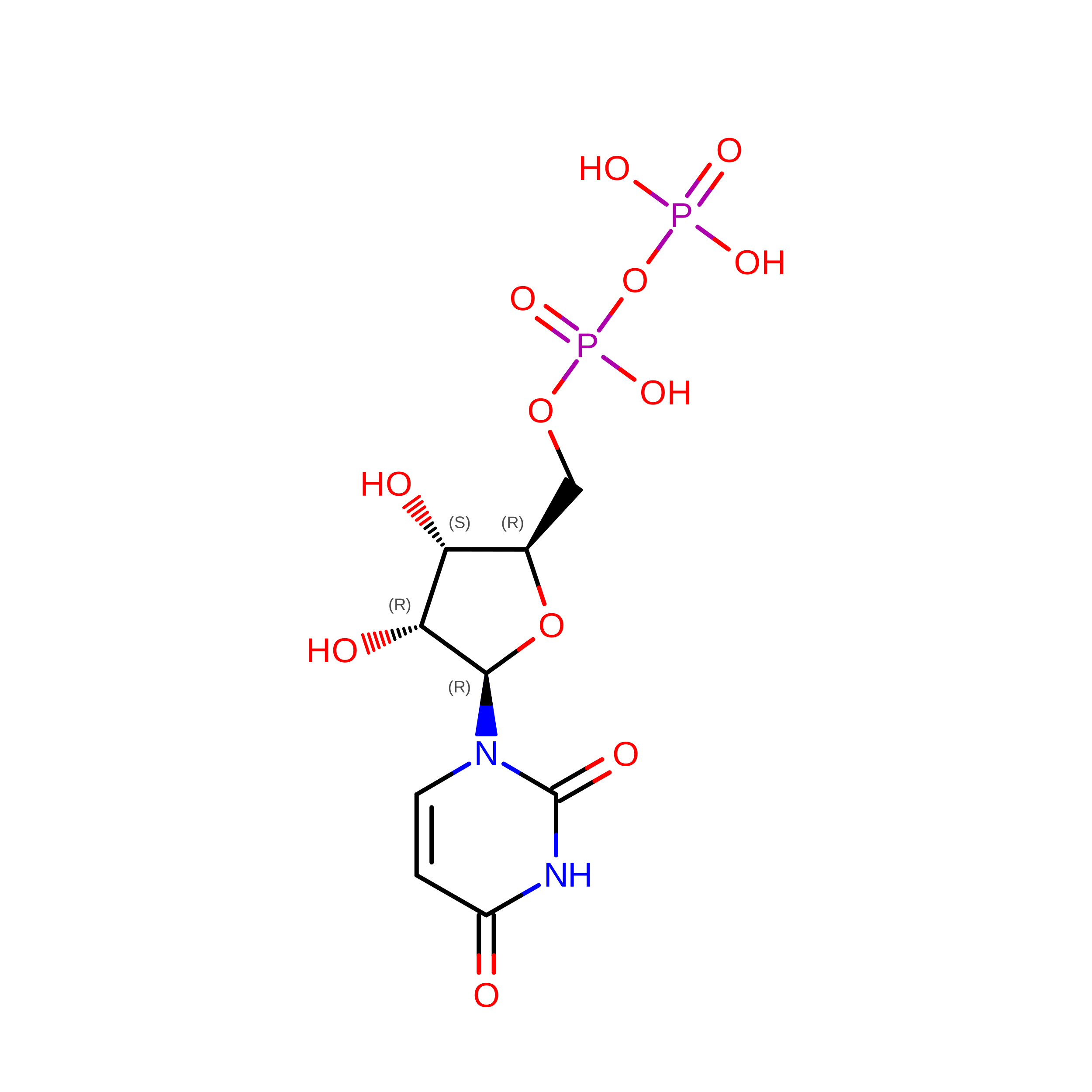
Phenylethanoid glycosides (PhGs) are a group of important natural products widely distributed in medicinal plants and known for their remarkable pharmacological properties. Uridine diphosphate (UDP) glycosyltransferase 79G15 (UGT79G15) from Rehmannia glutinosa catalyzes the conversion of osmanthuside A to osmanthuside B, a key intermediate in the PhG biosynthetic pathway, through the formation of a (1→3) glycosidic bond. In this study, we present the crystal structures of UGT79G15 in its apo form, UDP-bound form, and, notably, its ternary complex containing UDP and a mimic acceptor, forsythiaside A, within its active site. Structural and comparative analyses revealed that UGT79G15 possesses a distinctive funnel-shaped acceptor-binding pocket with a small auxiliary cavity capable of accommodating the 4'-hydroxycinnamoyl group of PhGs, explaining the enzyme's regiospecificity toward the 3'-OH of the acceptor. Additional structural examination and site-directed mutagenesis identified key residues that recognize and stabilize UDP-rhamnose and the sugar acceptor. Among the variants generated, I204W exhibits enhanced catalytic efficiency for osmanthuside A conversion, reaching up to 2.2-fold higher activity than the wild type. This study provides mechanistic insight into the donor specificity and acceptor regioselectivity of PhG 1,3-rhamnosyltransferase and expands the structural understanding of plant UGTs.
- National Key Laboratory of Chinese Medicine Modernization, State Key Laboratory of Component-Based Chinese Medicine, Tianjin University of Traditional Chinese Medicine, Tianjin 301617, China; Haihe Laboratory of Modern Chinese Medicine, Tianjin 301617, China.
Organizational Affiliation: