9Q0W | pdb_00009q0w

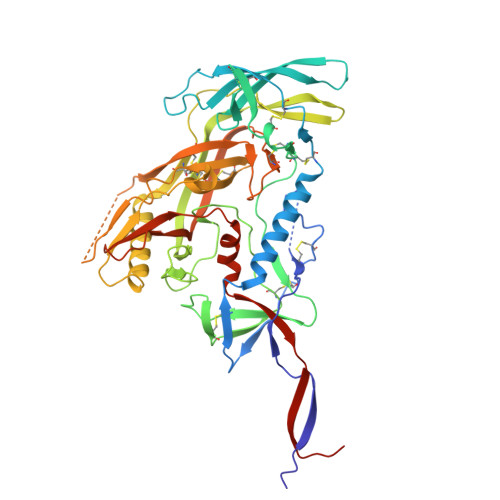
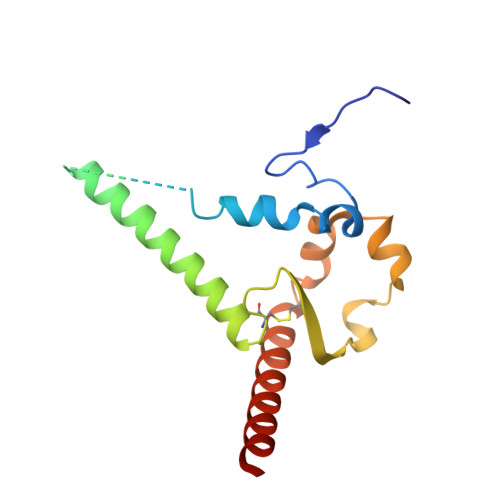
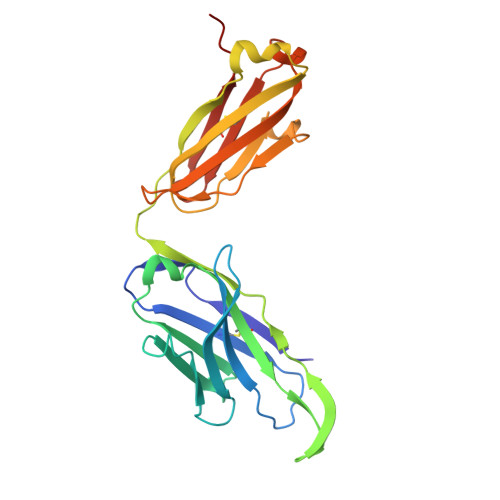
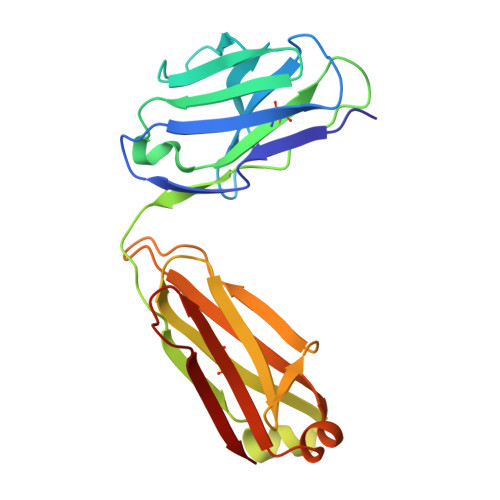
Cryo-EM Structure of HIV-1 BG505DS-SOSIP.664 Env Trimer Bound to DFPH-a.01_10R59P_LC Fab


Experimental Data Snapshot

  • Method: ELECTRON MICROSCOPY
  • Resolution: 3.00 Å
  • Aggregation State: PARTICLE 
  • Reconstruction Method: SINGLE PARTICLE 

wwPDB Validation 3D Report Full Report

Validation slider image for 9Q0W

This is version 1.0 of the entry. See complete history

Literature

Yeast Display Reveals Plentiful Mutations That Improve Fusion Peptide Vaccine-Elicited Antibodies Beyond 59% HIV-1 Neutralization Breadth.

Franca, C.T.Pletnev, S.Madan, B.Katsamba, P.S.McKee, K.Morano, N.C.Zhang, B.Bahna, F.Bylund, T.Lin, B.C.Louder, M.K.Mannepalli, S.Nimrania, R.O'Dell, S.Doria-Rose, N.A.Kwong, P.D.Shapiro, L.Sheng, Z.Zhou, T.DeKosky, B.J.

(2025) Vaccines (Basel) 13

  • DOI: https://doi.org/10.3390/vaccines13111098
  • Primary Citation Related Structures: 
    9Q0W

  • PubMed Abstract: 

    Background/Objectives : Vaccine elicitation of antibodies with high HIV-1 neutralization breadth is a long-standing goal. Recently, the induction of such antibodies has been achieved at the fusion peptide site of vulnerability. Questions remain, however, as to how much anti-fusion peptide antibodies can be improved and whether their neutralization breadth and potency are sufficient to prevent HIV-1 infection. Methods : Here, we use yeast display coupled with deep mutational screening and biochemical and structural analyses to study the improvement of the best fusion peptide-directed, vaccine-elicited antibody, DFPH_a.01, with an initial 59% breadth. Results : Yeast display identified both single and double mutations that improved recognition of HIV-1 envelope trimers. We characterized two paratope-distal light chain (LC) mutations, S10R and S59P, which together increased breadth to 63%. Biochemical analysis demonstrated DFPH-a.01_10R59P-LC, and its component mutations, to have increased affinity and stability. Cryo-EM structural analysis revealed elbow-angle influencing by S10R-LC and isosteric positioning by S59P-LC as explanations for enhanced breadth, affinity, and stability. Conclusions : These results, along with another antibody with enhanced performance (DFPH-a.01_1G10A56K-LC with 64% breadth), suggest that mutations improving DFPH_a.01 are plentiful, an important vaccine insight.


  • Organizational Affiliation
    • The Ragon Institute of Massachusetts General Hospital, Massachusetts Institute of Technology, and Harvard University, Cambridge, MA 02139, USA.

Macromolecule Content 

  • Total Structure Weight: 376.3 kDa 
  • Atom Count: 24,735 
  • Modeled Residue Count: 3,042 
  • Deposited Residue Count: 3,243 
  • Unique protein chains: 4

Macromolecules

Find similar proteins by:|  3D Structure
Entity ID: 1
MoleculeChains  Sequence LengthOrganismDetailsImage
HIV-1 BG505 DS-SOSIP gp120
A, C, E
481Human immunodeficiency virus 1Mutation(s): 0 
Gene Names: env
UniProt
Find proteins for Q2N0S6 (Human immunodeficiency virus type 1)
Explore Q2N0S6 
Go to UniProtKB:  Q2N0S6
Entity Groups
Sequence Clusters30% Identity50% Identity70% Identity90% Identity95% Identity100% Identity
UniProt GroupQ2N0S6
Glycosylation
Glycosylation Sites: 16
Sequence Annotations
Expand
Reference Sequence
Find similar proteins by:|  3D Structure
Entity ID: 2
MoleculeChains  Sequence LengthOrganismDetailsImage
BG505 DS-SOSIP GP41
B, D, F
153Human immunodeficiency virus 1Mutation(s): 2 
Gene Names: env
UniProt
Find proteins for Q2N0S5 (Human immunodeficiency virus type 1)
Explore Q2N0S5 
Go to UniProtKB:  Q2N0S5
Entity Groups
Sequence Clusters30% Identity50% Identity70% Identity90% Identity95% Identity100% Identity
UniProt GroupQ2N0S5
Sequence Annotations
Expand
Reference Sequence
Find similar proteins by:|  3D Structure
Entity ID: 3
MoleculeChains  Sequence LengthOrganismDetailsImage
DFPH-a.01_10R59P_LC Fab heavy chain
G, I, K
233MacacaMutation(s): 0 
Find similar proteins by:|  3D Structure
Entity ID: 4
MoleculeChains  Sequence LengthOrganismDetailsImage
DFPH-a.01_10R59P_LC Fab light chain
H, J, L
214MacacaMutation(s): 0 

Oligosaccharides

Help  
Entity ID: 5
MoleculeChains Length2D Diagram GlycosylationD Interactions
2-acetamido-2-deoxy-beta-D-glucopyranose-(1-4)-2-acetamido-2-deoxy-beta-D-glucopyranose
AA [auth Y],
BA [auth Z],
DA [auth d],
EA [auth e],
FA [auth f],
AA [auth Y],
BA [auth Z],
DA [auth d],
EA [auth e],
FA [auth f],
GA [auth g],
HA [auth h],
IA [auth i],
JA [auth j],
KA [auth k],
LA [auth l],
M [auth a],
N [auth M],
NA [auth n],
O [auth N],
OA [auth o],
P [auth O],
PA [auth p],
Q [auth P],
R [auth Q],
T [auth S],
U [auth T],
V [auth U],
W [auth c],
X [auth V],
Y [auth W],
Z [auth X]
2N-Glycosylation
Glycosylation Resources
GlyTouCan: G42666HT
GlyCosmos: G42666HT
GlyGen: G42666HT
Entity ID: 6
MoleculeChains Length2D Diagram GlycosylationD Interactions
alpha-D-mannopyranose-(1-2)-alpha-D-mannopyranose-(1-3)-beta-D-mannopyranose-(1-4)-2-acetamido-2-deoxy-beta-D-glucopyranose-(1-4)-2-acetamido-2-deoxy-beta-D-glucopyranoseCA [auth b],
MA [auth m],
S [auth R]
5N-Glycosylation
Glycosylation Resources
GlyTouCan: G42227JK
GlyCosmos: G42227JK
GlyGen: G42227JK

Small Molecules

Ligands 1 Unique
IDChains Name / Formula / InChI Key2D Diagram3D Interactions
NAG

Query on NAG


Download:Ideal Coordinates CCD File
AB [auth C]
BB [auth C]
CB [auth E]
DB [auth E]
EB [auth E]
AB [auth C],
BB [auth C],
CB [auth E],
DB [auth E],
EB [auth E],
FB [auth E],
GB [auth E],
HB [auth E],
QA [auth A],
RA [auth A],
SA [auth A],
TA [auth A],
UA [auth A],
VA [auth A],
WA [auth C],
XA [auth C],
YA [auth C],
ZA [auth C]
2-acetamido-2-deoxy-beta-D-glucopyranose
C8 H15 N O6
OVRNDRQMDRJTHS-FMDGEEDCSA-N

Experimental Data & Validation

Experimental Data

  • Method: ELECTRON MICROSCOPY
  • Resolution: 3.00 Å
  • Aggregation State: PARTICLE 
  • Reconstruction Method: SINGLE PARTICLE 
EM Software:
TaskSoftware PackageVersion
MODEL REFINEMENTPHENIX1.20
RECONSTRUCTIONcryoSPARC3.3

Structure Validation

View Full Validation Report


Entry History 

& Funding Information

Deposition Data


Funding OrganizationLocationGrant Number
National Institutes of Health/National Institute Of Allergy and Infectious Diseases (NIH/NIAID)United States--

Revision History  (Full details and data files)

  • Version 1.0: 2025-12-10
    Type: Initial release