Download Mendeley
A beta-lactamase inhibitory protein mutant displays high potency and a broad inhibition profile due to an altered binding mode with beta-lactamases.
Rivera, P., Lu, S., Ngango, D., Sankaran, B., Venkataram Prasad, B., Palzkill, T.(2025) J Biol Chem 301: 110850-110850
- PubMed: 41135675 Search on PubMedSearch on PubMed Central
- DOI: https://doi.org/10.1016/j.jbc.2025.110850
- Primary Citation Related Structures:
9Q0A, 9Q0B, 9Q0C - PubMed Abstract:
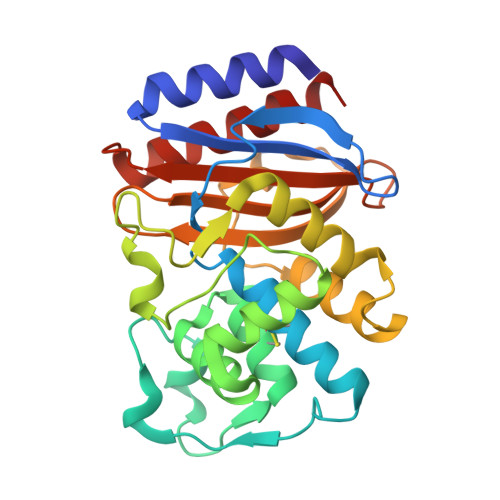
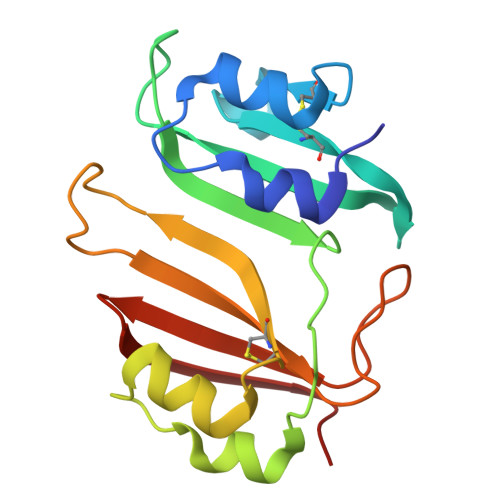
β-lactamase enzymes inactivate β-lactam antibiotics, leading to drug resistance. The β-lactamase inhibitory protein (BLIP) is a naturally occurring inhibitor of β-lactamases, with inhibition constants (K i ) ranging from picomolar to micromolar values. For example, BLIP inhibits CTX-M-14 β-lactamase with a K i of 330 nM, whereas the K i for CTX-M-15 is 3 nM, despite CTX-M-14 and CTX-M-15 sharing 83% sequence identity. We used a genetic screen to identify a BLIP mutant, E73W, that potently inhibited CTX-M-14. Subsequent purification and testing of BLIP E73W revealed that it is a potent, broad-spectrum inhibitor of class A β-lactamases. We determined structures of BLIP E73W in complex with the CTX-M-14, CTX-M-15, and TEM-1 β-lactamases to investigate the basis of the broad-spectrum inhibition. Previous structures of BLIP in complex with several class A β-lactamases revealed that β-lactamase active site residue Tyr105 is found in an altered rotamer conformation. Also, in the case of the BLIP-CTX-M-15 complex, an altered conformation of the active site 103 to 106 loop is observed. In contrast, the BLIP E73W-β-lactamase complexes did not show the altered conformations of Tyr105 or the 103 to 106 loop. Instead, the mutant's mechanism involves BLIP Trp73 trapping Tyr105 against the wall of the active site in a similar conformation as in the apoenzyme. Interestingly, the E73W mutant binds the apo-enzyme conformation in all the BLIP E73W-β-lactamase complexes. Binding to the apo-enzyme conformation, which is expected to be highly populated in solution, as well as enhanced hydrophobic interactions of Trp73 with β-lactamases are possible explanations for the high potency and broad-spectrum inhibition.
- Verna and Marrs McLean Department of Biochemistry and Molecular Pharmacology, Baylor College of Medicine, Houston, Texas, USA.
Organizational Affiliation: