Download Mendeley
Structural basis of sodium ion-dependent carnitine transport by OCTN2.
Davies, J.S., Zeng, Y.C., Briot, C., Brown, S.H.J., Ryan, R.M., Stewart, A.G.(2025) Nat Commun 17: 181-181
- PubMed: 41318751 Search on PubMedSearch on PubMed Central
- DOI: https://doi.org/10.1038/s41467-025-66867-6
- Primary Citation Related Structures:
9PDQ, 9PFB, 9PMD - PubMed Abstract:
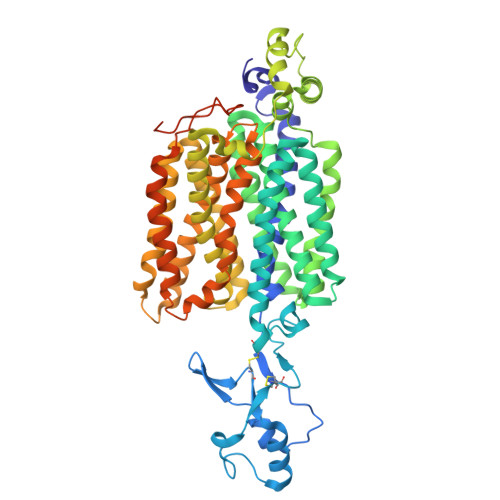
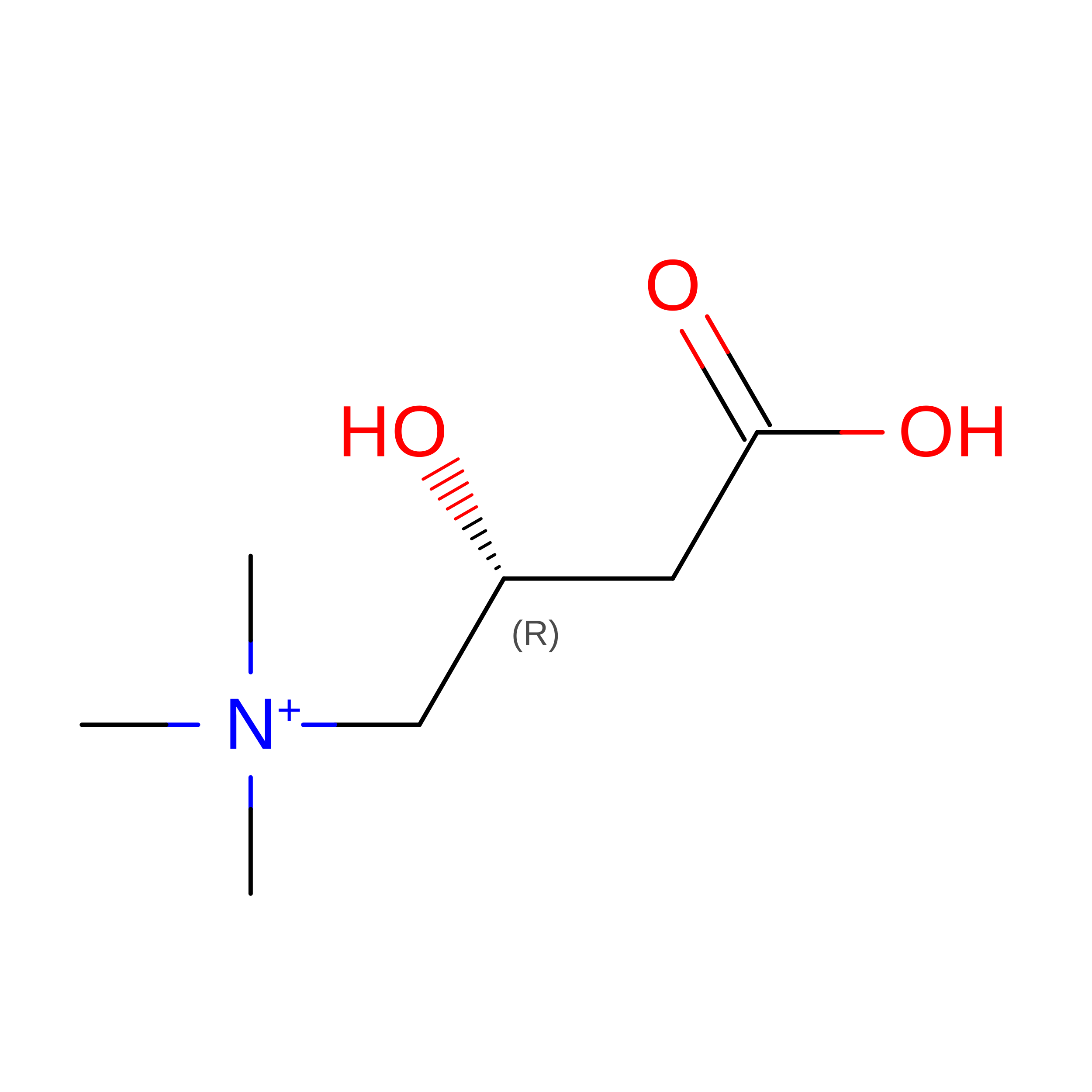
Carnitine is essential for the import of long-chain fatty acids into mitochondria, where they are used for energy production. The carnitine transporter OCTN2 (novel organic cation transporter 2, SLC22A5) mediates carnitine uptake across the plasma membrane and as such facilitates fatty acid metabolism in most tissues. OCTN2 dysfunction causes systemic primary carnitine deficiency (SPCD), a potentially lethal disorder. Despite its importance in metabolism, the mechanism of high-affinity, sodium ion-dependent transport by OCTN2 is unclear. Here we report cryo-EM structures of human OCTN2 in three conformations: inward-facing ligand-free, occluded carnitine- and Na + -bound, and inward-facing ipratropium-bound. These structures define key interactions responsible for carnitine transport and identify an allosterically coupled Na + binding site housed within an aqueous cavity, separate from the carnitine-binding site. Combined with electrophysiology data, we provide a framework for understanding variants associated with SPCD and insight into how OCTN2 functions as the primary human carnitine transporter.
- Molecular, Structural and Computational Biology Division, The Victor Chang Cardiac Research Institute, Darlinghurst, NSW, Australia.
Organizational Affiliation: