9NLV | pdb_00009nlv

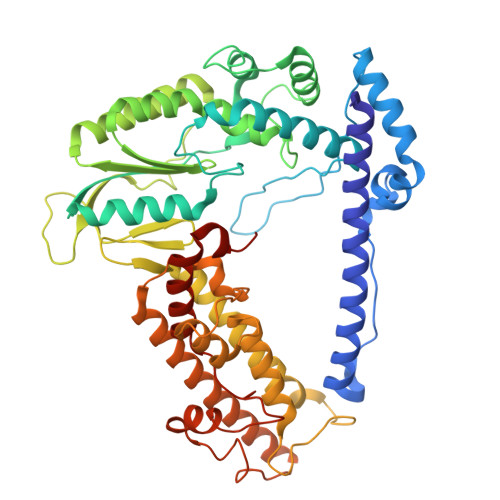
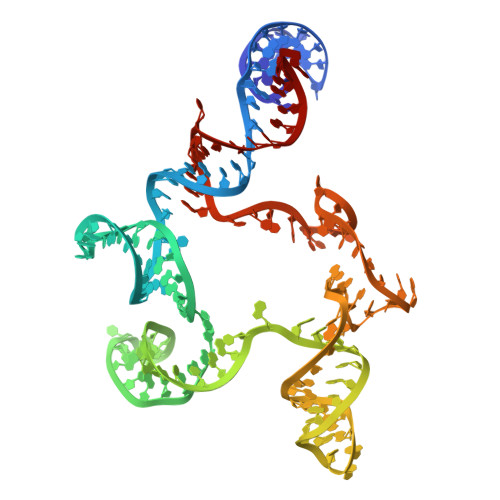
Cryo-EM structure of hexameric SenDRT9 RT-ncRNA complex


Experimental Data Snapshot

  • Method: ELECTRON MICROSCOPY
  • Resolution: 2.60 Å
  • Aggregation State: PARTICLE 
  • Reconstruction Method: SINGLE PARTICLE 

Starting Model: in silico
View more details

wwPDB Validation   3D Report Full Report


This is version 2.0 of the entry. See complete history


Literature

Protein-primed homopolymer synthesis by an antiviral reverse transcriptase.

Tang, S.Zedaveinyte, R.Burman, N.Pandey, S.Ramirez, J.L.Kulber, L.M.Wiegand, T.Wilkinson, R.A.Ma, Y.Zhang, D.J.Lampe, G.D.Berisa, M.Jovanovic, M.Wiedenheft, B.Sternberg, S.H.

(2025) Nature 643: 1352-1362

  • DOI: https://doi.org/10.1038/s41586-025-09179-5
  • Primary Citation of Related Structures:  
    9NLV, 9NLX

  • PubMed Abstract: 

    Bacteria defend themselves from viral predation using diverse immune systems, many of which target foreign DNA for degradation 1 . Defense-associated reverse transcriptase (DRT) systems provide an intriguing counterpoint to this strategy by leveraging DNA synthesis instead 2,3 . We and others recently showed that DRT2 systems use an RNA template to assemble a de novo gene that encodes an antiviral effector protein, Neo 4,5 . It remains unknown whether similar mechanisms of defense are employed by other related DRT families. Focusing on DRT9, here we uncover an unprecedented mechanism of DNA homopolymer synthesis. Viral infection triggers polydeoxyadenylate (poly-dA) accumulation in the cell, driving abortive infection and population-level immunity. Cryo-EM structures reveal how a noncoding RNA serves as both a structural scaffold and reverse transcription template to direct hexameric complex assembly and poly-dA synthesis. Remarkably, biochemical and functional experiments identify tyrosine residues within the reverse transcriptase itself that likely prime DNA synthesis, leading to the formation of high-molecular weight protein-DNA covalent adducts. Synthesis of poly-dA by DRT9 in vivo is regulated by the competing activities of phage-encoded triggers and host-encoded silencers. Collectively, our work unveils a novel nucleic acid-driven defense system that expands the paradigm of bacterial immunity and broadens the known functions of reverse transcriptases.


  • Organizational Affiliation
    • Department of Biochemistry and Molecular Biophysics, Columbia University, New York, NY, USA.

Macromolecules

Find similar proteins by:  (by identity cutoff)  |  3D Structure
Entity ID: 1
MoleculeChains Sequence LengthOrganismDetailsImage
RNA-dependent DNA polymerase
A, B, C, D, E
A, B, C, D, E, F
499Escherichia coliMutation(s): 0 
Gene Names: GQA06_05700
UniProt
Find proteins for A0A6D0I497 (Escherichia coli)
Explore A0A6D0I497 
Go to UniProtKB:  A0A6D0I497
Entity Groups  
Sequence Clusters30% Identity50% Identity70% Identity90% Identity95% Identity100% Identity
UniProt GroupA0A6D0I497
Sequence Annotations
Expand
  • Reference Sequence
Find similar nucleic acids by:  (by identity cutoff)  |  3D Structure
Entity ID: 2
MoleculeChains LengthOrganismImage
RNA (147-MER)
G, H, I, J, K
G, H, I, J, K, L
147Salmonella enterica
Sequence Annotations
Expand
  • Reference Sequence
Experimental Data & Validation

Experimental Data

  • Method: ELECTRON MICROSCOPY
  • Resolution: 2.60 Å
  • Aggregation State: PARTICLE 
  • Reconstruction Method: SINGLE PARTICLE 
EM Software:
TaskSoftware PackageVersion
MODEL REFINEMENTPHENIX1.21.2_5419:
RECONSTRUCTIONcryoSPARC4.6.2

Structure Validation

View Full Validation Report


Entry History & Funding Information

Deposition Data


Funding OrganizationLocationGrant Number
National Institutes of Health/National Institute of General Medical Sciences (NIH/NIGMS)United StatesR35GM134867
National Science Foundation (NSF, United States)United States2239685

Revision History  (Full details and data files)

  • Version 1.0: 2025-05-14
    Type: Initial release
  • Version 1.1: 2025-06-04
    Changes: Data collection, Database references
  • Version 1.2: 2025-06-11
    Changes: Data collection, Database references
  • Version 2.0: 2025-08-13
    Type: Coordinate replacement
    Reason: Model completeness
    Changes: Advisory, Atomic model, Data collection, Data processing, Database references, Derived calculations, Polymer sequence, Refinement description, Source and taxonomy, Structure summary