Download Mendeley
Structural basis of RNA-guided transcription by a dCas12f-sigma E -RNAP complex.
Xiao, R., Hoffmann, F.T., Xie, D., Wiegand, T., Palmieri, A.I., Sternberg, S.H., Chang, L.(2026) Nature 653: 288-296
- PubMed: 41781609 Search on PubMedSearch on PubMed Central
- DOI: https://doi.org/10.1038/s41586-026-10178-3
- Primary Citation Related Structures:
9N9C, 9N9M, 9N9O, 9N9P, 9N9Q - PubMed Abstract:
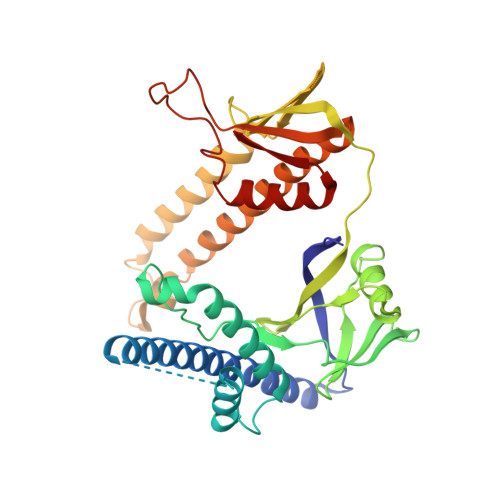
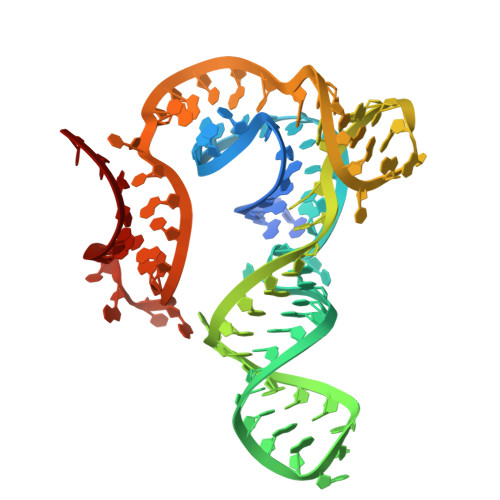
In both natural and engineered biological systems, RNA-guided proteins have emerged as critical transcriptional regulators by modulating RNA polymerase (RNAP) and its associated factors 1-3 . In bacteria, diverse clades of repurposed TnpB and CRISPR-associated proteins repress gene expression by blocking transcription initiation or elongation, enabling non-canonical modes of regulatory control and adaptive immunity 1,4,5 . A distinct class of nuclease-dead Cas12f homologues (dCas12f) instead activates gene expression through its association with unique extracytoplasmic function sigma factors (σ E ) 6 , although the molecular basis has remained elusive. Here we reveal a new mode of RNA-guided transcription initiation by determining the cryo-electron microscopy structures of the dCas12f-σ E system from Flagellimonas taeanensis. We captured multiple conformational and compositional states, including the DNA-bound dCas12f-σ E -RNAP holoenzyme complex, revealing how RNA-guided DNA binding leads to σ E -RNAP recruitment and nascent mRNA synthesis at a precisely defined distance downstream of the R-loop. Rather than following the classical paradigm of σ E -dependent promoter recognition, these studies show that recognition of the -35 element is largely supplanted by CRISPR-Cas targeting, whereas the melted -10 element is stabilized through unusual stacking interactions rather than insertion into the typical recognition pocket. Collectively, this work provides high-resolution insights into an unexpected mechanism of RNA-guided transcription, expanding our understanding of bacterial gene regulation and opening new avenues for programmable transcriptional control.
- Department of Biological Sciences, Purdue University, West Lafayette, IN, USA.
Organizational Affiliation: