9MOJ | pdb_00009moj

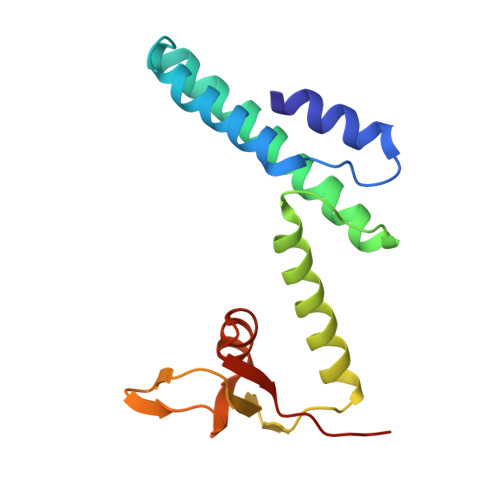
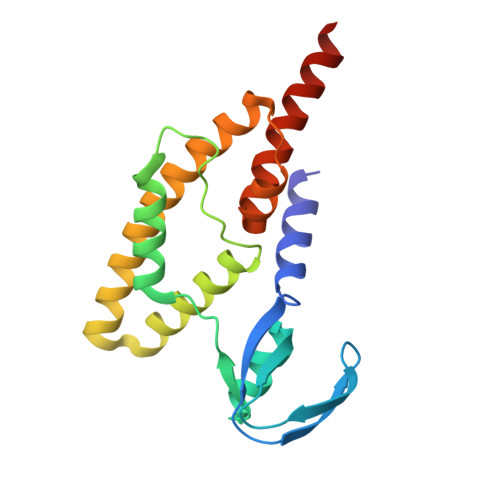
Saccharolobus solfataricus GINS tetramer


Experimental Data Snapshot

  • Method: X-RAY DIFFRACTION
  • Resolution: 2.30 Å
  • R-Value Free: 
    0.243 (Depositor), 0.243 (DCC) 
  • R-Value Work: 
    0.220 (Depositor), 0.220 (DCC) 
  • R-Value Observed: 
    0.221 (Depositor) 

Starting Models: in silico
View more details

wwPDB Validation 3D Report Full Report

Validation slider image for 9MOJ

This is version 1.1 of the entry. See complete history

Literature

Structure of the Saccharolobus solfataricus GINS tetramer.

Shankar, S.Enemark, E.J.

(2025) Acta Crystallogr F Struct Biol Commun 81: 207-215

  • DOI: https://doi.org/10.1107/S2053230X25003085
  • Primary Citation Related Structures: 
    9MOJ

  • PubMed Abstract: 

    DNA replication is tightly regulated to ensure genomic stability and prevent several diseases, including cancers. Eukaryotes and archaea partly achieve this regulation by strictly controlling the activation of hexameric minichromosome maintenance (MCM) helicase rings that unwind DNA during its replication. In eukaryotes, MCM activation critically relies on the sequential recruitment of the essential factors Cdc45 and a tetrameric GINS complex at the onset of the S-phase to generate a larger CMG complex. We present the crystal structure of the tetrameric GINS complex from the archaeal organism Saccharolobus solfataricus (Sso) to reveal a core structure that is highly similar to the previously determined GINS core structures of other eukaryotes and archaea. Using molecular modeling, we illustrate that a subdomain of SsoGINS would need to move to accommodate known interactions of the archaeal GINS complex and to generate a SsoCMG complex analogous to that of eukaryotes.


  • Organizational Affiliation
    • Department of Biochemistry and Molecular Biology, University of Arkansas for Medical Sciences, 4301 West Markham Street, Slot 516, Little Rock, AR 72205, USA.

Macromolecule Content 

  • Total Structure Weight: 76.97 kDa 
  • Atom Count: 5,309 
  • Modeled Residue Count: 646 
  • Deposited Residue Count: 660 
  • Unique protein chains: 2

Macromolecules

Find similar proteins by:|  3D Structure
Entity ID: 1
MoleculeChains  Sequence LengthOrganismDetailsImage
SsoGINS51
A, B
151Saccharolobus solfataricus P2Mutation(s): 0 
Gene Names: SSO1049
UniProt
Find proteins for Q97Z82 (Saccharolobus solfataricus (strain ATCC 35092 / DSM 1617 / JCM 11322 / P2))
Explore Q97Z82 
Go to UniProtKB:  Q97Z82
Entity Groups
Sequence Clusters30% Identity50% Identity70% Identity90% Identity95% Identity100% Identity
UniProt GroupQ97Z82
Sequence Annotations
Expand
Reference Sequence
Find similar proteins by:|  3D Structure
Entity ID: 2
MoleculeChains  Sequence LengthOrganismDetailsImage
GINS subunit domain-containing protein
C, D
179Saccharolobus solfataricus P2Mutation(s): 0 
Gene Names: Ssol_1833
UniProt
Find proteins for Q7LXJ7 (Saccharolobus solfataricus (strain ATCC 35092 / DSM 1617 / JCM 11322 / P2))
Explore Q7LXJ7 
Go to UniProtKB:  Q7LXJ7
Entity Groups
Sequence Clusters30% Identity50% Identity70% Identity90% Identity95% Identity100% Identity
UniProt GroupQ7LXJ7
Sequence Annotations
Expand
Reference Sequence

Experimental Data & Validation

Experimental Data

  • Method: X-RAY DIFFRACTION
  • Resolution: 2.30 Å
  • R-Value Free:  0.243 (Depositor), 0.243 (DCC) 
  • R-Value Work:  0.220 (Depositor), 0.220 (DCC) 
  • R-Value Observed: 0.221 (Depositor) 
Space Group: P 63
Unit Cell:
Length ( Å )Angle ( ˚ )
a = 180.236α = 90
b = 180.236β = 90
c = 51.203γ = 120
Software Package:
Software NamePurpose
PHENIXrefinement
HKL-2000data reduction
HKL-2000data scaling
PHASERphasing

Structure Validation

View Full Validation Report


Entry History 

& Funding Information

Deposition Data


Funding OrganizationLocationGrant Number
National Institutes of Health/National Institute of General Medical Sciences (NIH/NIGMS)United StatesR35GM136313
National Institutes of Health/National Institute of General Medical Sciences (NIH/NIGMS)United StatesP20GM152281

Revision History  (Full details and data files)

  • Version 1.0: 2025-04-23
    Type: Initial release
  • Version 1.1: 2025-05-07
    Changes: Database references