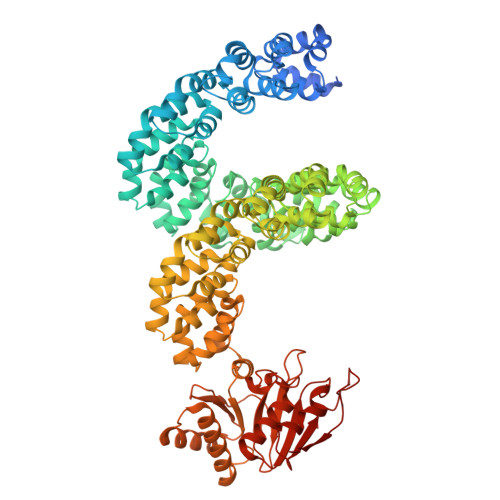
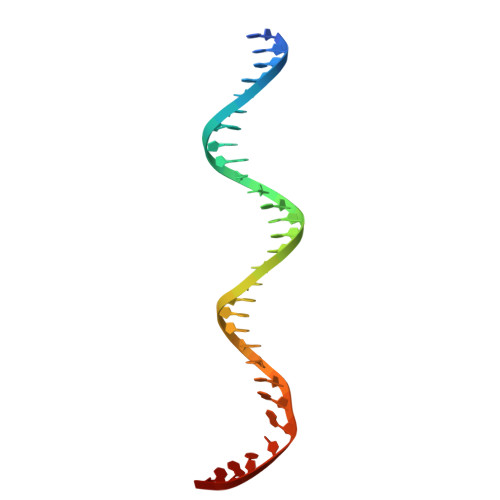
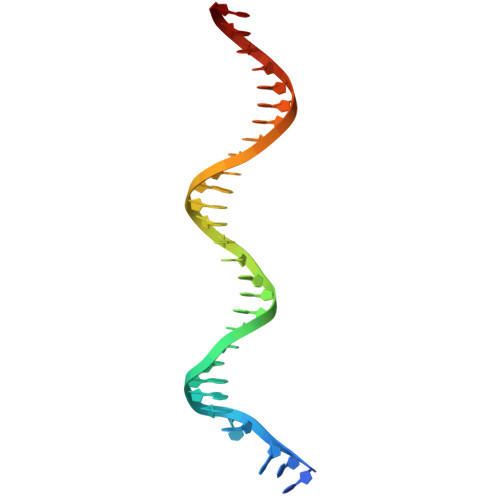
9LCZ | pdb_00009lcz

Inactivate TOD6 with GC DNA substrate


Experimental Data Snapshot

  • Method: ELECTRON MICROSCOPY
  • Resolution: 2.93 Å
  • Aggregation State: PARTICLE 
  • Reconstruction Method: SINGLE PARTICLE 

wwPDB Validation 3D Report Full Report

Validation slider image for 9LCZ

This is version 1.3 of the entry. See complete history. 

Literature

Computational design of a high-precision mitochondrial DNA cytosine base editor.

Mi, L., Li, Y.X., Lv, X., Wan, Z.L., Liu, X., Zhang, K., Li, H., Yao, Y., Zhang, L., Xu, Z., Zhuang, X., Ji, K., Jiang, M., Wang, Y., Lu, P.

(2025) Nat Struct Mol Biol 32: 2575-2586

  • DOI: https://doi.org/10.1038/s41594-025-01714-2
  • Primary Citation Related Structures: 
    9LCX, 9LCY, 9LCZ, 9LD0, 9LD1

  • PubMed Abstract: 

    Bystander editing remains a major limitation of current base editors, hindering their precision and therapeutic potential. Here, we present a de novo protein design strategy that creates a structurally rigid interface between a DNA-binding TALE domain and a cytosine deaminase, forming a unified editing module termed TALE-oriented deaminase (TOD). Cryo-EM analysis of TOD-DNA complexes confirms that this precise spatial architecture tightly restricts the deaminase activity window, thereby minimizing unwanted deamination. To further enhance editing specificity, we develop a split version, termed DdCBE-TOD, which virtually eliminates off-target editing. As a proof of concept, we apply DdCBE-TOD to generate a mitochondrial disease mouse model and to correct a pathogenic mutation associated with MERRF syndrome in patient-derived cells, achieving single-nucleotide precision. This work introduces a generalizable and computationally guided approach for ultra-precise base editing, offering a promising platform for both mechanistic studies and therapeutic correction of single-nucleotide mutations.


  • Organizational Affiliation: 
    • State Key Laboratory of Gene Expression, Research Center for Industries of the Future, School of Life Sciences, Westlake University, Hangzhou, China.

Macromolecule Content 

  • Total Structure Weight: 112.36 kDa 
  • Atom Count: 7,331 
  • Modeled Residue Count: 892 
  • Deposited Residue Count: 947 
  • Unique protein chains: 1
  • Unique nucleic acid chains: 2

Macromolecules


Find similar proteins by:|  3D Structure
Entity ID: 1
MoleculeChains  Sequence LengthOrganismDetailsImage
Inactivate TOD6885XanthomonasMutation(s): 0 
Entity Groups
Sequence Clusters30% Identity50% Identity70% Identity90% Identity95% Identity100% Identity
Sequence Annotations
Expand
Reference Sequence
Find similar nucleic acids by:  (by identity cutoff) 
Entity ID: 2
MoleculeChains LengthOrganismImage
GC DNA substrate forward strand31synthetic construct
Sequence Annotations
Expand
Reference Sequence
Find similar nucleic acids by:  (by identity cutoff) 
Entity ID: 3
MoleculeChains LengthOrganismImage
GC DNA substrate reverse strand31synthetic construct
Sequence Annotations
Expand
Reference Sequence

Small Molecules

Experimental Data & Validation

Experimental Data

  • Method: ELECTRON MICROSCOPY
  • Resolution: 2.93 Å
  • Aggregation State: PARTICLE 
  • Reconstruction Method: SINGLE PARTICLE 
EM Software:
TaskSoftware PackageVersion
MODEL REFINEMENTPHENIX1.21.2_5419:
RECONSTRUCTIONcryoSPARCv4.2.1

Structure Validation

View Full Validation Report


Entry History 

& Funding Information

Deposition Data


Funding OrganizationLocationGrant Number
Ministry of Science and Technology (MoST, China)China2020YFA0909200
Ministry of Education (MoE, China)China2024M762947

Revision History  (Full details and data files)

  • Version 1.0: 2025-11-19
    Type: Initial release
  • Version 1.1: 2025-11-26
    Changes: Data collection, Database references
  • Version 1.2: 2025-12-03
    Changes: Data collection, Database references
  • Version 1.3: 2025-12-31
    Changes: Data collection, Database references