Download Mendeley
A new family of StnC-like pseudo-FMN-preferred reductase components in two-component flavoprotein monooxygenases.
Xie, X., Wang, X., Yang, X., Ji, S., Ouyang, X., Zhou, Z., Xiao, Z., Guo, W., Liang, R., Huang, T., Deng, Z., Zhao, Y.L., Lin, S.(2025) Int J Biol Macromol 328: 147543-147543
- PubMed: 40935041 Search on PubMed
- DOI: https://doi.org/10.1016/j.ijbiomac.2025.147543
- Primary Citation Related Structures:
9L10, 9L11 - PubMed Abstract:
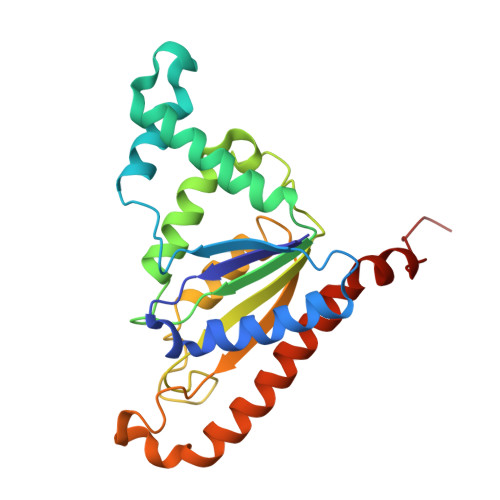
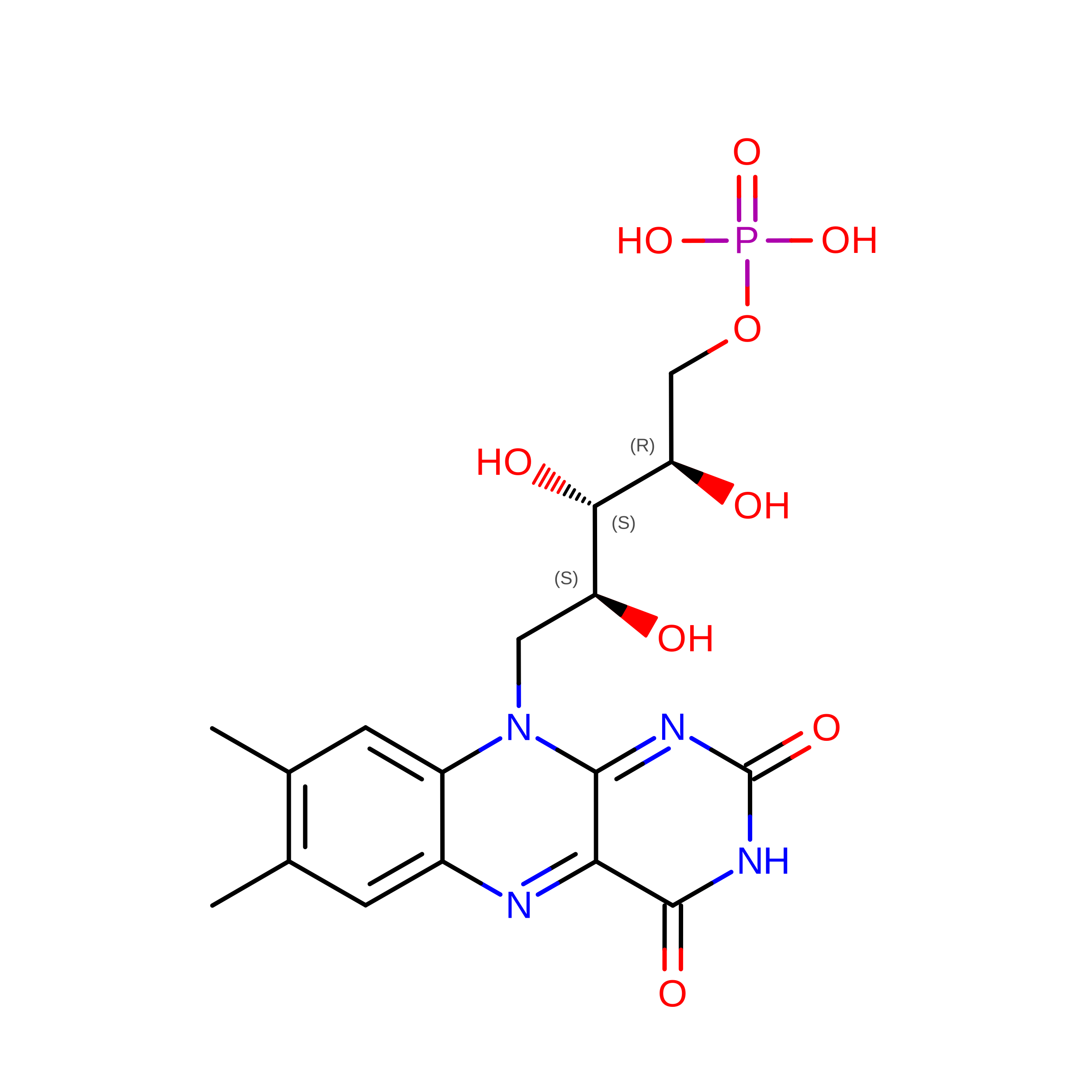
The reductase components of two-component flavoprotein monooxygenases (FPMOs) can reduce flavin mononucleotide (FMN) or flavin adenine dinucleotide (FAD) for their monooxygenase partners. Typically, the type of flavin cofactor bound by a flavoenzyme dictates the cofactor applied in its catalytic reactions. Here, we report the discovery of StnC, a previously unknown reductase family member involved in the biosynthesis of streptonigrin, a potent antimicrobial and antitumor compound. StnC exhibits a paradoxical performance in binding ability and catalytic activity toward flavins. Specifically, it binds FMN 147-fold stronger than FAD, but reduces FAD six times faster than FMN, enabling it to supply reduced FAD to its FAD-preferred monooxygenase partner StnD efficiently. Crystallographic, computational, and structural comparative analyses identified key residues and distinct structural features in StnC-like reductases, including extended clamp-like loops, that enable tight FMN binding and efficient FAD reduction. These features define a family of FAD-preferred reductases under physiological conditions. Our findings significantly broaden the understanding of the sequence-structure-function relationships in FPMO reductase components, uncover a structurally unique family of FAD-preferred reductases, and provide mechanistic insights into their coordination with monooxygenase partners.
- State Key Laboratory of Microbial Metabolism, School of Life Sciences and Biotechnology, Shanghai Jiao Tong University, Shanghai, China.
Organizational Affiliation: