Download Mendeley
Structures of Polyhydroxyalkanoate Synthase PhaC from Aeromonas caviae, Producing Biodegradable Plastics.
Chek, M.F., Kim, S.Y., Mori, T., Matsumoto, K., Sato, S., Hakoshima, T.(2025) Angew Chem Int Ed Engl 64: e202504626-e202504626
- PubMed: 40276819 Search on PubMed
- DOI: https://doi.org/10.1002/anie.202504626
- Primary Citation Related Structures:
9KNJ, 9KNK, 9KNL - PubMed Abstract:
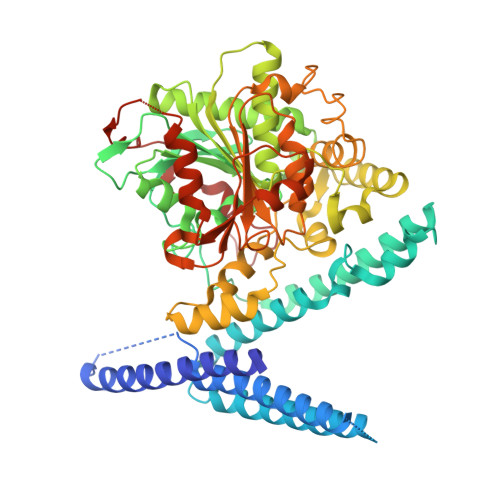
Polyhydroxyalkanoate (PHA) is a biodegradable polyester that can serve as a promising alternative to petrochemical plastics, which present a serious source of pollution. PHA synthase (PhaC) is a key enzyme responsible for producing a wide variety of PHAs in microorganisms. Here, we present crystal structures of full-length PhaC from Aeromonas caviae, a high-performance PhaC employed for industrial use. The structure reveals an N-terminal helical domain that mediates head-to-head dimerization and stabilizes the C-terminal α/β catalytic domain to form a tunnel that connects the catalytic center embedded inside the protein to the protein surface. We showed that this tunnel is a putative egress tunnel for the product PHA chain. Our results establish a fundamental understanding of the PhaC machinery that should lead to improvement of this enzyme in industrial applications.
- Structural Biology and Protein Engineering Laboratory, Institute for Research Initiatives, Nara Institute of Science and Technology, 8916-5 Takayama, Ikoma, Nara, 630-0192, Japan.
Organizational Affiliation: