Download Mendeley
A critical residue in a conserved RBD epitope determines neutralization breadth of pan-sarbecovirus antibodies with recurring YYDRxxG motifs.
Stein, S.C., Ssebyatika, G., Benecke, T., Stroh, L., Rajak, M.K., Vollmer, B., Menz, S., Waldmann, J.-.Y., Tipp, S.N., Ochulor, O., Herold, E., Schwarzloh, B., Mutschall, D., Zischke, J., Schneider, T., Hinrichs, I., Blasczyk, R., Kleine-Weber, H., Hoffmann, M., Klein, F., Kaiser, F.K., Gonzalez-Hernandez, M., Armando, F., Ciurkiewicz, M., Beythien, G., Pohlmann, S., Baumgartner, W., Gruenewald, K., Osterhaus, A., Schulz, T.F., Krey, T., Hansen, G.(2025) mBio 16: e0060625-e0060625
- PubMed: 40742150 Search on PubMedSearch on PubMed Central
- DOI: https://doi.org/10.1128/mbio.00606-25
- Primary Citation Related Structures:
9H6U - PubMed Abstract:
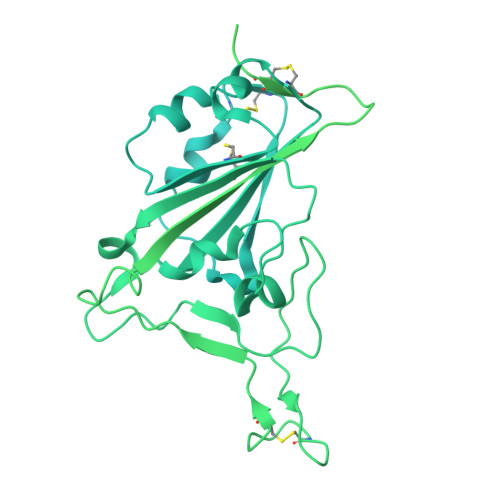
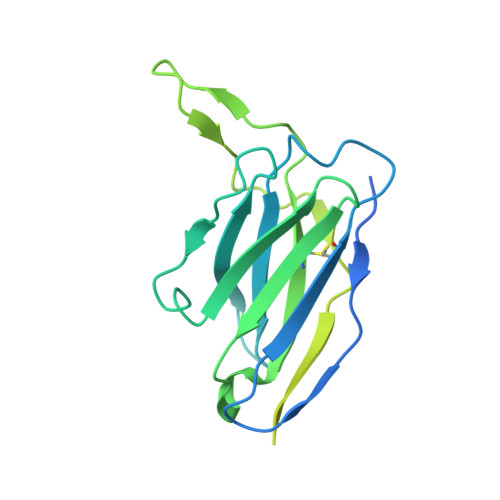
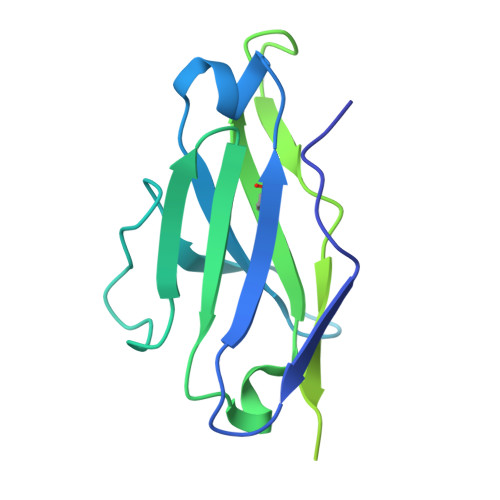
The emergence of pandemic coronaviruses remains a global health concern, highlighting the need for broadly neutralizing antibodies (bnAbs) that can target multiple sarbecoviruses. In this study, we isolated and characterized a novel antibody, pT1679, that demonstrates exceptional neutralization breadth. The antibody prevented infection with SARS-CoV-2 variants of concern, such as Omicron BA.1, and effectively neutralized pseudotyped viruses displaying S proteins from many SARS-CoV-2 variants and various bat and pangolin sarbecoviruses, including both SARS-CoV-like and SARS-CoV-2-like viruses. In addition, pT1679 reduced the viral load in the lung of infected Syrian hamsters and prevented the severe lung pathology typical for SARS-CoV-2 infections. The cryo-electron microscopy structure of pT1679 in complex with SARS-CoV-2 S revealed that the antibody employs a YYDRxxG motif to recognize a highly conserved epitope on the RBD. Through detailed structural analysis, mutagenesis studies, and binding assays, we identified RBD residue 384 as a critical determinant of antibody recognition. Structure-function analyses of several related bnAbs, such as COVA1-16, allowed for the classification of YYDRxxG antibodies into two distinct groups that differ in neutralization breadth. Our findings provide crucial insights into the molecular basis of broad Sarbecovirus neutralization and offer strategic guidance for selecting therapeutic antibodies in preparation for future Sarbecovirus outbreaks.IMPORTANCEThe threat of emerging coronaviruses demands therapeutic strategies capable of targeting both current and future circulating viruses. We report the discovery and characterization of pT1679, a broadly neutralizing antibody that demonstrates cross-reactivity against diverse sarbecoviruses, including SARS-CoV, SARS-CoV-2 variants, and related viruses from bats and pangolins. pT1679 targets a highly conserved epitope via a YYDRxxG motif in the paratope, with RBD residue 384 serving as a critical determinant of recognition. Our analysis allows for a classification of YYDRxxG antibodies, providing a framework for predicting antibody effectiveness against emerging sarbecoviruses.
- Institute of Virology, Hannover Medical School, Hannover, Germany.
Organizational Affiliation: