9G13 | pdb_00009g13

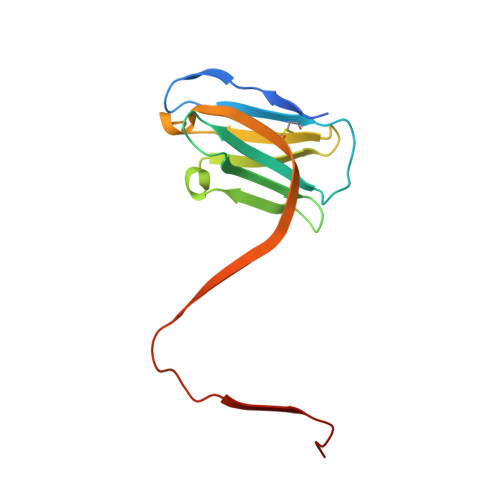
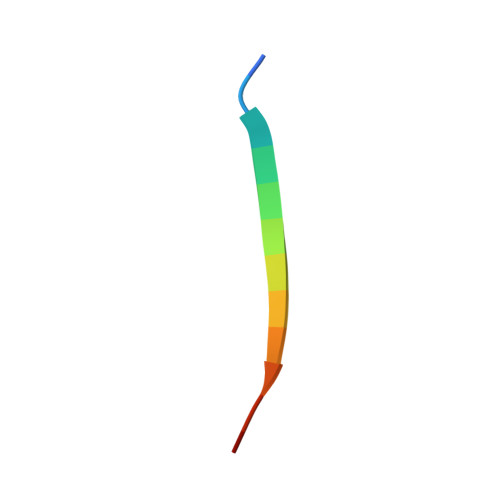
VHH H3-2 in complex with Tau C-terminal peptide


Experimental Data Snapshot

  • Method: X-RAY DIFFRACTION
  • Resolution: 1.80 Å
  • R-Value Free: 
    0.231 (Depositor), 0.240 (DCC) 
  • R-Value Work: 
    0.172 (Depositor) 

Starting Model: experimental
View more details

wwPDB Validation 3D Report Full Report

Validation slider image for 9G13

This is version 1.2 of the entry. See complete history

Literature

Inhibition of tau neuronal internalization using anti-tau single domain antibodies.

Danis, C.Dupre, E.Bouillet, T.Denechaud, M.Lefebvre, C.Nguyen, M.Mortelecque, J.Cantrelle, F.X.Rain, J.C.Hanoulle, X.Colin, M.Buee, L.Landrieu, I.

(2025) Nat Commun 16: 3162-3162

  • DOI: https://doi.org/10.1038/s41467-025-58383-4
  • Primary Citation Related Structures: 
    9G13

  • PubMed Abstract: 

    In Alzheimer's disease, tau pathology spreads across brain regions as the disease progresses. Intracellular tau can be released and taken up by nearby neurons. We evaluated single domain anti-tau antibodies, also called VHHs, as inhibitors of tau internalization. We identified three VHH inhibitors of tau uptake: A31, H3-2, and Z70 mut1 . These VHHs compete with the membrane protein LRP1, a major receptor mediating neuronal uptake of tau. A31 and Z70 mut1 bind to microtubule binding domain repeats, which are involved in the interaction with LRP1. VHH H3-2 is the only VHH from our library that reduces the internalization of both monomeric tau and tau fibrils. VHH H3-2 binds a C-terminal tau epitope with high affinity. Its three-dimensional structure in complex with a tau peptide reveals a unique binding mode as a VHH-swapped dimer. These anti-tau VHHs are interesting tools to study tau prion-like propagation in tauopathies and potentially develop novel biotherapies.


  • Organizational Affiliation
    • CNRS EMR9002 - BSI - Integrative Structural Biology, Lille, France. clement.danis@inserm.fr.

Macromolecule Content 

  • Total Structure Weight: 63.68 kDa 
  • Atom Count: 4,715 
  • Modeled Residue Count: 551 
  • Deposited Residue Count: 580 
  • Unique protein chains: 2

Macromolecules

Find similar proteins by:|  3D Structure
Entity ID: 1
MoleculeChains  Sequence LengthOrganismDetailsImage
VHH H3-2A,
C [auth E],
E [auth C],
G
132Lama glamaMutation(s): 0 
Find similar proteins by:  Sequence   |   3D Structure  
Entity ID: 2
MoleculeChains  Sequence LengthOrganismDetailsImage
Isoform Tau-F of Microtubule-associated protein tauB,
D [auth F],
F [auth D],
H
13Homo sapiensMutation(s): 0 
UniProt & NIH Common Fund Data Resources
Find proteins for P10636 (Homo sapiens)
Explore P10636 
Go to UniProtKB:  P10636
PHAROS:  P10636
GTEx:  ENSG00000186868 
Entity Groups
Sequence Clusters30% Identity50% Identity70% Identity90% Identity95% Identity100% Identity
UniProt GroupP10636
Sequence Annotations
Expand
Reference Sequence

Experimental Data & Validation

Experimental Data

  • Method: X-RAY DIFFRACTION
  • Resolution: 1.80 Å
  • R-Value Free:  0.231 (Depositor), 0.240 (DCC) 
  • R-Value Work:  0.172 (Depositor) 
Space Group: P 21 21 21
Unit Cell:
Length ( Å )Angle ( ˚ )
a = 70.394α = 90
b = 76.346β = 90
c = 95.565γ = 90
Software Package:
Software NamePurpose
REFMACrefinement
Cootmodel building
Aimlessdata scaling
XDSdata reduction
pointlessdata scaling
MOLREPphasing

Structure Validation

View Full Validation Report


Entry History 

& Funding Information

Deposition Data


Funding OrganizationLocationGrant Number
Agence Nationale de la Recherche (ANR)FranceANR-18-CE44-0016
Agence Nationale de la Recherche (ANR)FranceANR-11-LABX-01

Revision History  (Full details and data files)

  • Version 1.0: 2024-07-31
    Type: Initial release
  • Version 1.1: 2024-11-20
    Changes: Structure summary
  • Version 1.2: 2025-04-09
    Changes: Database references