Download Mendeley
Efficient and selective energy transfer photoenzymes powered by visible light.
Crawshaw, R., Smithson, R., Hofer, J., Hardy, F.J., Roberts, G.W., Trimble, J.S., Kohn, A.R., Levy, C.W., Drost, D.A., Merten, C., Heyes, D.J., Obexer, R., Bach, T., Green, A.P.(2025) Nat Chem 17: 1083-1090
- PubMed: 40329013 Search on PubMedSearch on PubMed Central
- DOI: https://doi.org/10.1038/s41557-025-01820-0
- Primary Citation Related Structures:
9FYU, 9FYV, 9G65 - PubMed Abstract:
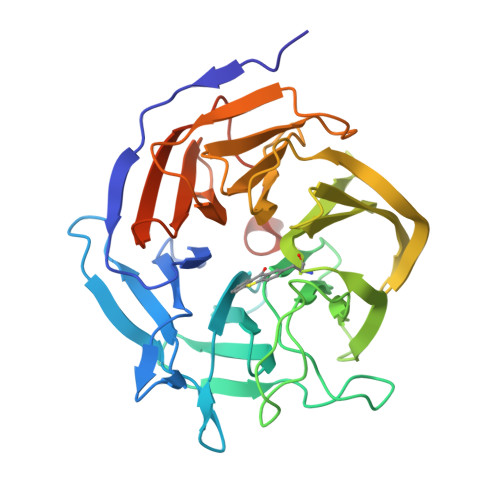
The development of [2 + 2] cyclases containing benzophenone triplet sensitizers highlights the potential of engineered enzymes as a platform for stereocontrolled energy transfer photocatalysis. However, the suboptimal photophysical features of benzophenone necessitates the use of ultraviolet light, limits photochemical efficiency and restricts the range of chemistries accessible. Here we engineer an orthogonal Methanococcus jannaschii tyrosyl-tRNA synthetase/tRNA pair for encoding thioxanthone triplet sensitizers into proteins, which can efficiently harness visible light to drive photochemical conversions. Initially, we developed an enantioselective [2 + 2] cyclase that is orders of magnitude more efficient than our previously developed photoenzymes (k cat = 13 s -1 , >1,300 turnovers). To demonstrate that thioxanthone-containing enzymes can enable more challenging photochemical conversions, we developed a second oxygen-tolerant enzyme that can steer selective C-H insertions of excited quinolone substrates to afford spirocyclic β-lactams with high selectivity (99% e.e., 22:1 d.r.). This photoenzyme also suppresses a competing substrate decomposition pathway observed with small-molecule sensitizers, underscoring the ability of engineered enzymes to control the fate of excited-state intermediates.
- Department of Chemistry & Manchester Institute of Biotechnology, The University of Manchester, Manchester, UK.
Organizational Affiliation: