9EXS | pdb_00009exs

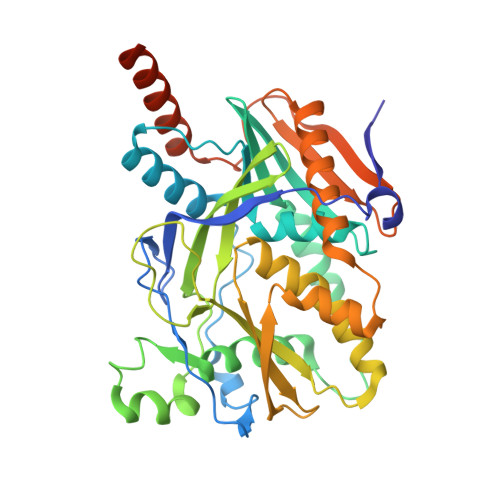
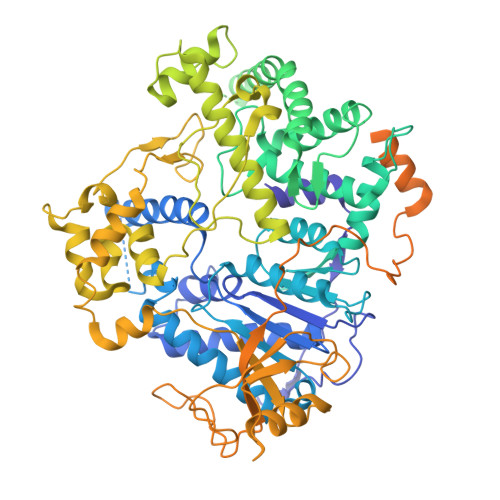
Cryo-EM structure of Ch. thermophilum Rai1-Rat1 dimer.


Experimental Data Snapshot

  • Method: ELECTRON MICROSCOPY
  • Resolution: 3.28 Å
  • Aggregation State: PARTICLE 
  • Reconstruction Method: SINGLE PARTICLE 

wwPDB Validation 3D Report Full Report

Validation slider image for 9EXS

This is version 1.2 of the entry. See complete history. 

Literature

Assembly of the Xrn2/Rat1-Rai1-Rtt103 termination complexes in mesophilic and thermophilic organisms.

Dikunova, A., Noskova, N., Overbeck, J.H., Polak, M., Stelzig, D., Zapletal, D., Kubicek, K., Novacek, J., Sprangers, R., Stefl, R.

(2025) Structure 33: 300

  • DOI: https://doi.org/10.1016/j.str.2024.11.010
  • Primary Citation Related Structures: 
    8Q6V, 9EXS, 9FMS

  • PubMed Abstract: 

    The 5'-3' exoribonuclease Xrn2, known as Rat1 in yeasts, terminates mRNA transcription by RNA polymerase II (RNAPII). In the torpedo model of termination, the activity of Xrn2/Rat1 is enhanced by Rai1, which is recruited to the termination site by Rtt103, an adaptor protein binding to the RNAPII C-terminal domain (CTD). The overall architecture of the Xrn2/Rat1-Rai1-Rtt103 complex remains unknown. We combined structural biology methods to characterize the torpedo complex from Saccharomyces cerevisiae and Chaetomium thermophilum. Comparison of the structures from these organisms revealed a conserved protein core fold of the subunits, but significant variability in their interaction interfaces. We found that in the mesophile, Rtt103 utilizes an unstructured region to augment a Rai1 β-sheet, while in the thermophile Rtt103 binds to a C-terminal helix of Rai1 via its CTD-interacting domain with an α-helical fold. These different torpedo complex assemblies reflect adaptations to the environment and impact complex recruitment to RNAPII.


  • Organizational Affiliation: 
    • CEITEC-Central European Institute of Technology, Masaryk University, Brno, Czechia; National Centre for Biomolecular Research, Faculty of Science, Masaryk University, Brno, Czechia.

Macromolecule Content 

  • Total Structure Weight: 166.18 kDa 
  • Atom Count: 8,016 
  • Modeled Residue Count: 1,004 
  • Deposited Residue Count: 1,462 
  • Unique protein chains: 2

Macromolecules

Find similar proteins by:|  3D Structure
Entity ID: 1
MoleculeChains  Sequence LengthOrganismDetailsImage
Decapping nuclease396Thermochaetoides thermophilaMutation(s): 0 
Gene Names: CTHT_0061920
EC: 3.6.1
UniProt
Find proteins for G0SE00 (Thermochaetoides thermophila (strain DSM 1495 / CBS 144.50 / DAOM 24625 / IMI 039719))
Explore G0SE00 
Go to UniProtKB:  G0SE00
Entity Groups
Sequence Clusters30% Identity50% Identity70% Identity90% Identity95% Identity100% Identity
UniProt GroupG0SE00
Sequence Annotations
Expand
Reference Sequence
Find similar proteins by:|  3D Structure
Entity ID: 2
MoleculeChains  Sequence LengthOrganismDetailsImage
5'-3' exoribonuclease1,066Thermochaetoides thermophilaMutation(s): 0 
Gene Names: CTHT_0008830
EC: 3.1.13
UniProt
Find proteins for G0S058 (Thermochaetoides thermophila (strain DSM 1495 / CBS 144.50 / DAOM 24625 / IMI 039719))
Explore G0S058 
Go to UniProtKB:  G0S058
Entity Groups
Sequence Clusters30% Identity50% Identity70% Identity90% Identity95% Identity100% Identity
UniProt GroupG0S058
Sequence Annotations
Expand
Reference Sequence

Small Molecules

Ligands 1 Unique
IDChains Name / Formula / InChI Key2D Diagram3D Interactions
MG
(Subject of Investigation/LOI)

Query on MG


Download:Ideal Coordinates CCD File
C [auth A]MAGNESIUM ION
Mg
JLVVSXFLKOJNIY-UHFFFAOYSA-N

Experimental Data & Validation

Experimental Data

  • Method: ELECTRON MICROSCOPY
  • Resolution: 3.28 Å
  • Aggregation State: PARTICLE 
  • Reconstruction Method: SINGLE PARTICLE 
EM Software:
TaskSoftware PackageVersion
RECONSTRUCTIONcryoSPARC4.4.1

Structure Validation

View Full Validation Report


Entry History 

& Funding Information

Deposition Data


Funding OrganizationLocationGrant Number
Czech Science FoundationCzech Republic--

Revision History  (Full details and data files)

  • Version 1.0: 2024-12-18
    Type: Initial release
  • Version 1.1: 2024-12-25
    Changes: Data collection, Database references
  • Version 1.2: 2025-02-19
    Changes: Data collection, Database references