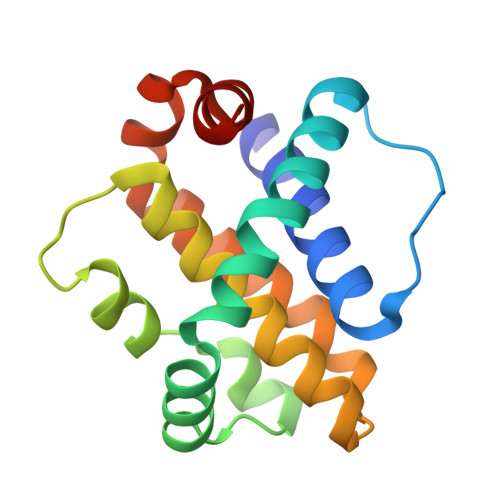
9EFJ | pdb_00009efj

Irreversible Mcl-1/HIT2 Complex


Experimental Data Snapshot

  • Method: X-RAY DIFFRACTION
  • Resolution: 1.82 Å
  • R-Value Free: 
    0.295 (Depositor), 0.295 (DCC) 
  • R-Value Work: 
    0.260 (Depositor), 0.260 (DCC) 
  • R-Value Observed: 
    0.262 (Depositor) 

Starting Model: experimental
View more details

wwPDB Validation   3D Report Full Report


Ligand Structure Quality Assessment 


This is version 1.2 of the entry. See complete history


Literature

A Fragment-Based Electrophile-First Approach to Target Histidine with Aryl-Fluorosulfates: Application to hMcl-1.

Alboreggia, G.Muzzarelli, K.Assar, Z.Pellecchia, M.

(2025) J Med Chem 68: 24305-24315

  • DOI: https://doi.org/10.1021/acs.jmedchem.5c02199
  • Primary Citation of Related Structures:  
    9EFJ

  • PubMed Abstract: 

    Aryl-fluorosulfates are mild electrophiles that are very stable in biological media and in vivo and can efficiently react with the side chains of Lys, Tyr, or His residues, when properly juxtaposed by a high-affinity ligand. A more powerful approach to derive novel ligands would consist of starting from the covalent adduct and building the ligand off those initial interactions. While this strategy has been proven for Cys with molecular fragments containing Cys targeting electrophiles such as acrylamides, a corresponding strategy with fluorosulfates targeting His/Lys/Tyr residues has yet to be reported. We report here that a fragment library of aryl-fluorosulfates, when deployed with proper biophysical screening strategies, can identify initial covalent fragments. We report on novel strategies to enhance the success rate of such electrophile-based fragment screening for His/Lys/Tyr residues and to characterize the resulting hits. As an application, we report on novel covalent fragment hits targeting hMcl-1 His 224.


  • Organizational Affiliation
    • Division of Biomedical Sciences, School of Medicine, University of California Riverside, 900 University Avenue, Riverside, California 92521, United States.

Macromolecules
Find similar proteins by:  (by identity cutoff)  |  3D Structure
Entity ID: 1
MoleculeChains Sequence LengthOrganismDetailsImage
Induced myeloid leukemia cell differentiation protein Mcl-1152Homo sapiensMutation(s): 0 
Gene Names: MCL1BCL2L3
UniProt & NIH Common Fund Data Resources
Find proteins for Q07820 (Homo sapiens)
Explore Q07820 
Go to UniProtKB:  Q07820
PHAROS:  Q07820
GTEx:  ENSG00000143384 
Entity Groups  
Sequence Clusters30% Identity50% Identity70% Identity90% Identity95% Identity100% Identity
UniProt GroupQ07820
Sequence Annotations
Expand
  • Reference Sequence
Small Molecules
Ligands 1 Unique
IDChains Name / Formula / InChI Key2D Diagram3D Interactions
A1BI3 (Subject of Investigation/LOI)
Query on A1BI3

Download Ideal Coordinates CCD File 
B [auth A](1R)-N-{5-[(dihydroxy-lambda~4~-sulfanyl)oxy]pyridin-3-yl}-2,3-dihydro-1H-indene-1-carboxamide
C15 H14 N2 O5 S
UUXBXVVEARPXOI-CQSZACIVSA-N
Experimental Data & Validation

Experimental Data

  • Method: X-RAY DIFFRACTION
  • Resolution: 1.82 Å
  • R-Value Free:  0.295 (Depositor), 0.295 (DCC) 
  • R-Value Work:  0.260 (Depositor), 0.260 (DCC) 
  • R-Value Observed: 0.262 (Depositor) 
Space Group: P 1 21 1
Unit Cell:
Length ( Å )Angle ( ˚ )
a = 41.556α = 90
b = 40.135β = 111.87
c = 42.052γ = 90
Software Package:
Software NamePurpose
PHENIXrefinement
PHENIXrefinement
xia2data reduction
xia2data scaling
PHASERphasing

Structure Validation

View Full Validation Report


Ligand Structure Quality Assessment 


Entry History & Funding Information

Deposition Data


Funding OrganizationLocationGrant Number
National Institutes of Health/National Cancer Institute (NIH/NCI)United States--

Revision History  (Full details and data files)

  • Version 1.0: 2025-11-19
    Type: Initial release
  • Version 1.1: 2025-11-26
    Changes: Database references
  • Version 1.2: 2025-12-10
    Changes: Database references