Download Mendeley
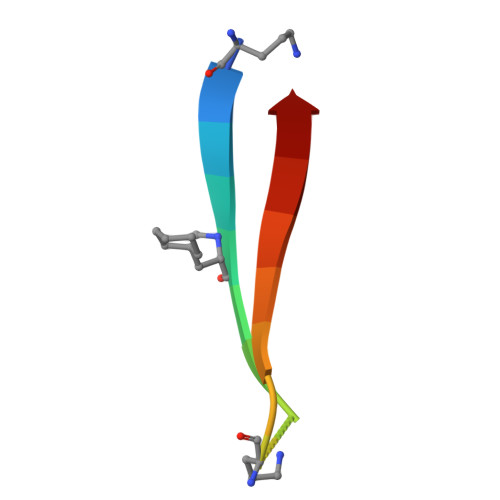
A beta-hairpin peptide derived from A beta forms different oligomers in the crystal state and in aqueous solution.
Zhu, J., Kreutzer, A.G., Liu, Z., Li, X., Richter, S.M., Pophristic, V., Nowick, J.S.(2025) Org Biomol Chem 23: 3881-3893
- PubMed: 40130612 Search on PubMedSearch on PubMed Central
- DOI: https://doi.org/10.1039/d5ob00296f
- Primary Citation Related Structures:
9EEC - PubMed Abstract:
The supramolecular assembly of amyloid-β into soluble oligomers is critical Alzheimer's disease (AD) progression. Soluble Aβ oligomers have emerged as neurotoxic species involved in AD progression and some Aβ oligomers are thought to be composed of β-hairpins. In this work, we report the X-ray crystallographic and solution-phase assembly of a macrocyclic β-hairpin peptide that mimics a β-hairpin formed by Aβ 16-36 . In the crystal lattice, the peptide assembles into a symmetric hexamer composed of two identical triangular trimers. In aqueous solution, the peptide assembles to form an asymmetric hexamer. 1 H NMR, TOCSY, and 1 H, 15 N HSQC experiments establish that the asymmetric hexamer contains two different species, A and B. 15 N-edited NOESY reveals that species A is a cylindrin-like trimer and species B is a triangular trimer that collectively constitute the asymmetric hexamer. Diffusion-ordered NMR spectroscopy (DOSY) suggests that two asymmetric hexamers further assemble to form a dodecamer. NMR-guided molecular mechanics and molecular dynamics studies provide a model for the asymmetric hexamer and suggest how two asymmetric hexamers can form a dodecamer. Solution-phase NMR studies of analogues show that intermolecular hydrogen bonding and the formation of a hydrophobic core help stabilize the asymmetric hexamer. These NMR and crystallographic studies illustrate how an Aβ β-hairpin peptide can assemble to form different well-defined oligomers in the crystal state and in aqueous solution, providing a deeper understanding of the heterogeneity of Aβ oligomers and new structural models of Aβ oligomers composed of Aβ β-hairpins.
- Department of Chemistry, University of California, Irvine, Irvine, California 92697-2025, USA. jsnowick@uci.edu.
Organizational Affiliation: