Download Mendeley
Processing of Freestanding Single Supercrystal Assembled by Atomically Precise Protein-Decorated Nanoparticles.
Huang, X., Huang, Q., Feng, S., Wang, Z.(2025) Nano Lett 25: 7178-7185
- PubMed: 40257419 Search on PubMed
- DOI: https://doi.org/10.1021/acs.nanolett.5c01619
- Primary Citation Related Structures:
9E6X - PubMed Abstract:
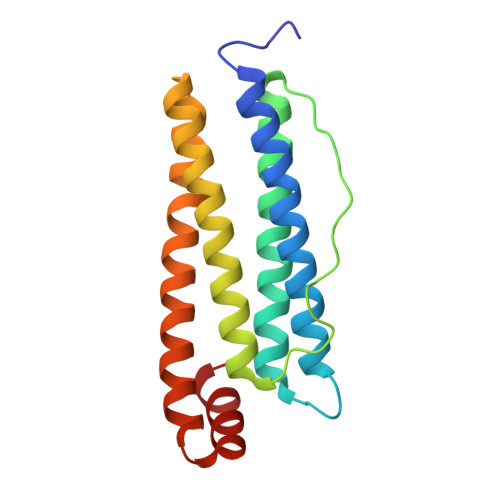
Protein-decorated ferrihydrite nanoparticles (NPs) can self-assemble into periodically ordered structures with response to an external stimulus. X-ray crystallography determines the self-assembly of ferritin-folded nanocages into a face-centered cubic ( fcc ) structure at atomic resolution, while Cryo-EM imaging with 3D Ab-initio reconstruction defines the size, shape, and distribution of inside NPs at a subnanoscale. Processing of freestanding crystals reveals a large 3D spacing variation of 314% with preservation of translational symmetry. At an internanocage separation of 3.3 nm, crystals still maintain both translational and orientational ordering. In situ SAXS measurements reveal that the diffusion-driven NP assembly starts with a close separation to 3.3 nm. Compression of the single crystal leads to a 3D spacing reduction of ∼40%, giving a rigid modulus of 0.81 GPa. Enhanced stress causes water release from the ordered lattice and triggers biomolecule unfolding. This study provides insights for designing molecules to enhance directional interactions in the NP assembly and engineering control of active materials for adaptive applications.
- Cornell High Energy Synchrotron Sources, Cornell University, Ithaca, New York 14853, United States.
Organizational Affiliation: