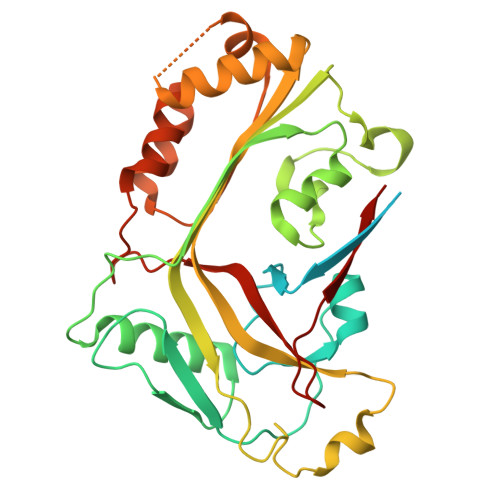
9CCQ | pdb_00009ccq

Cryo-EM structure of the prepore-like EaCDCL short oligomer


Experimental Data Snapshot

  • Method: ELECTRON MICROSCOPY
  • Resolution: 3.13 Å
  • Aggregation State: PARTICLE 
  • Reconstruction Method: SINGLE PARTICLE 

Starting Model: experimental
View more details

wwPDB Validation   3D Report Full Report


This is version 1.0 of the entry. See complete history


Literature

Structural basis for the pore-forming activity of a complement-like toxin.

Johnstone, B.A.Christie, M.P.Joseph, R.Morton, C.J.Brown, H.G.Hanssen, E.Sanford, T.C.Abrahamsen, H.L.Tweten, R.K.Parker, M.W.

(2025) Sci Adv 11: eadt2127-eadt2127

  • DOI: https://doi.org/10.1126/sciadv.adt2127
  • Primary Citation of Related Structures:  
    8G33, 9CCP, 9CCQ

  • PubMed Abstract: 

    Pore-forming proteins comprise a highly diverse group of proteins exemplified by the membrane attack complex/perforin (MACPF), cholesterol-dependent cytolysin (CDC), and gasdermin superfamilies, which all form gigantic pores (>150 angstroms). A recently found family of pore-forming toxins, called CDC-like proteins (CDCLs), are wide-spread in gut microbes and are a prevalent means of antibacterial antagonism. However, the structural aspects of how CDCLs assemble a pore remain a mystery. Here, we report the crystal structure of a proteolytically activated CDCL and cryo-electron microscopy structures of a prepore-like intermediate and a transmembrane pore providing detailed snapshots across the entire pore-forming pathway. These studies reveal a sophisticated array of regulatory features to ensure productive pore formation, and, thus, CDCLs straddle the MACPF, CDC, and gasdermin lineages of the giant pore superfamilies.


  • Organizational Affiliation
    • Department of Biochemistry and Pharmacology, Bio21 Molecular Science and Biotechnology Institute, University of Melbourne, Parkville, VIC 3010, Australia.

Macromolecules
Find similar proteins by:  (by identity cutoff)  |  3D Structure
Entity ID: 1
MoleculeChains Sequence LengthOrganismDetailsImage
Thiol-activated cytolysin family protein362Elizabethkingia anophelis Ag1Mutation(s): 0 
Gene Names: JCR23_19030
UniProt
Find proteins for A0A1T3D3K1 (Elizabethkingia anophelis)
Explore A0A1T3D3K1 
Go to UniProtKB:  A0A1T3D3K1
Entity Groups  
Sequence Clusters30% Identity50% Identity70% Identity90% Identity95% Identity100% Identity
UniProt GroupA0A1T3D3K1
Sequence Annotations
Expand
  • Reference Sequence
Small Molecules
Ligands 1 Unique
IDChains Name / Formula / InChI Key2D Diagram3D Interactions
CA
Query on CA

Download Ideal Coordinates CCD File 
AB [auth S]
BB [auth T]
CB [auth U]
DB [auth V]
EA [auth A]
AB [auth S],
BB [auth T],
CB [auth U],
DB [auth V],
EA [auth A],
EB [auth W],
FA [auth AA],
FB [auth X],
GA [auth AB],
GB [auth Y],
HA [auth AC],
HB [auth Z],
IA [auth AD],
JA [auth B],
KA [auth C],
LA [auth D],
MA [auth E],
NA [auth F],
OA [auth G],
PA [auth H],
QA [auth I],
RA [auth J],
SA [auth K],
TA [auth L],
UA [auth M],
VA [auth N],
WA [auth O],
XA [auth P],
YA [auth Q],
ZA [auth R]
CALCIUM ION
Ca
BHPQYMZQTOCNFJ-UHFFFAOYSA-N
Experimental Data & Validation

Experimental Data

  • Method: ELECTRON MICROSCOPY
  • Resolution: 3.13 Å
  • Aggregation State: PARTICLE 
  • Reconstruction Method: SINGLE PARTICLE 
EM Software:
TaskSoftware PackageVersion
MODEL REFINEMENTPHENIX1.20.1_4487:

Structure Validation

View Full Validation Report


Entry History & Funding Information

Deposition Data


Funding OrganizationLocationGrant Number
Australian Research Council (ARC)AustraliaDP160101874
Australian Research Council (ARC)AustraliaDP200102871
National Health and Medical Research Council (NHMRC, Australia)AustraliaAPP1194263

Revision History  (Full details and data files)

  • Version 1.0: 2025-04-09
    Type: Initial release