Download Mendeley
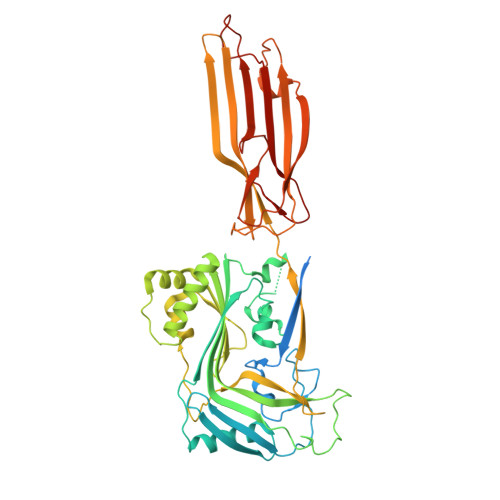
Structural basis for the pore-forming activity of a complement-like toxin.
Johnstone, B.A., Christie, M.P., Joseph, R., Morton, C.J., Brown, H.G., Hanssen, E., Sanford, T.C., Abrahamsen, H.L., Tweten, R.K., Parker, M.W.(2025) Sci Adv 11: eadt2127-eadt2127
- PubMed: 40153490 Search on PubMedSearch on PubMed Central
- DOI: https://doi.org/10.1126/sciadv.adt2127
- Primary Citation Related Structures:
8G33, 9CCP, 9CCQ - PubMed Abstract:
Pore-forming proteins comprise a highly diverse group of proteins exemplified by the membrane attack complex/perforin (MACPF), cholesterol-dependent cytolysin (CDC), and gasdermin superfamilies, which all form gigantic pores (>150 angstroms). A recently found family of pore-forming toxins, called CDC-like proteins (CDCLs), are wide-spread in gut microbes and are a prevalent means of antibacterial antagonism. However, the structural aspects of how CDCLs assemble a pore remain a mystery. Here, we report the crystal structure of a proteolytically activated CDCL and cryo-electron microscopy structures of a prepore-like intermediate and a transmembrane pore providing detailed snapshots across the entire pore-forming pathway. These studies reveal a sophisticated array of regulatory features to ensure productive pore formation, and, thus, CDCLs straddle the MACPF, CDC, and gasdermin lineages of the giant pore superfamilies.
- Department of Biochemistry and Pharmacology, Bio21 Molecular Science and Biotechnology Institute, University of Melbourne, Parkville, VIC 3010, Australia.
Organizational Affiliation: