9AU7 | pdb_00009au7

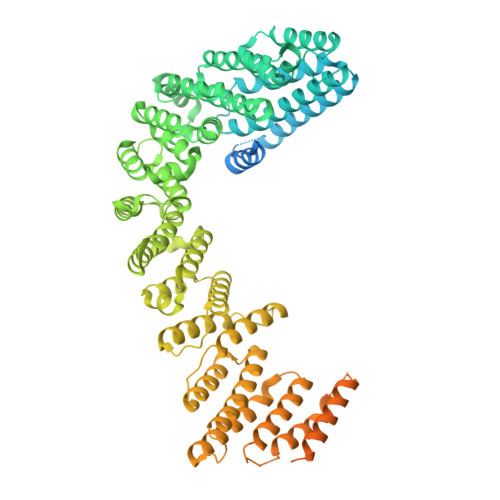
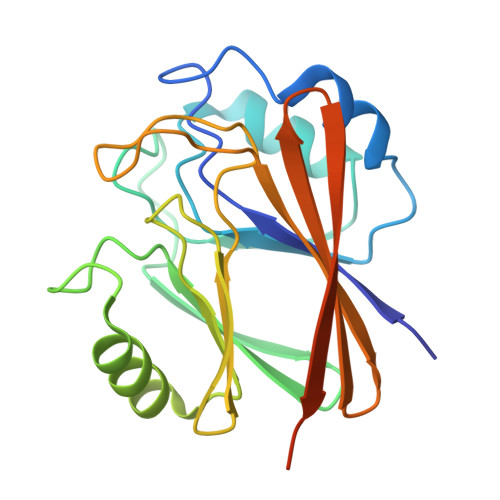
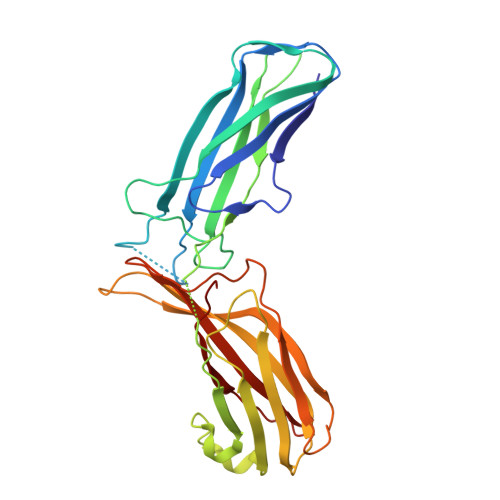
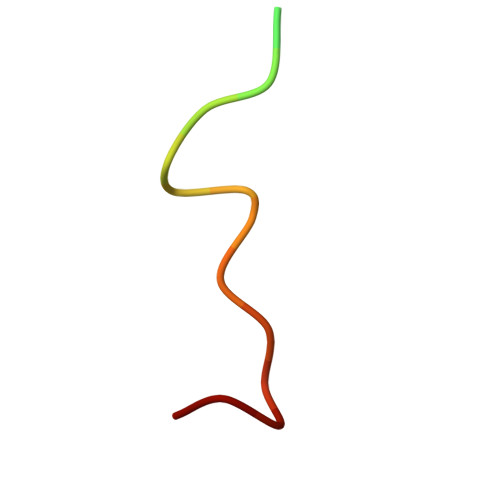
Human Retriever VPS35L/VPS29/VPS26C complex bound to SNX17 peptide (Composite Map)


Experimental Data Snapshot

  • Method: ELECTRON MICROSCOPY
  • Resolution: 3.40 Å
  • Aggregation State: PARTICLE 
  • Reconstruction Method: SINGLE PARTICLE 

Starting Model: in silico
View more details

wwPDB Validation   3D Report Full Report


This is version 1.1 of the entry. See complete history


Literature

Structural basis for Retriever-SNX17 assembly and endosomal sorting.

Singla, A.Boesch, D.J.Fung, H.Y.J.Ngoka, C.Enriquez, A.S.Song, R.Kramer, D.A.Han, Y.Banarer, E.Lemoff, A.Juneja, P.Billadeau, D.D.Bai, X.Chen, Z.Turer, E.E.Burstein, E.Chen, B.

(2024) Nat Commun 15: 10193-10193

  • DOI: https://doi.org/10.1038/s41467-024-54583-6
  • Primary Citation of Related Structures:  
    9AU7

  • PubMed Abstract: 

    During endosomal recycling, Sorting Nexin 17 (SNX17) facilitates the transport of numerous membrane cargo proteins by tethering them to the Retriever complex. Despite its importance, the mechanisms underlying this interaction have remained elusive. Here, we provide biochemical, structural, cellular, and proteomic analyses of the SNX17-Retriever interaction. Our data reveal that SNX17 adopts an autoinhibited conformation in the basal state, with its FERM domain sequestering its C-terminal tail. The binding of cargo proteins to the FERM domain displaces the C-terminal tail through direct competition. The released tail engages with Retriever by binding to a highly conserved interface between its VPS35L and VPS26C subunits, as revealed by cryogenic electron microscopy (cryo-EM). Disrupting this interface impairs the Retriever-SNX17 interaction, subsequently affecting the recycling of SNX17-dependent cargoes and altering the composition of the plasma membrane proteome. Intriguingly, the SNX17-binding pocket on Retriever can be utilized by other ligands containing a consensus acidic C-terminal tail motif. Together, our findings uncover a mechanism underlying endosomal trafficking of critical cargo proteins and reveal how Retriever can potentially engage with other regulatory factors or be exploited by pathogens.


  • Organizational Affiliation
    • Department of Internal Medicine, University of Texas Southwestern Medical Center, 5323 Harry Hines Boulevard, Dallas, TX, 75390, USA.

Macromolecules
Find similar proteins by:  (by identity cutoff)  |  3D Structure
Entity ID: 1
MoleculeChains Sequence LengthOrganismDetailsImage
VPS35 endosomal protein-sorting factor-like963Homo sapiensMutation(s): 0 
Gene Names: VPS35LC16orf62101F10.2
UniProt & NIH Common Fund Data Resources
Find proteins for Q7Z3J2 (Homo sapiens)
Explore Q7Z3J2 
Go to UniProtKB:  Q7Z3J2
PHAROS:  Q7Z3J2
GTEx:  ENSG00000103544 
Entity Groups  
Sequence Clusters30% Identity50% Identity70% Identity90% Identity95% Identity100% Identity
UniProt GroupQ7Z3J2
Sequence Annotations
Expand
  • Reference Sequence
Find similar proteins by:  (by identity cutoff)  |  3D Structure
Entity ID: 2
MoleculeChains Sequence LengthOrganismDetailsImage
Vacuolar protein sorting-associated protein 29205Homo sapiensMutation(s): 0 
Gene Names: VPS29DC15DC7MDS007
UniProt & NIH Common Fund Data Resources
Find proteins for Q9UBQ0 (Homo sapiens)
Explore Q9UBQ0 
Go to UniProtKB:  Q9UBQ0
PHAROS:  Q9UBQ0
GTEx:  ENSG00000111237 
Entity Groups  
Sequence Clusters30% Identity50% Identity70% Identity90% Identity95% Identity100% Identity
UniProt GroupQ9UBQ0
Sequence Annotations
Expand
  • Reference Sequence
Find similar proteins by:  (by identity cutoff)  |  3D Structure
Entity ID: 3
MoleculeChains Sequence LengthOrganismDetailsImage
Vacuolar protein sorting-associated protein 26C297Homo sapiensMutation(s): 0 
Gene Names: VPS26CDCRADSCR3DSCRA
UniProt & NIH Common Fund Data Resources
Find proteins for O14972 (Homo sapiens)
Explore O14972 
Go to UniProtKB:  O14972
PHAROS:  O14972
GTEx:  ENSG00000157538 
Entity Groups  
Sequence Clusters30% Identity50% Identity70% Identity90% Identity95% Identity100% Identity
UniProt GroupO14972
Sequence Annotations
Expand
  • Reference Sequence

Find similar proteins by:  Sequence   |   3D Structure  

Entity ID: 4
MoleculeChains Sequence LengthOrganismDetailsImage
Sorting nexin-1720Homo sapiensMutation(s): 0 
UniProt & NIH Common Fund Data Resources
Find proteins for Q15036 (Homo sapiens)
Explore Q15036 
Go to UniProtKB:  Q15036
PHAROS:  Q15036
GTEx:  ENSG00000115234 
Entity Groups  
Sequence Clusters30% Identity50% Identity70% Identity90% Identity95% Identity100% Identity
UniProt GroupQ15036
Sequence Annotations
Expand
  • Reference Sequence
Experimental Data & Validation

Experimental Data

  • Method: ELECTRON MICROSCOPY
  • Resolution: 3.40 Å
  • Aggregation State: PARTICLE 
  • Reconstruction Method: SINGLE PARTICLE 
EM Software:
TaskSoftware PackageVersion
RECONSTRUCTIONcryoSPARC
MODEL REFINEMENTISOLDE
MODEL REFINEMENTPHENIX
MODEL REFINEMENTCoot

Structure Validation

View Full Validation Report


Entry History & Funding Information

Deposition Data


Funding OrganizationLocationGrant Number
National Institutes of Health/National Institute of General Medical Sciences (NIH/NIGMS)United StatesR35GM128786
National Institutes of Health/National Institute of Diabetes and Digestive and Kidney Disease (NIH/NIDDK)United StatesR01DK107733
National Science Foundation (NSF, United States)United States2047640
Cancer Prevention and Research Institute of Texas (CPRIT)United StatesRP220582
National Institutes of Health/National Institute of General Medical Sciences (NIH/NIGMS)United StatesU24GM129547

Revision History  (Full details and data files)

  • Version 1.0: 2024-10-30
    Type: Initial release
  • Version 1.1: 2024-12-11
    Changes: Data collection, Database references