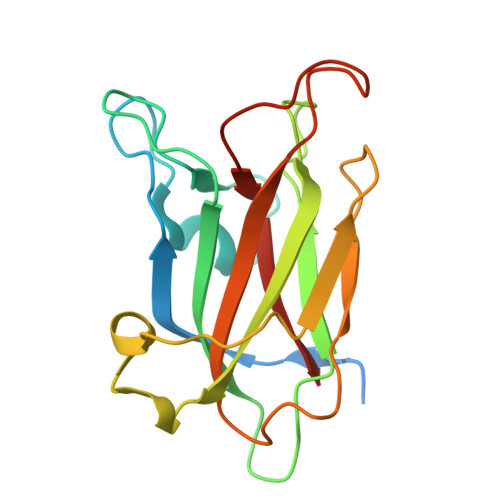
9WFH | pdb_00009wfh

Carbohydrate-binding module 32 of LnbB from Bifidobacterium bifidum, ligand free form, multiple small-wedge data set


Experimental Data Snapshot

  • Method: X-RAY DIFFRACTION
  • Resolution: 2.00 Å
  • R-Value Free: 
    0.240 (Depositor), 0.250 (DCC) 
  • R-Value Work: 
    0.224 (Depositor), 0.235 (DCC) 
  • R-Value Observed: 
    0.225 (Depositor) 

Starting Model: in silico
View more details

wwPDB Validation   3D Report Full Report


This is version 1.0 of the entry. See complete history


Literature

Structural insights into lacto-N-biose I recognition by a family 32 carbohydrate-binding module from Bifidobacterium bifidum.

Zhang, X.Sunagawa, N.Kashima, T.Igarashi, K.Miyanaga, A.Fushinobu, S.

(2025) FEBS Lett 

  • DOI: https://doi.org/10.1002/1873-3468.70217
  • Primary Citation of Related Structures:  
    9VAK, 9WFH

  • PubMed Abstract: 

    Bifidobacterium bifidum, a predominant colonizer of the infant gut, utilizes lacto-N-biose I (LNB), a prominent component of human milk oligosaccharides (HMOs), through a dedicated metabolic pathway. Among a diverse set of extracellular glycosidases involved in HMO degradation, lacto-N-biosidase (LnbB) plays a pivotal role by releasing LNB. We investigated the structure and function of the carbohydrate-binding module family 32 (CBM32) domain located at the C-terminus of the glycoside hydrolase family 20 catalytic domain in LnbB. Isothermal titration calorimetry showed that CBM32 binds LNB with a dissociation constant (K d ) of 98 μm. The crystal structure of the CBM32 complexed with LNB reveals the molecular basis for its specific recognition. Impact statement Bifidobacteria are beneficial gut microbes, and infant-associated strains establish symbiosis by degrading human milk oligosaccharides. This study uncovers the molecular mechanism by which Bifidobacterium bifidum captures lacto-N-biose I, a key disaccharide, functioning as a cross-feeder that promotes the growth of other bifidobacteria and supports the infant gut ecosystem.


  • Organizational Affiliation
    • Department of Biotechnology, The University of Tokyo, Japan.

Macromolecules
Find similar proteins by:  (by identity cutoff)  |  3D Structure
Entity ID: 1
MoleculeChains Sequence LengthOrganismDetailsImage
Lacto-N-biosidase
A, B
183Bifidobacterium bifidum JCM 1254Mutation(s): 0 
Gene Names: lnbB
EC: 3.2.1.140
UniProt
Find proteins for B3TLD6 (Bifidobacterium bifidum (strain DSM 20082 / JCM 1254 / BCRC 11844 / KCTC 3440 / E319f (Variant a)))
Explore B3TLD6 
Go to UniProtKB:  B3TLD6
Entity Groups  
Sequence Clusters30% Identity50% Identity70% Identity90% Identity95% Identity100% Identity
UniProt GroupB3TLD6
Sequence Annotations
Expand
  • Reference Sequence
Experimental Data & Validation

Experimental Data

  • Method: X-RAY DIFFRACTION
  • Resolution: 2.00 Å
  • R-Value Free:  0.240 (Depositor), 0.250 (DCC) 
  • R-Value Work:  0.224 (Depositor), 0.235 (DCC) 
  • R-Value Observed: 0.225 (Depositor) 
Space Group: P 41 21 2
Unit Cell:
Length ( Å )Angle ( ˚ )
a = 54.78α = 90
b = 54.78β = 90
c = 202.9γ = 90
Software Package:
Software NamePurpose
REFMACrefinement
PDB_EXTRACTdata extraction
XDSdata reduction
XSCALEdata scaling
MOLREPphasing

Structure Validation

View Full Validation Report


Entry History & Funding Information

Deposition Data


Funding OrganizationLocationGrant Number
Japan Society for the Promotion of Science (JSPS)Japan23H00322

Revision History  (Full details and data files)

  • Version 1.0: 2025-11-19
    Type: Initial release