9WAL | pdb_00009wal

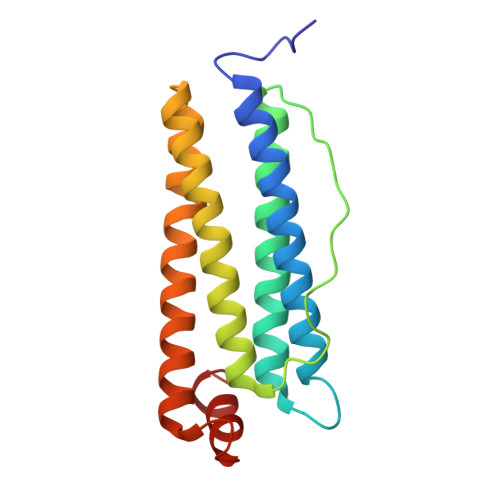
Apoferritin (118% Super resolution Nyquist, 236% physical Nyquist) by PASR on Acquisition-time Super Resolution K3 data


Experimental Data Snapshot

  • Method: ELECTRON MICROSCOPY
  • Resolution: 1.67 Å
  • Aggregation State: PARTICLE 
  • Reconstruction Method: SINGLE PARTICLE 

wwPDB Validation 3D Report Full Report

Validation slider image for 9WAL

This is version 1.1 of the entry. See complete history. 

Literature

Post-acquisition super resolution for cryo-electron microscopy.

Burton Smith, R.N., Murata, K.

(2026) IUCrJ 13: 589-605

  • DOI: https://doi.org/10.1107/S2052252526005348
  • Primary Citation Related Structures: 
    9WAL

  • PubMed Abstract: 

    Recently, reports have demonstrated achieving resolutions beyond the physical Nyquist limit using super resolution acquisition. Here, we demonstrate exceeding this limitation by pre-processing the raw micrograph movies from counting mode data that have already reached the physical Nyquist reconstruction resolution. To demonstrate functionality, micrograph movies of multiple datasets were pre-processed, showing that it is possible to exceed the physical Nyquist limit via pixel doubling before motion correction. We call this `post-acquisition super resolution', or PASR. While this was originally developed for processing of giant virus datasets, where acquiring at high magnification is not always possible or desirable, it is also shown to work for smaller objects such as adeno-associated virus and apoferritin, both of which are high symmetry, and jack bean urease, with lower symmetry. PASR reduces the magnification required to achieve desired resolutions, which may increase collection efficiency. Further, PASR may be applied on top of acquisition-time super resolution data collection, allowing results to exceed not just the physical sampling limit, but also the super resolution sampling limit. However, to benefit from PASR, data must already reach the Nyquist limit.


  • Organizational Affiliation: 
    • Exploratory Research Center on Life and Living Systems (ExCELLS), National Institutes of Natural Sciences, Okazaki, Aichi, Japan.

Macromolecule Content 

  • Total Structure Weight: 487.65 kDa 
  • Atom Count: 34,206 
  • Modeled Residue Count: 4,176 
  • Deposited Residue Count: 4,176 
  • Unique protein chains: 1

Macromolecules

Find similar proteins by:|  3D Structure
Entity ID: 1
MoleculeChains  Sequence LengthOrganismDetailsImage
Ferritin heavy chain, N-terminally processed
A, B, C, D, E
A, B, C, D, E, F, G, H, I, J, K, L, M, N, O, P, Q, R, S, T, U, V, W, X
174Mus musculusMutation(s): 0 
Gene Names: Fth1, Fth
EC: 1.16.3.1
UniProt & NIH Common Fund Data Resources
Find proteins for P09528 (Mus musculus)
Explore P09528 
Go to UniProtKB:  P09528
IMPC:  MGI:95588
Entity Groups
Sequence Clusters30% Identity50% Identity70% Identity90% Identity95% Identity100% Identity
UniProt GroupP09528
Sequence Annotations
Expand
Reference Sequence

Experimental Data & Validation

Experimental Data

  • Method: ELECTRON MICROSCOPY
  • Resolution: 1.67 Å
  • Aggregation State: PARTICLE 
  • Reconstruction Method: SINGLE PARTICLE 
EM Software:
TaskSoftware PackageVersion
RECONSTRUCTIONRELION

Structure Validation

View Full Validation Report


Entry History 

& Funding Information

Deposition Data


Funding OrganizationLocationGrant Number
Japan Society for the Promotion of Science (JSPS)Japan--

Revision History  (Full details and data files)

  • Version 1.0: 2025-09-17
    Type: Initial release
  • Version 1.1: 2026-09-16
    Changes: Data collection, Database references