Download Mendeley
Molecular mechanism underlying phosphate distribution by SULTR family transporter SPDT in Oryza sativa.
Fang, S., Zhao, Y., Zhang, X., Yu, F., Zhang, P.(2025) Sci Adv 11: eady3442-eady3442
- PubMed: 41071878 Search on PubMedSearch on PubMed Central
- DOI: https://doi.org/10.1126/sciadv.ady3442
- Primary Citation Related Structures:
9U9F, 9W3I - PubMed Abstract:
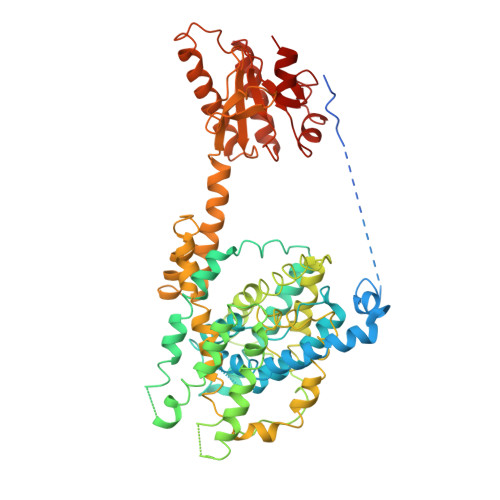
Phosphorus (P) limitation severely affects crop yields. To address the molecular basis of inorganic phosphate (Pi) specific transport within the sulfate transporter (SULTR) family, we determined the cryo-electron microscopy structures of Oryza sativa SULTR-like phosphorus distribution transporter (OsSPDT), a key Pi transporter for grain allocation, in apo- and Pi-binding states. OsSPDT forms a domain-swapped homodimer with each protomer containing an N-terminal domain (NTD), a transmembrane domain (TMD) divided into core and gate subdomains, and a C-terminal sulfate transporter and antisigma factor (STAS) domain. The structure adopts a cytoplasm-facing conformation with Pi coordinated at the core-gate interface. Key residues, including SPDT-unique Ser 170 , mediate Pi specificity within the binding pocket, distinguishing it evolutionarily from sulfate transporters within the SULTR family. Domain-swapping and mutational studies demonstrate functional interdependence of the NTD, TMD, and STAS domains. This work elucidates Pi selectivity in plant SULTR transporters and provides a molecular basis for developing low-phytate rice via OsSPDT gene editing.
- Key Laboratory of Plant Carbon Capture, CAS Center for Excellence in Molecular Plant Sciences, Institute of Plant Physiology and Ecology, Chinese Academy of Sciences, Shanghai 200032, China.
Organizational Affiliation: