Download Mendeley
Cryo-EM structure of drug-resistant Escherichia coli phage E1004 reveals a conserved cylindrical core among podophages.
Sun, B., Zheng, J., Fu, Y., Tian, F., Xiao, H., Li, S., Cheng, L., Chen, P., Liu, H.(2026) Structure 34: 229
- PubMed: 41317731 Search on PubMed
- DOI: https://doi.org/10.1016/j.str.2025.11.006
- Primary Citation Related Structures:
9V30, 9VVP, 9VVQ, 9VVR - PubMed Abstract:
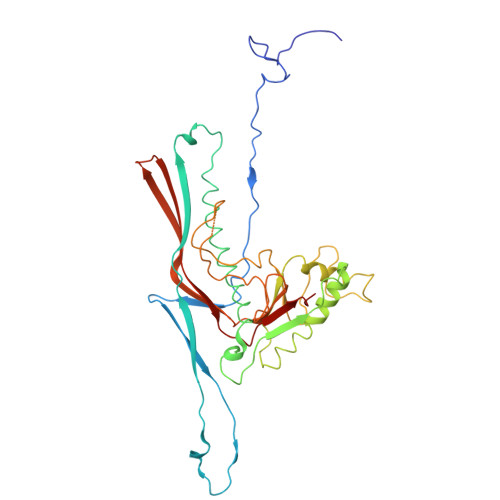
Podophage tails are too short to traverse the cell envelope and require internal core proteins to assemble into a transmembrane channel for genome delivery during infection. However, high-resolution structures of near-complete cores remain scarce. Here, we present the near-atomic-resolution cryo-electron microscopy (cryo-EM) structure of the drug-resistant E. coli phage E1004, which features a T7-like core-portal-tail structure with six P22-like tailspikes. We found that the cylindrical core comprises four proteins: gp17, gp27, gp28, and gp29. Gp29 forms a tetramer, while gp28 and gp27 assemble into octamers. Notably, there are sixteen copies of gp17 in two conformations, distinct from the small core protein gp6.7 in T7. The gp17-gp27 complex reveals the mechanism for mediating the symmetry adjustment at the core-portal interface. Moreover, comparative analysis with other podophage cores highlights diversity in core protein composition and organization, particularly among the small core proteins. We propose that these variations represent evolutionary adaptations to diverse host envelopes.
- Institute of Interdisciplinary Studies, Key Laboratory for Matter Microstructure and Function of Hunan Province, Key Laboratory of Low-dimensional Quantum Structures and Quantum Control, School of Physics and Electronics, Hunan Normal University, Changsha 410082, China.
Organizational Affiliation: