Download Mendeley
Structural and functional insights into Uly1040, an ulvan lyase from polysaccharide lyase family 40.
Wang, H.-.Q., Suo, C.-.L., Liu, D., Wang, M.-.Q., Li, J.-.X., Cao, H.-.Y., Qin, Q.-.L., Zhang, Y.-.Z., Wang, P., Xu, F.(2026) Appl Environ Microbiol 92: e0210125-e0210125
- PubMed: 41532755 Search on PubMedSearch on PubMed Central
- DOI: https://doi.org/10.1128/aem.02101-25
- Primary Citation Related Structures:
9VTK - PubMed Abstract:
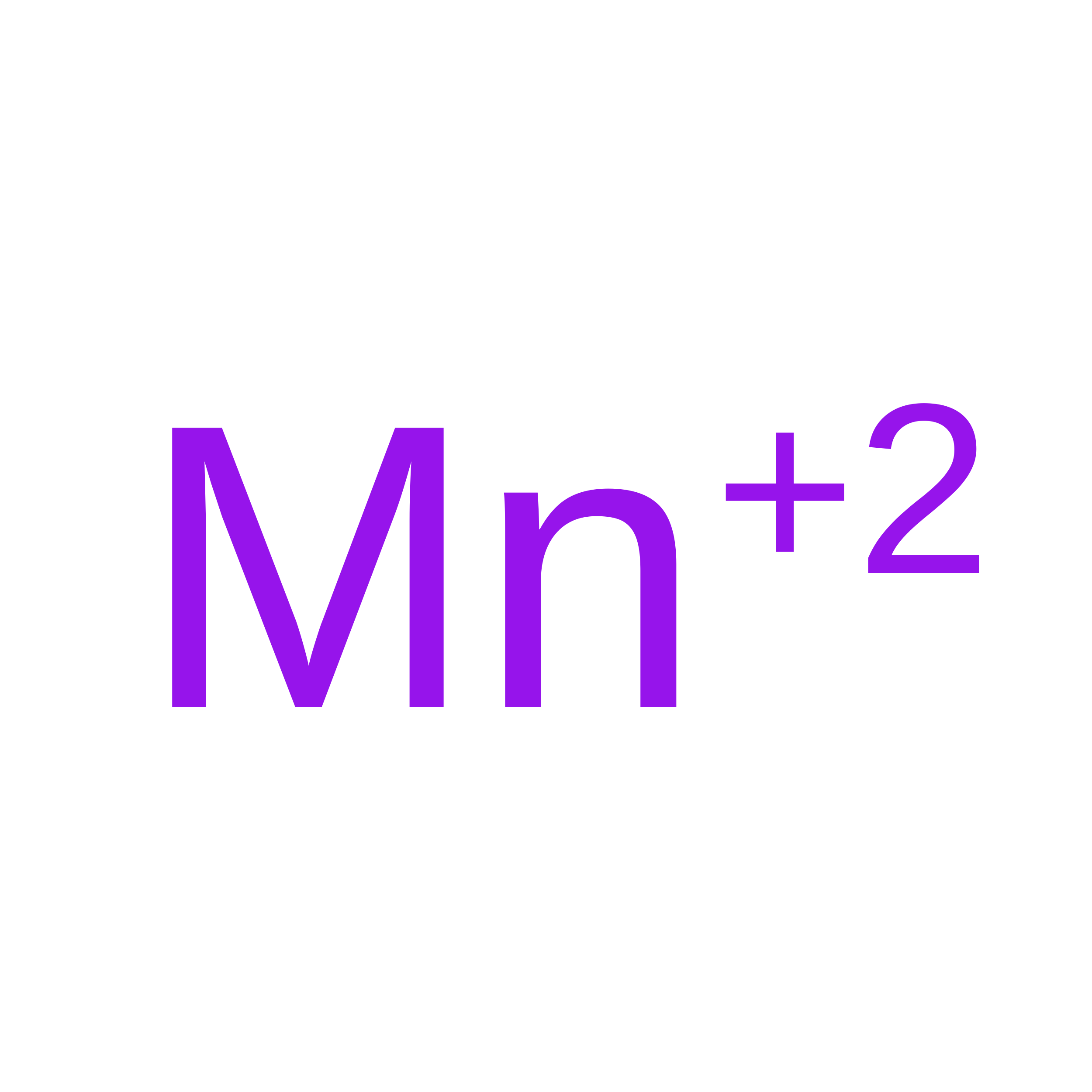
Ulvan is a major polysaccharide in marine green algae. Its oligosaccharide degradation products possess diverse bioactivities and hold considerable potential for various applications. Ulvan lyases, the key enzymes responsible for cleaving ulvan glycosidic bonds, generate bioactive oligosaccharides and play an essential role in ulvan degradation. However, studies on ulvan lyases remain limited, particularly for the poorly characterized polysaccharide lyase (PL) 40 family. Here, we identified Uly1040, a novel PL40 ulvan lyase, from the marine bacterium Alteromonas macleodii isolated from the intestine of an Aplysia sea slug. Uly1040 displays a unique two-domain architecture not previously reported in ulvan lyases. Mechanistically, Uly1040 employs a distinct His/Tyr catalytic strategy, divergent from known ulvan lyase mechanisms. During catalysis, Trp246 and Asn245 neutralize the negative charge of the carboxyl group at the +1 subsite. Concurrently, Mn 2+ , His487, and Asp358 activate His485 to serve as the catalytic base, while Tyr305 functions as the catalytic acid. Bioinformatic, phylogenetic, and biogeographic analyses further demonstrated that this catalytic mechanism is conserved across PL40 lyases and that Uly1040-like enzymes are widespread in marine environments. Collectively, these findings expand our understanding of PL40 ulvan lyases and provide new insights into the enzymatic basis of marine biomass utilization. Ulvan is a major structural polysaccharide in marine green algae, and its enzymatic degradation releases bioactive oligosaccharides with promising biotechnological potential. Ulvan lyases are key to this process, yet most characterized enzymes belong to only a few polysaccharide lyase families, leaving the PL40 family largely unexplored. Here, we identify and characterize Uly1040, a novel PL40 ulvan lyase from Alteromonas macleodii, revealing an unprecedented two-domain architecture and a distinct His/Tyr catalytic mechanism. Structural and biochemical analyses show that Mn2+, His487, and Asp358 cooperatively activate His485 as the catalytic base, while Tyr305 acts as the catalytic acid-representing a mechanistic innovation in ulvan cleavage. Bioinformatic and phylogenetic analyses indicate that the PL40 lyases are widespread in marine environment, and this catalytic strategy is conserved among PL40 enzymes. This work uncovers a previously unknown enzymatic paradigm for ulvan degradation, deepening our understanding of marine polysaccharide utilization and microbial carbon cycling.
- MOE Key Laboratory of Evolution and Marine Biodiversity, State Key Laboratory of Marine Food Processing and Safety Control, Frontiers Science Center for Deep Ocean Multispheres and Earth System & College of Marine Life Sciences, Ocean University of China, Qingdao, Shandong, China.
Organizational Affiliation: