Download Mendeley
From toxin to chiral building block: Engineered aldolase-catalyzed regioselective conversion of formaldehyde into L-glyceraldehyde.
Duysak, T., Kim, J.W., Seo, P.W., Woo, H.G., Park, J.B., Kim, J.S.(2025) Int J Biol Macromol 331: 148343-148343
- PubMed: 41130471 Search on PubMed
- DOI: https://doi.org/10.1016/j.ijbiomac.2025.148343
- Primary Citation Related Structures:
9V4B, 9V4C - PubMed Abstract:
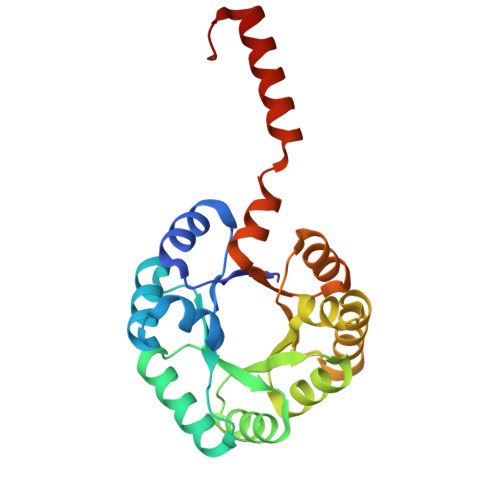
Formaldehyde (FALD) is a volatile and highly toxic compound widely used in industry and a major environmental pollutant due to its genotoxic and carcinogenic effects. Developing efficient methods to convert formaldehyde into value-added, non-toxic products is essential for both environmental protection and chemical sustainability. In this study, we present a biocatalytic cascade for the selective enzymatic conversion of formaldehyde into enantiopure L-glyceraldehyde, a high-value chiral C3 compound. The system employs a structurally engineered fructose-6-phosphate aldolase (GaFSA) from Gilliamella apicola, which catalyzes carbon-carbon bond formation via aldol condensation between glycolaldehyde (GALD) and formaldehyde. However, this system included a substantial portion of D-threose as a byproduct. By identifying Ser166 and Val203 as critical determinants of regioselectivity, structure-guided mutagenesis (S166R/V203S) suppressed D-threose formation and achieved >93 % selectivity under mild aqueous conditions. To avoid external GALD supplementation, the engineered GaFSA was coupled with an optimized glyoxylate carboligase from E. coli (EcGCL), enabling in situ GALD production from formaldehyde. This one-pot enzymatic cascade reached a conversion efficiency of ~94 % from 25 mM FALD at pH 7.5 and 40 °C, with minimal byproducts. The reaction proceeds entirely in water, under ambient pressure, without toxic reagents or organic solvents, requiring only natural cofactors for EcGCL activity. This work offers a sustainable enzymatic platform for formaldehyde detoxification and valorization, enabling selective C1-to-C3 upgrading and supporting greener chemical manufacturing.
- Department of Chemistry, Chonnam National University, Gwangju, 61186, Republic of Korea; Host-Directed Antiviral Research Center, Chonnam National University, Gwangju, Republic of Korea.
Organizational Affiliation: