9UU5 | pdb_00009uu5

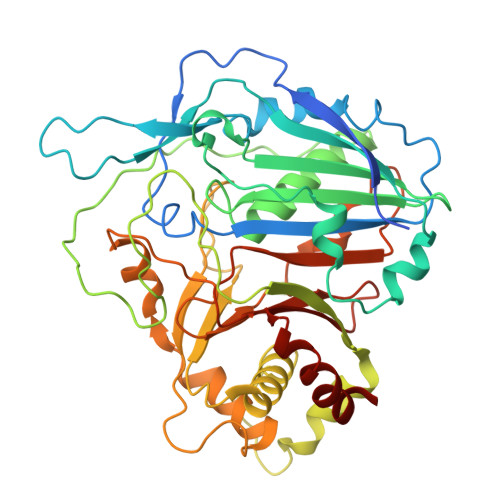
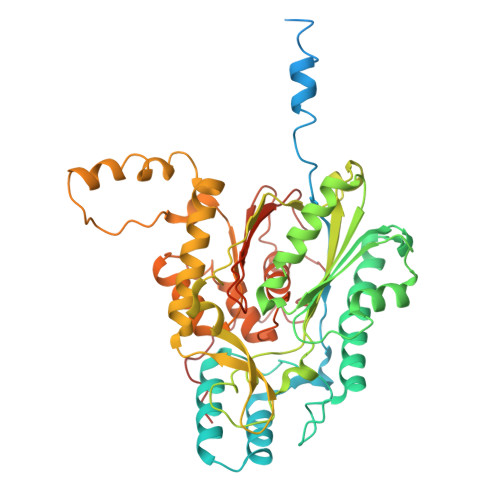
Cryo-EM structure of the maize CER6-GL2 complex in the presence of 30:0 CoA


Experimental Data Snapshot

  • Method: ELECTRON MICROSCOPY
  • Resolution: 3.26 Å
  • Aggregation State: PARTICLE 
  • Reconstruction Method: SINGLE PARTICLE 

wwPDB Validation   3D Report Full Report


This is version 1.1 of the entry. See complete history


Literature

Molecular basis of very-long-chain fatty acid elongation by the CER6-GL2 enzyme complex in plant wax biosynthesis.

Liu, Y.Chen, Y.Zhang, X.Li, M.Wang, J.Yang, Z.Ma, M.Zhao, Z.Liu, H.Yu, F.Zhang, P.

(2025) Sci Adv 11: eadz0135-eadz0135

  • DOI: https://doi.org/10.1126/sciadv.adz0135
  • Primary Citation Related Structures: 
    9UU3, 9UU4, 9UU5

  • PubMed Abstract: 

    Plant cuticular waxes, crucial hydrophobic barriers, are primarily composed of aliphatics derived from very-long-chain fatty acids (VLCFAs; >C28) synthesized by the endoplasmic reticulum fatty acid elongase complex. The core catalytic subunit, CER6 (KCS6), requires interaction with the BAHD protein GL2 to elongate acyl chains beyond C28. We determined the cryo-electron microscopy structure of the maize CER6-GL2 (ZmCER6-ZmGL2) heterotetramer bound to coenzyme A (CoA) and malonyl-CoA, revealing a membrane-anchored ZmCER6 homodimer, with each cytosolic catalytic domain having a substrate tunnel. Structural and biochemical analyses suggest that ZmGL2's amino terminus binds ZmCER6 and remodels its substrate tunnel into a continuous hydrophobic channel at their interface, enabling acyl-chain elongation. CER6 uses a distinct Cys-His-Asn catalytic triad, differing from the histidine-dependent catalysis of mammalian elongases. GL2 acts noncatalytically to modulate CER6 activity. Comparative analyses suggest that species-specific substrate preferences arise from divergent CER2/GL2 interactions. This work elucidates the acyl-chain elongation mechanism of plant VLCFA biosynthesis and provides a foundation for engineering stress-resilient crops via wax modulation.


  • Organizational Affiliation
    • Key Laboratory of Plant Carbon Capture, CAS Center for Excellence in Molecular Plant Sciences, Institute of Plant Physiology and Ecology, Chinese Academy of Sciences, Shanghai, China.

Macromolecules
Find similar proteins by:  (by identity cutoff)  |  3D Structure
Entity ID: 1
MoleculeChains Sequence LengthOrganismDetailsImage
Protein ECERIFERUM 26-likeA,
C [auth D]
434Zea maysMutation(s): 0 
Gene Names: LOC103645956
UniProt
Find proteins for A0A804MAL4 (Zea mays)
Explore A0A804MAL4 
Go to UniProtKB:  A0A804MAL4
Entity Groups  
Sequence Clusters30% Identity50% Identity70% Identity90% Identity95% Identity100% Identity
UniProt GroupA0A804MAL4
Sequence Annotations
Expand
  • Reference Sequence
Find similar proteins by:  (by identity cutoff)  |  3D Structure
Entity ID: 2
MoleculeChains Sequence LengthOrganismDetailsImage
3-ketoacyl-CoA synthaseB,
D [auth C]
500Zea maysMutation(s): 0 
Gene Names: LOC100191595ZEAMMB73_Zm00001d028241
EC: 2.3.1
UniProt
Find proteins for B4G0N2 (Zea mays)
Explore B4G0N2 
Go to UniProtKB:  B4G0N2
Entity Groups  
Sequence Clusters30% Identity50% Identity70% Identity90% Identity95% Identity100% Identity
UniProt GroupB4G0N2
Sequence Annotations
Expand
  • Reference Sequence
Experimental Data & Validation

Experimental Data

  • Method: ELECTRON MICROSCOPY
  • Resolution: 3.26 Å
  • Aggregation State: PARTICLE 
  • Reconstruction Method: SINGLE PARTICLE 
EM Software:
TaskSoftware PackageVersion
MODEL REFINEMENTPHENIX1.14_3260:

Structure Validation

View Full Validation Report


Entry History & Funding Information

Deposition Data


Funding OrganizationLocationGrant Number
National Natural Science Foundation of China (NSFC)China32230050

Revision History  (Full details and data files)

  • Version 1.0: 2025-10-29
    Type: Initial release
  • Version 1.1: 2026-03-11
    Changes: Data collection, Database references