Find PDB structures and Computed Structure Models (CSM) by combining queries from tools in this suite: Attribute Search, Sequence Similarity, Sequence Motif, 3D Similarity, and 3D Motif with 'AND' logic.
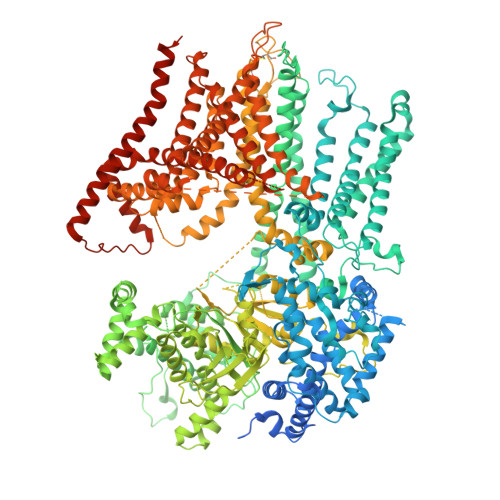
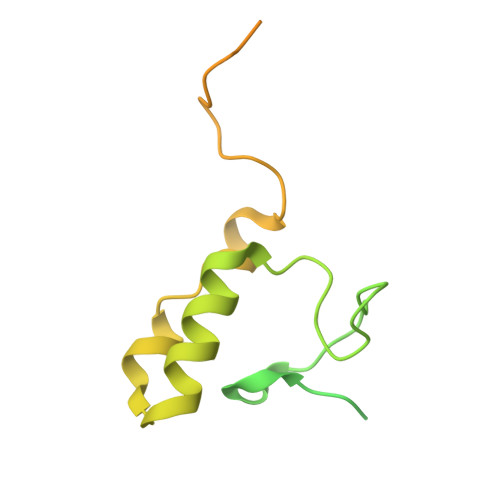
FKS1 is a β-1,3-glucan synthase critical for fungal cell wall formation and a target for antifungal drugs such as echinocandin and ibrexafungerp. However, the mechanisms regulating FKS1 activity remain largely unknown. Here, we reveal that transfer RNA (tRNA) acts as an endogenous inhibitor, whereas GSR1 functions as a stabilizer of FKS1. The cryo-EM structure of FKS1 adopts a tRNA-mediated homodimer configuration, representing a quiescent state of β-1,3-glucan synthase. Unexpectedly, the copurified endogenous tRNA is identified as a potent inhibitor that suppresses FKS1 activity. Moreover, high-resolution cryo-EM density analysis enable the identification of GSR1 as an additional binding partner of FKS1. Mutagenesis experiments confirm the interaction between FKS1 and GSR1. Evolutionarily conserved GSR1 is found to increase the stability of FKS1 in β-1,3-glucan biosynthesis. Collectively, our findings identify both tRNA and GSR1 as intrinsic modulators of β-1,3-glucan biosynthesis, thereby providing opportunities for the further development of FKS1-targeted antifungal drugs.
Organizational Affiliation:
Department of Obstetrics, Key Laboratory of Birth Defects and Related Disease of Women and Children of MOE, State Key Laboratory of Biotherapy, West China Second Hospital, Sichuan University, Chengdu, China.
Children's Medicine Key Laboratory of Sichuan Province, Chengdu, China.
State Key Laboratory of Synthetic Biology, Frontiers Science Center for Synthetic Biology (Ministry of Education), School of Synthetic Biology and Biomanufacturing, Tianjin University, Tianjin, China.
State Key Laboratory of Membrane Biology, Beijing Frontier Research Center for Biological Structure, Tsinghua-Peking Joint Center for Life Sciences, School of Life Sciences, Tsinghua University, Beijing, China.
The First Clinical Medical College, Lanzhou University, Lanzhou, China.
Key Laboratory of Molecular Epigenetics of the Ministry of Education (MOE), Northeast Normal University, Changchun, Jilin, China.
State Key Laboratory of Biotherapy, National Clinical Research Center for Geriatrics and General Practice Medical Center, West China Hospital, Sichuan University, Chengdu, China.
NHC Key Laboratory of Chronobiology, Development and Related Diseases of Women and Children Key Laboratory of Sichuan Province, Sichuan University, Chengdu, China.
State Key Laboratory of Membrane Biology, Beijing Frontier Research Center for Biological Structure, Tsinghua-Peking Joint Center for Life Sciences, School of Life Sciences, Tsinghua University, Beijing, China. yancy2019@tsinghua.edu.cn.
Department of Obstetrics, Key Laboratory of Birth Defects and Related Disease of Women and Children of MOE, State Key Laboratory of Biotherapy, West China Second Hospital, Sichuan University, Chengdu, China. dengd@scu.edu.cn.
NHC Key Laboratory of Chronobiology, Development and Related Diseases of Women and Children Key Laboratory of Sichuan Province, Sichuan University, Chengdu, China. dengd@scu.edu.cn.
State Key Laboratory of Synthetic Biology, Frontiers Science Center for Synthetic Biology (Ministry of Education), School of Synthetic Biology and Biomanufacturing, Tianjin University, Tianjin, China. yunzi.luo@tju.edu.cn.
Department of Obstetrics, Key Laboratory of Birth Defects and Related Disease of Women and Children of MOE, State Key Laboratory of Biotherapy, West China Second Hospital, Sichuan University, Chengdu, China. xiangwang@scu.edu.cn.
Children's Medicine Key Laboratory of Sichuan Province, Chengdu, China. xiangwang@scu.edu.cn.
NHC Key Laboratory of Chronobiology, Development and Related Diseases of Women and Children Key Laboratory of Sichuan Province, Sichuan University, Chengdu, China. xiangwang@scu.edu.cn.
Department of Andrology/Sichuan Human Sperm Bank, West China Second University Hospital, Sichuan University, Chengdu, Sichuan Province, China. xiangwang@scu.edu.cn.

 Download Mendeley