Download Mendeley
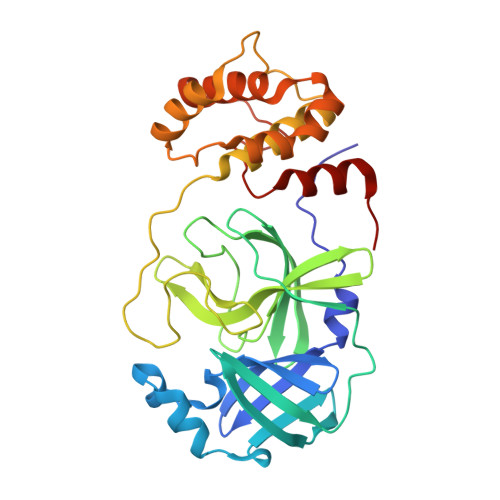
Structure-Based Development of Ultra-Broad-Spectrum 3C-Like Protease Inhibitors.
Su, H., Nie, T., Chen, G., Xiong, M., Zhang, Y., Wu, G., You, M., Xie, H., He, J., Xiong, Y., Hu, H., Zhao, W., Li, M., Xiao, G., Zhang, L., Xu, Y.(2026) Adv Sci (Weinh) 13: e12342-e12342
- PubMed: 41388583 Search on PubMedSearch on PubMed Central
- DOI: https://doi.org/10.1002/advs.202512342
- Primary Citation Related Structures:
9IR8, 9IR9, 9IRA, 9UOP, 9UOQ, 9UOR, 9UOS, 9X7D, 9X7E, 9X7F, 9X7G, 9X7H, 9X7I - PubMed Abstract:
Recurrence of coronavirus outbreaks and zoonotic origins of human coronaviruses underscore the importance of developing pan-coronavirus antivirals. The highly conserved 3C-like protease (3CL pro ) in coronaviruses, together with the well-established druggability, makes it an ideal target for broad-spectrum antiviral therapeutics. Here, the inhibitory activity of approved 3CL pro inhibitors, including nirmatrelvir, ensitrelvir, and simnotrelvir, against fifteen 3CL pro s is first reported by enzymatic assays. Despite their potent inhibition toward 3CL pro s of β-CoVs, these inhibitors show reduced potency against 3CL pro s from the other three genera, particularly against two newly identified human coronaviruses (α-CCoV-HuPn-2018 and δ-PDCoV). In this context, continued efforts in structure-based optimization of nirmatrelvir lead to the identification of compound 8 that potently inhibits a panel of 32 3CL pro s across all subgenera (IC 50 s: 19-146 nm), with an IC 50 value of 61 and 81 nm against α-CCoV-HuPn-2018 and δ-PDCoV 3CL pro s, respectively. Moreover, it effectively inhibits nirmatrelvir-resistant 3CL pro mutants and demonstrates broad-spectrum antiviral efficacy in cells. These findings suggest an important rule that a small, non-cyclic P2 segment and a P4 segment with a suitable size are preferred by the design of ultra-broad-spectrum 3CL pro inhibitors, and provide a proof-of-concept guide for developing broad-spectrum antivirals as potential pan-CoV therapeutics.
- State Key Laboratory of Drug Research, Shanghai Institute of Materia Medica, Chinese Academy of Sciences, Shanghai, 201203, China.
Organizational Affiliation: