Download Mendeley
Structural Dynamics of SARS-CoV-2 NSP4 C-terminal Domain and Implications for Viral Processing.
Meng, L., Ye, S., Pei, K., Tang, C.(2025) J Mol Biol 437: 169372-169372
- PubMed: 40763845 Search on PubMed
- DOI: https://doi.org/10.1016/j.jmb.2025.169372
- Primary Citation Related Structures:
9UCN - PubMed Abstract:
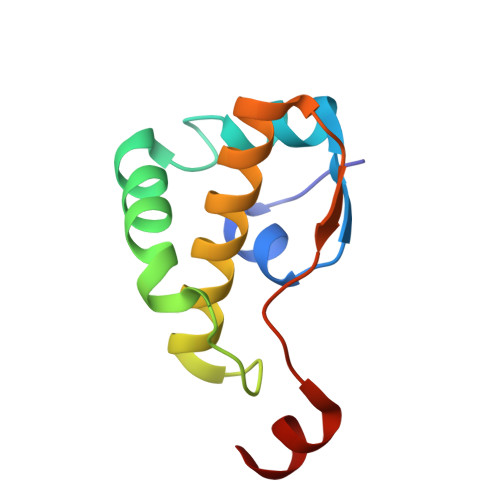
Coronaviruses, including SARS-CoV-2, pose a significant threat to global health. A critical step in viral maturation involves the proteolytic processing of viral polyproteins into functional nonstructural proteins (NSPs), with NSP4 being specifically cleaved by the main protease, NSP5, to release mature components. Through an integrative approach combining X-ray crystallography, NMR spectroscopy, and molecular dynamics simulations, we reveal that the C-terminal domain of NSP4 (NSP4-CTD) undergoes dynamic interconversion among multiple conformational states on distinct timescales. These states are characterized by variations in the position and secondary structure of the NSP4-CTD's C-terminal tail region, encompassing an undocked conformation, a docked extended conformation, and a docked helical conformation. We demonstrate that the formation of this C-terminal helix is influenced by both local sequence and overall structural context, playing a crucial role in positioning NSP4 relative to NSP5 and, consequently, modulating the efficiency of the autoprocessing event. While current antiviral therapeutic development has predominantly focused on targeting the mature NSP5 protease, our findings highlight the dynamic NSP4 C-terminal tail as a novel and promising target for antiviral intervention.
- Beijing National Laboratory for Molecular Sciences, College of Chemistry and Molecular Engineering, Peking University, Beijing 100871, China.
Organizational Affiliation: