Download Mendeley
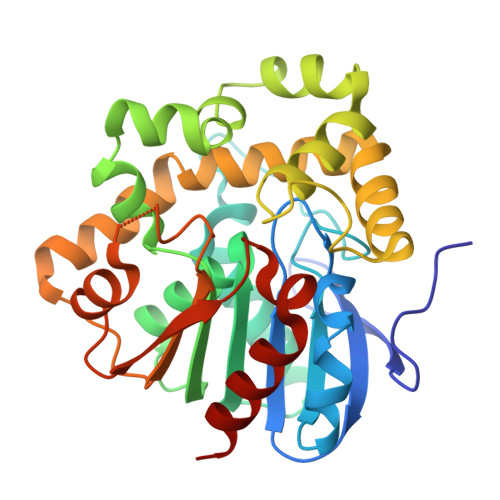
Creating highly active fluoroacetate dehalogenases via gate-based synergetic chain design.
Wang, C.Z., Huang, H., Hu, Z., Gao, L., Lin, Z.Q., Shi, M., Song, Z., Li, M., Wang, Y., Chen, K.W., Liu, Y., Ma, Y., Chen, B., Yan, Q., Zhang, Z.M., Wang, J.B.(2026) Nat Commun 17
- PubMed: 42062289 Search on PubMedSearch on PubMed Central
- DOI: https://doi.org/10.1038/s41467-026-72741-w
- Primary Citation Related Structures:
21BK, 9U5W, 9U5X, 9U9L, 9U9U, 9UE2 - PubMed Abstract:
Gate residues, acting in concert with distal dynamic networks, are emerging as critical yet underexploited regulators of enzymatic catalysis. Here we show that conformational dynamics analysis of fluoroacetate dehalogenase RPA1163 reveals a gate-based allosteric pair (K181-W185) that governs substrate access and reactivity. Network engineering of this pair yields a double mutant with high turnover number for α-fluorophenylpropionic acid (turnover number > 2 × 10⁵), establishing gate-centric allostery as a generalizable design principle. Structural and molecular dynamics analyses show that the activity enhancement arises from stabilization of catalytically competent open states through long-range coupling. Extension of this strategy to three additional dehalogenases confirms the universality of gate-based dynamic rewiring. Leveraging this framework, we establish a robust biocatalytic platform for stereoselective synthesis of α-fluoro and α-hydroxy carboxylic acids, achieving high productivity (turnover number > 3.7 × 10⁶) and enabling decagram-scale preparation of pharmaceutically relevant intermediates with high yield and enantioselectivity. Together, these findings establish gate-residue allostery as a powerful concept in protein engineering, bridging conformational dynamics with translational biocatalysis.
- Key Laboratory of Multiple Organ Failure (Zhejiang University), Ministry of Education, Department of General Intensive Care Unit of the Second Affiliated Hospital (Zhejiang University), Zhejiang University School of Medicine, Hangzhou, P. R. China.
Organizational Affiliation: