Download Mendeley
Nanoscale Direct-to-Biology Optimization and Structural Insights into Selective S. aureus TrmD Inhibitors.
Hubner, A.F., Weldert, A.C., Marciniak, T., Hof, F., Beck, V.S., Carien, S., Mulartschyk, S.N., Wolf, E., Ziebuhr, W., Barthels, F.(2025) J Med Chem 68: 26246-26262
- PubMed: 41367353 Search on PubMedSearch on PubMed Central
- DOI: https://doi.org/10.1021/acs.jmedchem.5c02323
- Primary Citation Related Structures:
9SDV, 9SDW - PubMed Abstract:
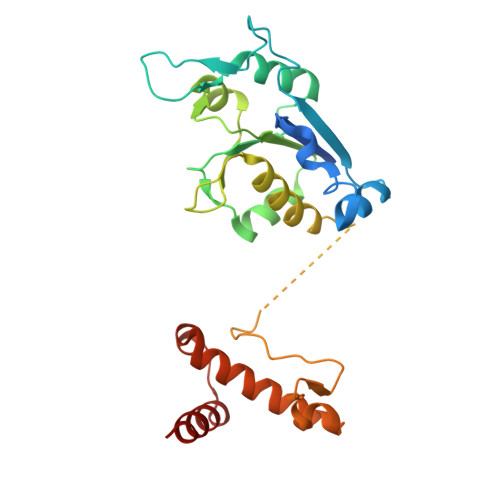
The tRNA m 1 G37 methyltransferase (TrmD) is considered essential in various bacteria, including Staphylococcus aureus , a pathogen responsible for a wide range of diseases. Here, we have performed a high-throughput nanomole-scale synthesis campaign (nanoSAR) by late-stage copper(I)-catalyzed alkyne-azide cycloaddition (CuAAC)-functionalizing a library of structurally diverse azides (N = 320) to a pyrrolopyrimidone alkyne. We have identified selective S. aureus TrmD inhibitors with inhibitory activity in the nanomolar to low micromolar range using a direct-to-biology assay read-out. A carbamate-masked guanidine intermediate of the lead structure selectively inhibited S. aureus growth at low micromolar concentrations in cell-based assays, while Gram-negative bacteria and an off-target panel of methyltransferases were not affected. Subsequent cocrystallization resulted in a crystal structure of S. aureus TrmD bound to an inhibitor, providing detailed insights into its binding mode and enabling future structure-guided optimization.
- Institute of Pharmaceutical and Biomedical Sciences, Johannes Gutenberg-University, Staudingerweg 5, 55128 Mainz, Germany.
Organizational Affiliation: