 Download Mendeley
Structural and functional analysis of the Mycobacterium tuberculosis MmpS5L5 efflux pump presages increased bedaquiline resistance.
Fountain, A.J., Bohning, J., McLaughlin, S.H., Morgan, T.E., Edelstein, P.H., Troll, M., Lamers, M.H., Bharat, T.A.M., Luisi, B.F., Ramakrishnan, L.(2025) Proc Natl Acad Sci U S A 122: e2516660122-e2516660122
- PubMed: 40986343 Search on PubMedSearch on PubMed Central
- DOI: https://doi.org/10.1073/pnas.2516660122
- Primary Citation Related Structures:
9S2U - PubMed Abstract:
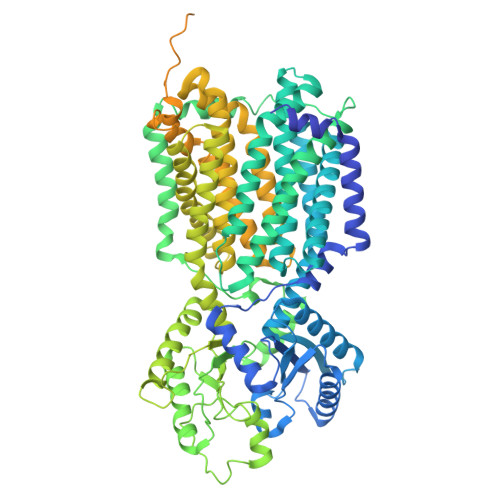
Bedaquiline, an antitubercular drug that targets ATP-synthase, is a key component of a new oral drug regimen that has revolutionized the treatment of multidrug-resistant tuberculosis. Clinical bedaquiline resistance in Mycobacterium tuberculosis has rapidly emerged, primarily due to mutations in the transcriptional repressor Rv0678 that result in upregulation of the resistance-nodulation-division (RND) efflux pump MmpS5/MmpL5 (MmpS5L5). Here, to understand how MmpS5L5 effluxes bedaquiline, we determined the structure of the MmpS5L5 complex using cryo-electron microscopy, revealing a trimeric architecture distinct from the canonical tripartite RND efflux pumps of gram-negative bacteria. Structure prediction modeling in conjunction with functional genetic analysis indicates that it uses a periplasmic coiled-coil tube to transport molecules across the cell wall. Structure-guided genetic approaches identify MmpL5 mutations that alter bedaquiline transport; these mutations converge on a region in MmpL5 located in the lower portion of the periplasmic cavity, proximal to the outer leaflet of the inner membrane, suggesting a route for bedaquiline entry into the pump. While currently known clinical resistance to bedaquiline is due to pump upregulation, our findings that several MmpL5 variants increase bedaquiline efflux may presage the emergence of additional modes of clinical resistance.
- Medical Research Council Laboratory of Molecular Biology, Cambridge CB2 0QH, United Kingdom.
Organizational Affiliation: