9RPD | pdb_00009rpd

D. melanogaster Augmin TII N-clamp (GST-fusion) bound to a microtubule, well-defined subset of particles


Experimental Data Snapshot

  • Method: ELECTRON MICROSCOPY
  • Resolution: 4.90 Å
  • Aggregation State: HELICAL ARRAY 
  • Reconstruction Method: SINGLE PARTICLE 

wwPDB Validation   3D Report Full Report


This is version 1.1 of the entry. See complete history


Literature

Conserved function of the HAUS6 calponin homology domain in anchoring augmin for microtubule branching.

Wurtz, M.Tonon, G.Vermeulen, B.J.A.Zezlina, M.Gao, Q.Neuner, A.Seidl, A.Konig, M.Harkenthal, M.Eustermann, S.Erhardt, S.Lolicato, F.Schiebel, E.Pfeffer, S.

(2025) Nat Commun 16: 7845-7845

  • DOI: https://doi.org/10.1038/s41467-025-63165-z
  • Primary Citation of Related Structures:  
    9RPD

  • PubMed Abstract: 

    Branching microtubule nucleation is a key mechanism for mitotic and meiotic spindle assembly and requires the hetero-octameric augmin complex. Augmin recruits the major microtubule nucleator, the γ-tubulin ring complex, to pre-existing microtubules to direct the formation of new microtubules in a defined orientation. Although recent structural work has provided key insights into the structural organization of augmin, molecular details of its interaction with microtubules remain elusive. Here, we identify the minimal conserved microtubule-binding unit of augmin across species and demonstrate that stable microtubule anchoring is predominantly mediated via the calponin homology (CH) domain in Dgt6/HAUS6. Comparative sequence and functional analyses in vitro and in vivo reveal a highly conserved functional role of the HAUS6 CH domain in microtubule binding. Using cryo-electron microscopy and molecular dynamics simulations in combination with AlphaFold structure predictions, we show that the D. melanogaster Dgt6/HAUS6 CH domain binds microtubules at the inter-protofilament groove between two adjacent β-tubulin subunits and thereby orients augmin on microtubules. Altogether, our findings reveal how augmin binds microtubules to pre-determine the branching angle during microtubule nucleation and facilitate the rapid assembly of complex microtubule networks.


  • Organizational Affiliation
    • Zentrum für Molekulare Biologie der Universität Heidelberg (ZMBH), Heidelberg, Germany. m.wuertz@zmbh.uni-heidelberg.de.

Macromolecules
Find similar proteins by:  (by identity cutoff)  |  3D Structure
Entity ID: 1
MoleculeChains Sequence LengthOrganismDetailsImage
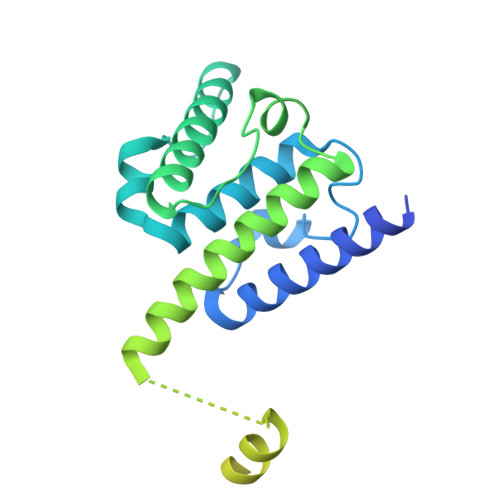
Augmin complex subunit dgt4A [auth I]108Drosophila melanogasterMutation(s): 0 
Gene Names: dgt4CG4865
UniProt
Find proteins for Q9W4M8 (Drosophila melanogaster)
Explore Q9W4M8 
Go to UniProtKB:  Q9W4M8
Entity Groups  
Sequence Clusters30% Identity50% Identity70% Identity90% Identity95% Identity100% Identity
UniProt GroupQ9W4M8
Sequence Annotations
Expand
  • Reference Sequence
Find similar proteins by:  (by identity cutoff)  |  3D Structure
Entity ID: 2
MoleculeChains Sequence LengthOrganismDetailsImage
Augmin complex subunit dgt6B [auth J]280Drosophila melanogasterMutation(s): 0 
Gene Names: dgt6CG11881
UniProt
Find proteins for Q9VAP2 (Drosophila melanogaster)
Explore Q9VAP2 
Go to UniProtKB:  Q9VAP2
Entity Groups  
Sequence Clusters30% Identity50% Identity70% Identity90% Identity95% Identity100% Identity
UniProt GroupQ9VAP2
Sequence Annotations
Expand
  • Reference Sequence
Find similar proteins by:  (by identity cutoff)  |  3D Structure
Entity ID: 3
MoleculeChains Sequence LengthOrganismDetailsImage
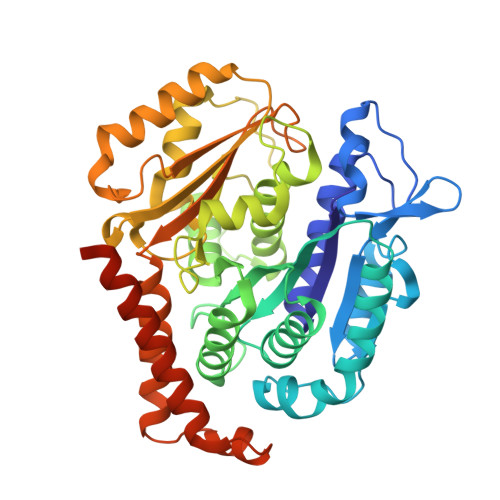
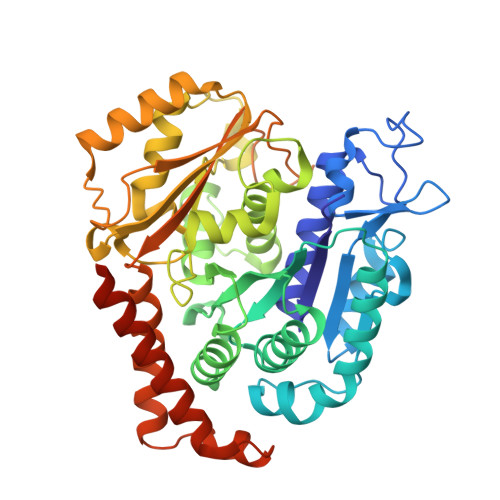
Augmin complex subunit msd5,Green fluorescent protein,Glutathione S-transferase class-mu 26 kDa isozymeC [auth K]672Drosophila melanogasterAequorea victoriaSchistosoma japonicum
This entity is chimeric
Mutation(s): 3 
Gene Names: msd5dgt7CG2213GFP
EC: 2.5.1.18
UniProt
Find proteins for P08515 (Schistosoma japonicum)
Explore P08515 
Go to UniProtKB:  P08515
Find proteins for P42212 (Aequorea victoria)
Explore P42212 
Go to UniProtKB:  P42212
Find proteins for Q9W0G6 (Drosophila melanogaster)
Explore Q9W0G6 
Go to UniProtKB:  Q9W0G6
Entity Groups  
Sequence Clusters30% Identity50% Identity70% Identity90% Identity95% Identity100% Identity
UniProt GroupsP42212Q9W0G6P08515
Sequence Annotations
Expand
  • Reference Sequence
Find similar proteins by:  (by identity cutoff)  |  3D Structure
Entity ID: 4
MoleculeChains Sequence LengthOrganismDetailsImage
Tubulin beta chainD [auth B],
E [auth D]
445Sus scrofaMutation(s): 0 
UniProt
Find proteins for P02554 (Sus scrofa)
Explore P02554 
Go to UniProtKB:  P02554
Entity Groups  
Sequence Clusters30% Identity50% Identity70% Identity90% Identity95% Identity100% Identity
UniProt GroupP02554
Sequence Annotations
Expand
  • Reference Sequence
Find similar proteins by:  (by identity cutoff)  |  3D Structure
Entity ID: 5
MoleculeChains Sequence LengthOrganismDetailsImage
Tubulin alpha-1A chainF [auth A],
G [auth C],
H [auth G],
I [auth E]
451Sus scrofaMutation(s): 0 
EC: 3.6.5
UniProt
Find proteins for P02550 (Sus scrofa)
Explore P02550 
Go to UniProtKB:  P02550
Entity Groups  
Sequence Clusters30% Identity50% Identity70% Identity90% Identity95% Identity100% Identity
UniProt GroupP02550
Sequence Annotations
Expand
  • Reference Sequence
Experimental Data & Validation

Experimental Data

  • Method: ELECTRON MICROSCOPY
  • Resolution: 4.90 Å
  • Aggregation State: HELICAL ARRAY 
  • Reconstruction Method: SINGLE PARTICLE 
EM Software:
TaskSoftware PackageVersion
RECONSTRUCTIONRELION5.0

Structure Validation

View Full Validation Report


Entry History & Funding Information

Deposition Data


Funding OrganizationLocationGrant Number
German Research Foundation (DFG)GermanySch Baden-Wuerttemberg
German Research Foundation (DFG)GermanyINST 35/1314-1 FUGG
German Research Foundation (DFG)GermanyINST 35/1503-1 FUGG
German Research Foundation (DFG)GermanyINST 35/1134-1 FUGG
German Research Foundation (DFG)GermanyDFG Schi 295/4-4
German Research Foundation (DFG)GermanySCHI 295/11-1
German Research Foundation (DFG)GermanySCHI 295/9-1
German Research Foundation (DFG)GermanyDFG PF 963/1-4
German Research Foundation (DFG)GermanyDFG PF 963/4-1

Revision History  (Full details and data files)

  • Version 1.0: 2025-08-27
    Type: Initial release
  • Version 1.1: 2025-09-03
    Changes: Data collection, Database references