Download Mendeley
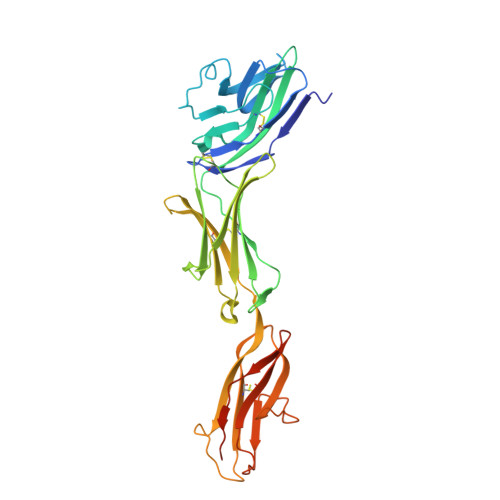
Molecular Insights into the Engagement of High-Affinity Sialylated Ligands to Human CD22.
Ereno-Orbea, J., Pang, L., Sicard, T., Nycholat, C., Cui, H., Borovsky, D., Franconetti, A., Jimenez-Barbero, J., Paulson, J.C., Julien, J.P.(2025) JACS Au 5: 5524-5537
- PubMed: 41311955 Search on PubMedSearch on PubMed Central
- DOI: https://doi.org/10.1021/jacsau.5c01013
- Primary Citation Related Structures:
9RM3, 9RO7, 9ROB - PubMed Abstract:
CD22 is a sialic acid-binding immunoglobulin-like lectin (Siglec) that maintains a baseline level of B cell inhibition. Its function and restricted expression in B cells make CD22 a validated target in therapies against dysregulated B cells, which cause cancer and autoimmune diseases. High-affinity sialic acid-based ligands capable of competing with natural ligands to bind CD22 represent a promising therapeutic opportunity. Here, we describe the design and synthesis of a sialoside library constructed by chemical modifications on carbon C2 of 9- N -biphenylcarboxamide Neu5Ac ( BPC Neu5Ac) or 9- N -m-phenoxybenzamide Neu5FAc ( MPB Neu5FAc) scaffold using a copper-(I)-catalyzed alkyne-azide cycloaddition (CuAAC) reaction. Subsequent analysis of binding to human CD22 using competitive binding assays and isothermal titration calorimetry reveals that addition of noncarbohydrate substituents at C2 and C9 can improve the affinity toward CD22 from high micromolar to submicromolar K D values. We describe the molecular basis of this affinity improvement for three of the newly synthesized compounds by solving cocrystal structures in complex with CD22. These findings contribute to our understanding of the affinity increase of chemically modified Neu5Ac toward CD22, providing the molecular basis for further compound design of sialic acid-based molecules with potential therapeutic relevance.
- Program in Molecular Medicine, The Hospital for Sick Children Research Institute, Toronto, ON M5G 0A4, Canada.
Organizational Affiliation: